Trump says 'we’ll find out' whether Khamenei was right about regional war
Asked about Khamenei’s remarks warning of a possible regional war in the event of a US attack on Iran, Trump told reporters, "Why wouldn't he say that? Of course you can say that. But we have the biggest, most powerful ships in the world, over there, very close, couple of days."
"Hopefully we'll make a deal. We don't make a deal, then we'll find out whether or not he was right."
For families searching for wounded protesters in Iran’s latest crackdown, hospitals have offered no refuge—only dead ends.
One such case was described by the Wall Street Journal in a report on Sunday, which recounted the final hours of a teenage protester identified as Sam, shot and then taken away while still alive.
According to the paper, a medic told Sam’s family that he was “in critical condition being treated for a single gunshot wound in the back of his head,” before security forces arrived and removed him along with other patients.
The medic urged the family to look elsewhere. “The medic advised them to check the morgues,” Sam’s father, Parviz, said, according to the report.
They found him days later. “They found him inside a body bag on Jan. 11 with a second bullet wound that tore through half of his face and made him almost unrecognizable,” Parviz told the Journal.
The second shot—delivered after medical care had begun—was not an act of mercy. It was finalization.
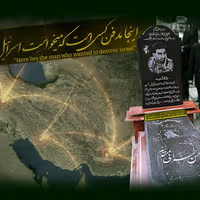
File photo shows the grave of Parnian Dabiri, 16, who was shot in the back of the head during protests in Baharestan, west of Tehran.
Accounts from grieving families, medics and rights groups point to a grim pattern in Iran’s crackdown: wounded protesters were not just denied care but deliberately shot again in hospitals or removed alive and later killed.
For families searching for wounded protesters in Iran’s latest crackdown, hospitals have offered no refuge—only dead ends.
One such case was described by the Wall Street Journal in a report on Sunday, which recounted the final hours of a teenage protester identified as Sam, shot and then taken away while still alive.
According to the paper, a medic told Sam’s family that he was “in critical condition being treated for a single gunshot wound in the back of his head,” before security forces arrived and removed him along with other patients.
The medic urged the family to look elsewhere. “The medic advised them to check the morgues,” Sam’s father, Parviz, said, according to the report.
They found him days later. “They found him inside a body bag on Jan. 11 with a second bullet wound that tore through half of his face and made him almost unrecognizable,” Parviz told the Journal.
The second shot—delivered after medical care had begun—was not an act of mercy. It was finalization.
Similar accounts have emerged from Karaj, west of Tehran, where witnesses told Iran International that armed forces surrounded hospitals following days of mass killings and resistance.
Witnesses speaking to Iran International on the condition of anonymity report the abduction of wounded protesters from hospitals and the execution of injured people who were unable to move.
A Karaj taxi driver, who said he witnessed the violence firsthand, described security forces loading both dead and wounded protesters into trucks without distinction.
“Even the wounded were not separated from the dead. They piled everyone together. Someone injured like that will die anyway,” he said.
A photo received by Iran International showed the body of a deceased protester at Kahrizak morgue south of Tehran with his hands bound.
In the image, the man’s body is seen inside a black body bag typically used for those killed, with his hands tied and placed on his abdomen.
The image appeared to show that the citizen was in the custody of security forces at the time of his death and that he died while in detention.
Other witnesses said the killings continued inside medical facilities. One source told Iran International that agents used suppressed weapons. “That person was crying and saying they were shooting the wounded with silenced guns,” the witness said, describing what was explicitly referred to as a finishing shot.
Hospitals including Ghasem Soleimani, Kasra and Takht-e Jamshid were placed under armed lockdown, according to eyewitness reports, with families barred from entry and medical staff working under threat.
One healthcare worker said more than 400 people killed during January 8-9 were brought to Karaj hospitals alone.
The practice has been documented elsewhere. The Iran Human Rights Documentation Center previously reported that one wounded protester, terrified of being executed in hospital, remained motionless for three days inside a plastic body bag used for transporting corpses. His family eventually located him alive in Kahrizak.
In Karaj, fear of those final shots drove families to keep bodies hidden at home rather than risk official channels. According to reports and accounts obtained by Iran International, authorities halted burials, closed morgues, and restricted funerals to a single family member, firing shots into the air to disperse mourners.
What emerges from these accounts is not chaos but method.
Wounded protesters—those who survived initial gunfire—appear to have been treated as liabilities. Removing them from hospitals, or killing them outright, ensured that testimony would not survive.
Sam’s father said his son had dreamed of studying information technology in Germany, where he planned to reunite with him. Instead, he was shot once, treated, and then shot again.
Iranian President Masoud Pezeshkian’s office said on Sunday it was releasing the names of 2,986 people it said were killed in the recent unrest, describing all the victims as “children of this land.”
The presidential office said the list was published under a policy of transparency and accountability and on Pezeshkian’s orders, after the names were compiled by Iran’s Legal Medicine Organization and cross-checked with the national civil registry.
More than 36,500 Iranians were killed by security forces during the January 8-9 crackdown on nationwide protests, making it the deadliest two-day protest massacre in history, according to documents reviewed by Iran International.
Millions of dollars have been wagered on Polymarket prediction markets on the timing of a possible US military strike against Iran and on the potential ousting of Supreme Leader Ali Khamenei, according to market data and reports.
Polymarket, a blockchain-based platform where users can buy and sell outcome-based contracts using cryptocurrency or traditional payment methods, shows heavy trading in contracts tied to whether and when the United States might carry out aerial, drone or missile strikes on Iranian soil or at Iranian embassies, with volumes in the tens of millions of dollars.
Some bettors have lost substantial sums as timelines they wagered on passed without a strike occurring.
Further millions have been placed on contracts tied to the likelihood of Khamenei being removed from power, according to Polymarket’s listings.
An Iranian official told Reuters on Sunday that media reports that the Islamic Revolutionary Guard Corps plans to hold a military exercise in the Strait of Hormuz are incorrect.
Iran's state-run Press TV reported on Thursday that the force would carry out drills in the strategic waterway on February 1 and February 2.
"There was no plan for the Guards to hold military exercises there and there was no official announcement about it. Only media reports which were wrong," the official said.