For more than two weeks and counting, the country has existed inside a manufactured silence. The public internet, the basic infrastructure of modern life, has been reduced to rumor and fragments. What remains functional are the regime’s approved channels, whitelisted networks that keep the state connected to itself while cutting the country off from civic circulation.
From outside Iran, this condition is often described as another episode of unrest. From inside, it feels closer to a new revolution that has already cost the country thousands of lives.
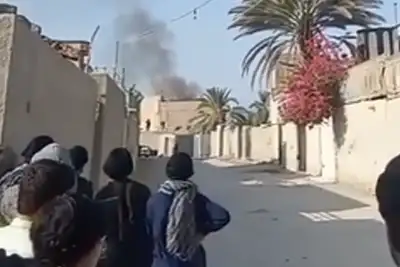
Iran has experienced a massacre and entered a post-massacre moment, a phase in which the state no longer performs restraint. It kills, buries, rewrites the narrative, and disconnects.
The blackout is not a byproduct of disorder. It is part of the machinery. Violence is easier to carry out when it is harder to document, and easier to deny when proof is delayed, partial, or erased.
From the studio of The Program with Kambiz Hosseini, where Iranians have been calling into a live call-in program broadcast to Iran, the question no longer sounds abstract. It sounds prosecutorial.
What, exactly, does the world believe it is watching?
The calls do not arrive as speeches. They arrive as exertion, as voices pushing through dead air and dropped connections.
'No more fear'
Ali, calling from Mazandaran in northern Iran, addresses the security forces directly. “You do not need to put your weapon down. No one is afraid of you.” He repeats it, not as bravado, but as fact. Fear, he suggests, is no longer the organizing principle.
Pouria, calling from Shiraz in southern Iran, offers a different register. “We did not abandon a single wounded person, and we did not allow anyone to be left behind or written off.” The language is practical, almost logistical. It describes a moral line that held even as institutions collapsed. Do not leave anyone behind.
Bahram, from a working-class neighborhood in southern Tehran, explains why he went into the streets. “For my country, and for my children.” It is not an ideological statement. It is an intergenerational one.
Mahsa, from Najafabad, asks for something simpler. “I want to tell the story of my city.” The request itself is an indictment. In Iran today, telling the story of a place can be an act of defiance.
From the southern port city of Bandar Abbas, Alia’s anger is controlled and unsentimental. “You thought we were afraid. We are not afraid. We are angry, and we are waiting.” She repeats it, sharpening the point. “They think we are afraid. We are not. We are angry, and we are waiting.” She does not ask to be comforted. She asks to be heard.
These voices share a quality that has become rare in authoritarian systems. They are unembellished. They do not seek spectacle. They insist on being recorded.
The power of names
That insistence recalls the life of Raha Bohlouli-Pour, a university student who was shot and killed by Iranian security forces near Fatemi Square in Tehran on January 8, 2026. Raha, whose name in Farsi means free, was interested in art and music, according to her online profiles.
She was not an organizer or a public figure. She carried no slogans and belonged to no faction. In a political culture trained to search for enemies, she was unexceptional.
Raha did not die because she exercised power or issued demands. She died because she embodied a way of being the state has learned to fear. Her generation does not aspire to heroic gestures or sacrificial myths. It seeks something quieter and more difficult to suppress, the right to live an ordinary life with dignity, continuity, and attention. To breathe without permission. To imagine tomorrow without explanation.
She left behind no manifesto. What remains are fragments, short reflections, carefully chosen lines. Her language returns again and again to elemental concerns, breathing, continuing, tomorrow. Even when fear appears, it is not dramatized. Her writing is restrained and lucid. If it is political, it is so in the most basic sense. It insists that being alive is not negotiable.
One detail matters. Raha wrote names. She named detainees and the missing. She recorded people as people, not as abstractions. She understood how repression begins, not with bullets, but with erasure. Violence becomes easier once names disappear and individuals dissolve into numbers.
That is why the callers matter. They produce the most destabilizing thing such a state can face, a record. Names. Places. Timelines. Descriptions of fear moving through neighborhoods, and of solidarity moving faster. Strangers pulling one another out of danger. Shopkeepers closing doors. Families taking risks that would be unthinkable in a normal society.
Navid, a physician from Tehran, describes hospitals overwhelmed, security forces stationed inside wards, families pleading for information, and staff pushed beyond exhaustion into something closer to moral injury. He does not sound ideological. He sounds like someone trying, with diminishing success, to remain human inside a system designed to punish humanity.
'Uncertainty as camouflage'
The numbers, always and only the numbers, arrive as estimates.
One widely cited figure suggests the death toll may exceed twenty thousand. Whether the final count is higher or lower will matter to historians and prosecutors. The deeper point is simpler. The state has made counting dangerous, and then uses uncertainty as camouflage.
This is what post-massacre means.
Not only that people have been killed, but that proving they were killed becomes a second battlefield.
People no longer sound shocked. They sound worn down by the reliability of cruelty.
Iran today is no longer merely in internal crisis. When a government treats its own population as an enemy force, the consequences do not remain contained. They ripple outward through refugee flows, regional instability, and a precedent that other regimes quietly study.
The calls continue coming into the show. Not because a phone line can defeat a security apparatus, but because history is written by those who insist on being counted as human.
The state can disrupt the signal. It cannot fully erase the insistence.
That insistence, name by name and breath by breath, may be the most dangerous thing in Iran right now.
What we are witnessing in Iran today can be categorized as a crime against humanity.