White House says Venezuela, Iran faced military action after refusing deals
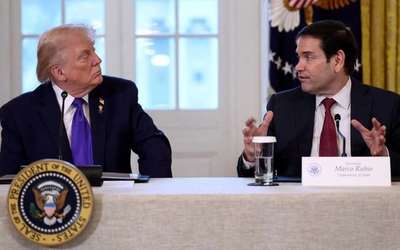
White House Press Secretary Karoline Leavitt on Wednesday told reporters that US military attacks on Venezuela and Iran came after they refused sincere efforts by President Donald Trump to reach deals sought by Washington.
With respect to Iran, the president ... tried to have serious interest in a deal with the Iranian regime with respect to their nuclear capabilities," she said.
"They were not interested so operation Midnight Hammer happened which was another remarkable military success under the leadership of this commander in chief."
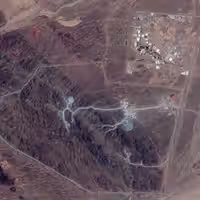
The June 22 attack on three Iranian nuclear facilities capped off a surprise military campaign launched by Israel after two months of US-Iran talks over its disputed nuclear deal stalled.
A large crowd of protesters was seen moving through the streets during protests in Abadan, in Khuzestan province in southwestern Iran, according to videos sent to Iran International.
The footage shows protesters chanting slogans against the government, including “Death to the dictator” and “Pahlavi will return.”
US Senator Ted Cruz says Iran’s ruling system has been “fatally weakened,” arguing that recent protests and military setbacks have left Tehran more vulnerable than ever.
Speaking to Iran International, Cruz said he supports Iranians protesting against what he described as a “tyrannical” and “theocratic” rule.
"The Ayatollah is a zealot. He is a murderer, and I think the regime is fatally weakened as a consequence of losing the war," he added.
“For a self-proclaimed supreme leader, losing a war to Israel weakens the regime profoundly.”
US Senator Ted Cruz told Iran International on Wednesday that the American people back ongoing protests in the country against theocratic rule and credited President Donald Trump for attacks on Iranian nuclear sites in June.
"I absolutely support the (Iranian) people. They’re rising up against a tyrannical regime, a regime that is theocratic, that is corrupt, that murders and tortures the Iranian people and the American people are cheering for the people of Iran to shake free this yoke of oppression, to have a free and democratic society," Cruz said.
The hawkish Texas lawmaker is close to Trump and is a strong backer of Israel and muscular US military stance in the Middle East.
Protests have roiled Iranian cities since December 28 and 34 demonstrators along with two members of the security forces have died according to US-based rights group HRANA.
Economic grievances sparked the unrest, which quickly transformed into anti-government rallies throughout the country.
"I think the people of Iran want to stand with America," Cruz added. "They want to stand with freedom. They want to stand with the West. And tragically, they have suffered under this radical Islamist regime."
"The Ayatollah is a zealot. He is He is a murderer, and I think the regime is fatally weakened as a consequence of losing the war. Not only did the Ayatollah lose the war," Cruz continued.
Israel launched a surprise military campaign against Iran in June which was capped off by US attacks on three key nuclear facilities. US President Donald Trump said the strikes "obliterated" Iran's atomic program.
"I will say President Trump showed bold leadership. Taking out the Iranian nuclear facilities, very few things would produce greater peace in Iran, across the world than seeing the end to this to radical regime."
Iranian authorities have said legitimate protest against economic hardships will be tolerated but what they have deemed riots will be put down. Iran has quashed with deadly force previous waves of unrest against authorities.
A protester can be heard saying police are opening fire during protests in Shadabad, southwest Tehran, on Wednesday, with gunshots heard in videos sent to Iran International.
One video shows people running as gunshots are heard. Another video from the area shows protesters chanting “shameless, shameless” at security forces and “An Iranian may die, but will not accept humiliation,” before briefly sitting on the ground.
A young woman holds a print of Iran's supreme leader Ali Khamenei at a state-sponsored rally in Tehran, December 31, 2025
Iran may not be Venezuela, but the Islamic Republic may at its most vulnerable point in its near 50-year existence as pressure builds from the streets, foreign intelligence services and inside the clerical establishment, analysts told Iran International.
US forces captured Venezuelan President Nicolas Maduro in a daring, deadly raid over the weekend and launched a surprise attack on Iranian nuclear sites in June.
His maverick military style may visit Iran once again after he twice warned Washington's sworn enemies in the Islamic theocracy against killing protestors, after which over 25 people have been killed.
The question now confronting Washington is whether Donald Trump will stick to pressure and covert tools or move toward a more dramatic confrontation.
Those who follow Trump’s foreign policy decisions see a clear pattern. He favors actions that create leverage without committing the US to open-ended wars.
Drawing on that record, Dr. Mehrzad Boroujerdi, Vice Provost and Dean at Missouri University of Science and Technology and a longtime scholar of Iranian politics, described a president inclined toward targeted operations rather than large deployments.
Trump, he explained, “prefers low risk and no boots on the ground model of a surgical attack.”
In the most extreme versions of surgical-strike planning, even the Supreme Leader appears as a hypothetical target, especially after Trump said during hostilities in June that the United States was well aware of his hiding place.
A broader conflict, Boroujerdi added, would come with serious complications.
“Any type of serious military intervention, meaning boots on the ground, in a place like Iran is going to be politically risky, legally contested and strategically rather complex.”
Is a Venezuela-style scenario possible?
The dramatic operation that removed Venezuela’s Nicolás Maduro has raised questions about whether something similar could unfold in Iran.
Alex Vatanka, director of the Iran Program at the Middle East Institute in Washington, pointed to the depth of foreign intelligence penetration in Iran’s security apparatus.
“If we look at the 12 day war we just had in the summer of 2025, clearly Israel, certainly in the United States, I’m sure they have many eyes and ears inside the Iranian regime. Otherwise they could not have done the sort of targeted assassinations that they achieved.”
During the 12-day war, Israeli airstrikes targeted Iran’s nuclear and military infrastructure, killing senior commanders such as Revolutionary Guards Brigadier General Davoud Sheikhian and several nuclear scientists including Abdolhamid Minouchehr and Mohammad Mehdi Tehranchi.
That level of access, Vatanka said, creates the possibility of deals inside the ruling elite if they decide the current path is unsustainable.
“That suggests defections. That suggest a good part of an existing regime decides, you know what, going forward things have to change and they might have cut a deal.”
Boroujerdi said Washington may not rely on exiled figures. Instead, it could negotiate with people already in power.
“The Venezuela model definitely shows … that instead of choosing an opposition figure, the Trump administration is quite content with striking a deal for a negotiated transition with the elements of the regime,” he said.
But Iran’s internal structure makes such transitions unpredictable. The Revolutionary Guard dominates key sectors of the economy and the security state.
Eric Mandel, director of the Middle East Political Information Network and a frequent adviser on regional security issues, warned that power might consolidate around them.
“I think the regime change in Iran could be one where the IRGC picks up the pieces because they're the most organized force.”
Prince Reza Pahlavi, the most prominent opposition figure outside Iran and son of the deposed last shah of Iran, has taken the opposite view. In recent interviews and opinion pieces, he argued that Iran does not need foreign intervention or a Venezuela-style operation.
“We don’t need a single boot of your military on the ground in Iran,” he told the Wall Street Journal in an interview published on Monday, saying the Islamic Republic is weakening from within and that a planned transition led by Iranians themselves could prevent chaos. Supporters see him as a potential unifying figure.
Many protest videos from inside Iran feature chants invoking Prince Reza Pahlavi to return.
Do Iranians actually want an attack?
Years of inflation, corruption and repression have pushed some Iranians to consider outside intervention as a price worth paying. Yet analysts caution against assuming most people are calling for war.
Boroujerdi emphasized the economic reality first. In his assessment, “hardly anyone is asking for war because that is going to amount to even worse economic conditions.”
Protesters in Iran have appealed to US President Donald Trump for help, according to videos sent to Iran International on Tuesday, with posts and signs reading 'Trump don't let them kill us.'
US President Donald Trump said on Sunday night aboard Air Force One that the United States was monitoring developments in Iran closely and warned that if Iranian authorities killed protesters, the country would face a strong response.
Meanwhile, the make-up of protests is shifting. Demonstrations are less concentrated among Tehran’s elite and increasingly driven by smaller cities and working-class families, once supporters of the clerical establishment and pillars of the 1979 Islamic Revolution.
“Right now, 70 plus cities and towns are protesting. This is a nationwide phenomena … It’s inflation, it’s unemployment, it’s the corruption,” said Vatanka.
Police in Abdanan, in Ilam Province, are seen in footage viewed by Iran International waving and cheering on protesters - an unusual scene in a system built on loyalty to the state.
What happens if there is an attack?
Mandel believes escalation remains possible, especially around Iran’s missile program.
“I think there’s a good chance that there will be a war with Iran,” he said, warning that Tehran could also strike first to distract from domestic crises and attempt to rally nationalist sentiment.
Iran’s newly formed Defense Council warned on Tuesday that the country could respond before an attack if it detected clear signs of a threat. Israeli Prime Minister Benjamin Netanyahu said on Monday that he and Trump would not permit Iran to restore its ballistic and nuclear program.
For Iranians already living with inflation, repression and unrest, the question is no longer whether pressure will continue. It is what form it will take, and how high the price will be.