Iran’s president has appointed former economy minister Abdolnaser Hemmati as the new head of the central bank, state-linked media reported on Monday, confirming a leadership change amid turmoil in currency markets and mounting economic pressure.
Mehdi Tabatabaei, deputy head of communications at the president’s office, said on X that President Masoud Pezeshkian had decided to name Hemmati as central bank governor.

Iran’s president has appointed former economy minister Abdolnaser Hemmati as the new head of the central bank, state-linked media reported on Monday, confirming a leadership change amid turmoil in currency markets.
Mehdi Tabatabaei, deputy head of communications at the president’s office, said on X that President Masoud Pezeshkian had decided to name Hemmati as central bank governor.
The move follows days of conflicting reports over the fate of Mohammad Reza Farzin, who had faced intensifying criticism as the rial slid to record lows and inflation accelerated.
Earlier on Monday, Iran’s judiciary denied reports that senior political leaders had agreed to retain Farzin, saying no such decision had been taken and that the matter fell solely within the president’s authority.
Later, the president’s office confirmed that Farzin had submitted his resignation earlier in December.
Hemmati, a former governor of the central bank and ex-economy minister, returns to the post as Iran grapples with severe currency instability.
On Monday, the dollar was trading at around 1.41 million rials on the open market, while gold prices also hit record highs, triggering protests and strikes by shopkeepers in parts of Tehran.
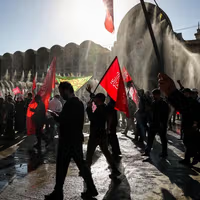
Iranian security forces on motorcycles moved against protesting shopkeepers on Tehran’s Jomhouri Street on Monday, footage received by Iran International showed.
In the video, one protester sat down in the middle of the road and did not flee as the motorbike units advanced, in an apparent act of defiance.
Iran’s interior ministry on Monday blamed recent currency volatility on what it described as hostile psychological operations, as pressure on the rial intensifies amid public discontent.
Ali-Akbar Pourjamshidian, the security and law enforcement deputy to the interior minister, said fluctuations in foreign exchange markets were driven not by fundamentals but by “enemy inducements” and a manufactured psychological climate, urging the public not to be swayed by what he called external propaganda.
Pourjamshidian’s comments reflect a broader narrative within the government that links economic instability to national security, at a time when authorities face mounting pressure to stabilize markets and address rising living costs without signaling vulnerability.
Iranian state-linked media on Monday portrayed strikes by Tehran shopkeepers as part of a foreign-backed effort to destabilize the country, as protests over the collapsing rial and rising prices entered a second day.
Fars News Agency, which is affiliated with Iran’s Revolutionary Guards, quoted an unnamed official at the Intelligence Ministry as saying the protests followed a “security destabilization scenario” orchestrated by Iran’s adversaries.
“The pattern of small cells appearing in trade gatherings to steer them in a radical direction is exactly in line with the enemy’s security-destabilization scenario,” the official was quoted as saying. “The aim is to turn economic criticism into political instability.”
Fars said analysts linked to the outlet viewed the unrest reminder as part of a broader campaign that began with what it described as “maximum pressure” sanctions and has now entered a phase focused on undermining internal security.
“Economic pressure, then incitement to protest, and finally instability – this is the enemy’s strategic triangle against the Islamic Republic,” the agency said.
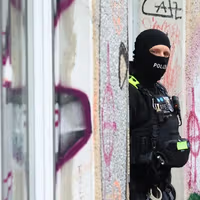
Security forces fired tear gas at protesting shopkeepers in Tehran’s Bagh-e Sepahsalar area on Monday, according to a video received by Iran International.
The incident occurred as merchants who had closed their shops gathered to protest worsening economic conditions and the rial’s sharp decline, with demonstrations continuing into a second day across parts of the capital.