'People of Iran want freedom', US ambassador to UN says


US Ambassador to the UN Michael Waltz voiced support for protesters in Iran on Monday, saying people there want freedom and that “we stand with them."
“The people of Iran want freedom. They have suffered at the hands of the ayatollahs for too long,” Waltz wrote on X.
“We stand with Iranians in the streets of Tehran and across the country as they protest a radical regime that has brought them nothing but economic downturn and war,” he added.

An Iranian human rights lawyer has shared a text message sent by the Islamic Revolutionary Guard Corps (IRGC) Intelligence as evidence of state control, responding with a defense of the right to protest.
“When there is no longer any way left for democratic change, when in less than a year the value of people's money is halved and people are at risk of becoming homeless, when in summer and winter we have neither electricity nor gas nor water nor clean air, then protests against the country's politics, economy and management are the nation’s right,” Amir Raeisian wrote on X on Monday.
Raeisian posted a surveillance warning from the IRGC, although it is not clear whether he received the message himself or whether it was forwarded to him by one of the protesters, as he does not clarify who the original recipient was.
“Your presence in connection with the illegal gatherings on December 29 has come under intelligence monitoring, so it is advised that you strictly refrain from taking part yourself, and from the participation of your relatives, in such illegal gatherings, which serve the enemy’s aims,” the IRGC Intelligence text read.
“These are not illegal gatherings,” Raeisian said.

Iran’s President Masoud Pezeshkian on Monday issued his first official response to the latest protests over worsening economic conditions, saying he has instructed his interior minister to hold talks with demonstrators.
In a post on X, Pezeshkian said he had ordered Interior Minister Ahmad Vahidi to “listen to the legitimate demands of protesters” and help the government “respond responsibly.”
Pezeshkian said improving people’s livelihoods remains his “daily concern,” and that reforms to the banking and monetary system are on the agenda.
But it remains unclear how the dialogue he has proposed will work or whether it can contain protests that are increasingly political in tone.
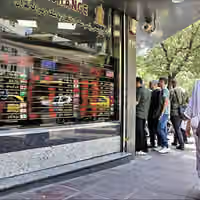
The unrest began with anger over the surging price of the US dollar and the collapse of the rial but quickly broadened.
Strikes and demonstrations spread nationwide on Monday, turning violent in several cities as nighttime crowds chanted against the ruling system and bazaar merchants vowed to continue their shutdowns.
In Tehran, large parts of the Grand Bazaar were shuttered, while clashes were reported in central streets.
While the slogans were mainly focused on economic issues on the first day, the second day's chants underscored a transition from economic frustration to more explicit political dissent.
Chants in several cities targeted Iran's political authority, with crowds shouting slogans such as "death to the dictator" and "Seyyed Ali (Khamenei) will be toppled this year".
The turmoil has been fueled by a currency crisis that pushed the dollar to roughly 144,000 tomans over the weekend. The head of Iran’s central bank resigned amid the turmoil, and Pezeshkian appointed former chief Abdolnaser Hemmati in a move seen as aimed at calming markets.

US President Donald Trump on Monday criticized the Islamic Republic’s violent crackdown on protests but stopped short of calling for regime change, hours after demonstrators demanded a new ruling system in nationwide protests.
Speaking on Monday in Florida alongside Israeli Prime Minister Benjamin Netanyahu, Trump said Iranian authorities routinely open fire on demonstrators.
“They kill people,” Trump said at Mar-a-Lago. “Every time they have a riot, or somebody forms a group, little or big, they start shooting people.”
Massive nationwide protests erupted across Iran over the weekend, with merchants vowing to continue their shutdowns into a third day on Tuesday.
What began as anger over the soaring price of the US dollar and the collapse of the rial has widened into a broader wave of unrest, spreading beyond market corridors into streets, squares and university campuses across several provinces.
While the slogans were mainly focused on economic issues on the first day, the second day's chants underscored a transition from economic frustration to more explicit political dissent.
Chants in several cities targeted Iran's political authority, with crowds shouting slogans such as 'death to the dictator" and "Seyyed Ali (Khamenei) will be toppled this year".
When asked about regime change in Iran on Monday, the US president drew a line.
“I’m not going to talk about overthrow of a regime,” Trump said, adding that Iran’s leadership already faces severe internal pressure.
“They’ve got a lot of problems. They have tremendous inflation. Their economy is bust. And I know that people aren’t so happy.”
He told reporters Monday that Iranians are increasingly discontented with their rulers. “There’s tremendous discontent. They form 100,000, 200,000 people. All of a sudden, people start getting shot, and that group disbands pretty quickly,” he said.
Long history of brutal crackdowns
Violence against protesters is not new in the Islamic Republic.
Amnesty International has documented past crackdowns in which security forces fired live ammunition at largely peaceful crowds.
During the 2022 Woman Life Freedom movement, sparked by the in-custody death of Mahsa Jina Amini, security forces fired on and killed protesters in cities across Iran, with many victims reportedly targeted in the eyes, according to human rights groups and the UN Fact-Finding Mission on Iran.
The November 2019 demonstrations, known as “Bloody November,” are also widely considered one of the deadliest crackdowns in recent decades, with security forces shooting directly at protesters and killing hundreds.
Former Secretary of State Mike Pompeo said on Monday that it comes as no surprise to see protests in Iran, since the government has stripped away prosperity and steeped the country in corruption.
“It’s no surprise that the people of Iran are taking to the streets to protest the collapsing economy. The Iranian regime has ruined what should be a vibrant and prosperous country with its extremism and corruption,” Pompeo posted on X.
“The people of Iran deserve a representative government that serves their interests—not those of the mullahs and their cronies,” he added.
Jailed Iranian politician and prominent dissident Mostafa Tajzadeh warned on Monday that relentless price hikes and the collapse of the national currency are pushing Iran rapidly toward “statelessness and chaos.”
He called for the abolition of clerical rule and a democratic overhaul of the system.
“Now the time has come for all those who want a prosperous, free, and independent Iran to speak with one voice and call for the separation of religious institutions from political institutions, for the clergy to hand power back to the people, and to return to their traditional base in the seminaries,” Tajzadeh posted on Instagram.
“The logical outcome of the Leader’s destructive approach has been the sidelining and exclusion of the competent, and the elevation of the inept to the top, Tajzadeh said.
“The safest and most reliable way out of the crises is to convene a constituent assembly and amend the constitution in line with the will of the nation,” he added.
“Peaceful protest is the inalienable legal right of citizens, and its suppression by the government is entirely unjustifiable and, if it occurs, must be firmly condemned by all political forces and currents.”