Iranian Kurdish dissident shot dead outside home in Istanbul, reports say
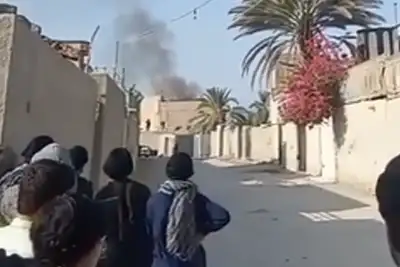
An Iranian Sunni cleric and outspoken critic of the Islamic Republic was shot dead outside his home in Istanbul by unidentified gunmen, the Kurdish rights outlet Haalvsh reported on Wednesday.
Masoud Nazari, a Kurdish religious and political activist from the city of Javanrud in Iran’s Kermanshah province, was shot several times late Tuesday as he returned from a mosque to his home in Istanbul’s Arnavutköy district, the Turkish news outlet Haberler reported. The attack took place around 8:30 p.m. on Salih Street in the Islambey neighborhood. The gunman, who had followed Nazari, fled the scene on foot after the shooting.
Nazari was taken to the hospital with serious injuries and later died, Haberler said. Police have launched a large-scale investigation, but no suspect has been detained and no group has claimed responsibility.
Haalvsh said Nazari left Iran about ten years ago after facing pressure over his religious and political activities and had lived in Turkey since then. Citing his family and friends, the outlet said he had “repeatedly received threats from Iranian security agencies” and that “the fingerprints of the Islamic Republic’s security institutions are clear in this incident.”
Nazari was known among Kurdish Sunni activists for his criticism of Iran’s religious policies. Haalvsh described him as a cleric and political critic who had opposed the Islamic Republic for years.
Rights groups have long accused Iran of targeting its critics abroad. The Abdorrahman Boroumand Center, a Washington-based human rights foundation, said in a report last year that it had documented at least 862 extrajudicial killings and more than 120 abduction or assassination attempts linked to the Iranian government since 1979.
Australian authorities have charged a western Sydney man for allegedly sending about $650,000 to Iranian banks under sanctions, the Australian Federal Police said on Wednesday.
The 34-year-old, a director of an Auburn-based remittance company, is accused of processing 543 international transfers worth $649,308 to sanctioned Iranian banks over a year, the AFP said in a joint statement with the Australian Sanctions Office and AUSTRAC.
Search warrants were executed in July at a Wentworthville home and an Auburn business, where investigators seized electronic devices. Forensic examination allegedly revealed evidence of funds transfers to designated banks.
The man has been ordered to appear before Downing Centre Local Court on Wednesday charged with contravening Australian sanction laws, an offence carrying a maximum of 10 years in prison and fines of up to three times the transaction value.
AFP Detective Superintendent Peter Fogarty said the force “works closely with the Australian Government and partners to ensure Australians aren’t breaching sanctions and dealing with foreign entities which engage in concerning conduct.” He added, “If you are contravening Australian sanctions, be warned – the AFP is ready and willing to act to disrupt your criminal activities.”
AUSTRAC national manager Anthony Helmond said, “Every time a business is instructed to transfer funds internationally, they must report that to AUSTRAC. We monitor these reports for signs of this type of activity and other criminality.”
Authorities said the Auburn company’s registration had been suspended for one year. The Australian Sanctions Office said it continues to monitor remittance companies to ensure compliance with financial sanctions.
Iran’s ambassador to Russia on Wednesday rejected praise among Israeli supporters of Donald Trump as a modern-day Cyrus the Great, citing the US president's support for what he called human rights violations in Gaza.
“One of the officials of the Zionist regime used the phrase ‘Trump as Cyrus the Great,’” Kazem Jalali, said at a ceremony in Moscow on . “Those who call the US president by such a title should be reminded that a person who supports the killing of tens of thousands in Gaza cannot be called a defender of human rights,” he said.
The remarks appeared to answer comments by Knesset Speaker Amir Ohana, who on Monday called Trump “a giant of Jewish history” and compared him to the ancient Persian ruler.
Ohana made the remarks during Trump’s visit to Jerusalem, where he addressed Israeli lawmakers after brokering a ceasefire in Gaza.
Banners in Tel Aviv posted this week by the Friends of Zion, a Christian organization dedicated to backing Israel, proclaimed "Cyrus is Alive!" alongside Trump's picture.
Cyrus is revered as a powerful ancient ruler by Iranians and remembered fondly in the Jewish tradition for ending the so-called Babylonian Captivity of Jews when his forces conquered that empire and allowed exiled Jews to return to Jerusalem.
A decree after his conquest recorded on an ancient artifact called the Cyrus Cylinder created in 539 BC enshrined aspects of religious freedom and has been hailed as the first bill of human rights.
Trump received a hero’s welcome in Israel this week after helping to secure a truce that ended two years of war in Gaza and freed the last living Israeli hostages. During his visit, he signed a Gaza ceasefire deal at a summit in Sharm el-Sheikh and said US strikes on Iran’s nuclear facilities had “obliterated” the program.
“The bully of the Middle East has been taken down,” Trump said, adding that Iran “will not return to the nuclear world again.”
Iran has denied pursuing nuclear weapons and accused Israel of misleading the US president into authorizing the attacks. Foreign Minister Abbas Araghchi said on Tuesday that Trump had been “badly fed the fake line” that Iran was close to producing a bomb.
Araghchi wrote on X that Trump was “being misled by the same warmongers who derailed American diplomacy with Iran for many years.” He said the US could not call for peace while leading military action against Iran and reinstating sanctions.
“The real bully of the Middle East, Mr. President, is the same parasitic actor that has long been bullying and milking the United States,” he wrote, referring to Israel.
US Senator John Hoeven, a Republican from North Dakota, told Iran International that building the Gaza ceasefire into a broader Mideast peace hinges on curbing Iran’s influence and reviving the Abraham Accords it opposes.
“There’s a lot more work to be done on the overall peace agreement,” Hoeven said, referring to ongoing US-backed efforts to consolidate a regional peace framework following the Gaza ceasefire.
The ceasefire between Israel and Hamas is holding for now after Hamas released 20 hostages to Israel on Monday in exchange for hundreds of Palestinian political prisoners.
In Sharm el-Sheikh, regional and international leaders convened to advance the fragile peace process. Egypt’s president described the US-backed proposal as “the last chance” to secure lasting stability in the Middle East.
“If this peace agreement can come together, and it has such broad-based support among not only Israel and the United States, but the Arab countries, we have a chance to really change the paradigm in the Middle East," Hoeven told Iran International.
Hoeven, a senior senator and long-time supporter of Israel, said Iran remained the key obstacle to regional stability.
“As far as Iran and the reign of terror, they have been the number one state sponsor of terror for many years,” he said. “Hamas and Hezbollah and the Houthis, they are proxies for Iran. Iran props them up," Hoeven said.
The senator expressed optimism that renewed US and Arab cooperation could reshape the region’s security and economic future. “If we can change that dynamic and get back to the Abraham Accords and get Saudi Arabia engaged like we’d like to, hopefully we can really change the region for a better, peaceful, prosperous future.”
The Abraham Accords, brokered in 2020 by President Donald Trump and his senior adviser son-in-law Jared Kushner, normalized relations between Israel and several Arab states.
Current efforts to expand that framework could gain momentum following the Gaza ceasefire.
Hoeven’s remarks follow similar comments made to Iran International last week by Democratic Senator Cory Booke, who said Iran “plays a destructive role across the Middle East” and remains the main spoiler of peace efforts.
Iran’s foreign ministry said on Tuesday that refugees can return to the country without facing legal consequences, as long as they have not committed offenses.
“Conditions for the entry of Iranian refugees have been prepared … provided they have not committed other criminal acts,” Hossein Nooshabadi, the ministry’s director general for parliamentary and legal affairs, told the semi-official ILNA news agency.
"Seeking asylum is not considered a crime," Nooshabadi added.
His remarks came after a meeting attended by Foreign Minister Abbas Araghchi and lawmakers, where officials discussed expanding engagement with Iranians abroad, including the possibility of postal or electronic voting in future presidential elections.
Nooshabadi added that Iran would provide consular services to citizens abroad “regardless of their political views.”
While Iran says it welcomes the return of refugees, the country’s laws criminalize a wide range of behavior — including political dissent, activism, homosexuality, and refusal to comply with compulsory hijab rules — the same issues that have led many Iranians to seek asylum abroad.
Pop singer Amir Tataloo, who lived in exile in Turkey for about four years before returning to Iran in 2023, was arrested upon his return and sentenced to death on blasphemy charges.
Iranian media reports in August said the judiciary is reviewing the case for a possible pardon after accepting his repentance. Though he remains imprisoned in Iran.
A 2014 report by UK-based IranWire said Iranian embassies in Europe have refused consular services to critics and opponents of the Islamic Republic living abroad.
Human rights groups have documented widespread repression inside Iran, including arbitrary arrests, forced confessions, and prosecutions of peaceful critics.
In reports this year, they have documented widespread repression inside Iran, including arbitrary arrests, forced confessions and prosecutions of peaceful critics.
The family of a British couple imprisoned in Iran on spying charges says it is considering appealing to US President Donald Trump for help, according to the Daily Telegraph.
Lindsay and Craig Foreman, both 52, were arrested in January while traveling through Iran on an around-the-world motorcycle tour.
Iranian authorities accused them of espionage — charges their relatives have forefully denied.
The pair have been held for nine months, with Mrs. Foreman only recently moved from the infamous Qarchak women’s prison to Evin prison in Tehran, where her husband is also detained.
Qarchak, a converted cattle farm about south of Tehran, is one of the country's harshest prisons, and rights groups have said it is overcrowded and rife with disease.
Mrs. Foreman, the family told the Telegraph, was transferred to Evin after three women in Qarchak died in just ten days from lack of medical care.
Evin prison has held foreign nationals, journalists and political dissidents for decades.
Joe Bennett, Mrs. Foreman’s 31-year-old son from Kent, said the family was watching recent political developments closely — particularly President Trump’s remarks about Iran during his address to Israel’s parliament on Monday.
In his speech to the Knesset, President Trump appeared to extend an olive branch to Tehran, declaring: “We are ready when you (Iran) are, and it will be the best decision that Iran has ever made, and it’s going to happen. The hand of friendship and cooperation is open.”
Bennett said his family took hope from the statement, suggesting Trump’s renewed push for Middle East diplomacy could offer a path toward freeing the couple.
“What’s happened with the Hamas peace treaty and everything over there, Donald Trump is saying he wants to start the same course of action potentially with Iran, there might be scope for some sort of negotiation in that sense.”
Asked whether the family would reach out directly to Trump or his team, Bennett said: “I think as a family we would be open to exploring that to get the safe and urgent return of my mum and Craig home, we would be naive not to explore all opportunities, or at least listen to what’s possible. It may not be that it’s the US or Donald Trump that does it, it may be a third-party embassy.”
The family is scheduled to meet UK Foreign Secretary Yvette Cooper on Thursday. Bennett said they are cautiously optimistic about his mother’s transfer to Evin, calling it “welcome news” given the slightly better conditions there and the possibility of more phone contact.
The only direct communication he has had with his mother in nine months was an eight-minute call in July. “She was placed on an intravenous drip while held in Qarchak but has learnt that she no longer needs one,” he said.
The case underscores the ongoing strain between Iran and Western governments over the detention of dual nationals and foreign travelers — a pattern human rights groups have decried as “hostage diplomacy.”
For the Foreman family, the hope now lies in a potential shift in US-Iran relations