Larijani backs Lebanon’s ‘resistance’ in Beirut visit
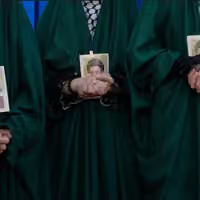
Iran’s top security official, Ali Larijani, traveled to Beirut on Saturday to attend memorial ceremonies for the slain Hezbollah leader Hassan Nasrallah, announcing his support for Lebanon’s role as a frontline of resistance against Israel.
“We are hopeful for the future of the region. Awareness and vigilance in the region are on the rise,” said Larijani.
“The Israeli regime spares no country as seen in the recent incident in Qatar,” he said.
“Many countries are seeking to establish a joint mechanism for cooperation, and we support this path,” Iranian media quoted him as saying.
Larijani will meet senior Lebanese officials to discuss bilateral relations and regional and international issues of mutual concern, the Iranian embassy in Beirut said.
He is joined by Ebrahim Azizi, head of parliament’s National Security Committee, and Rouhollah Motefaker Azad, a deputy speaker, during his trip to Lebanon.
In his previous Beirut visit in August, Lebanese political figures publicly criticized Tehran’s influence and interference, warning that Iran’s pressure on Hezbollah’s armament threatened Lebanon’s sovereignty.
Though Hezbollah was once seen as Iran’s dominant proxy in Lebanon, it has endured heavy losses. Israeli strikes last year killed thousands of its fighters and senior leaders, with much of its military infrastructure destroyed.
Lebanese officials have said a sovereign, unified Lebanon requires the elimination of foreign influence, adding that Hezbollah’s control over armed power remains a major obstacle.
Founded in 1982 by Iran’s Islamic Revolutionary Guards Corps, Hezbollah has long been Israel’s principal military adversary in Lebanon. Fighting late last year left the group weakened.
The human rights situation in Iran has worsened sharply since the June attacks by the United States and Israel and the Islamic Republic’s response, according to a new United Nations report to be formally presented in New York on October 30.
Mai Sato, the UN Special Rapporteur on human rights in Iran, wrote that the situation is “deeply troubling” and “profoundly affected by the devastating military escalation and its aftermath” in the first half of 2025.
“While the military escalation between States ceased on 24 June, its end has not brought relief to the people of the Islamic Republic of Iran, who continue to face systematic repression,” according to the report.
The attacks, which targeted nuclear facilities, residential areas and Evin prison, killed more than 1,100 people and injured over 5,600, with between 40 and 60 per cent of deaths estimated to be civilian, the report said.
The strikes also killed 14 Iranian nuclear scientists and destroyed medical centers, worsening shortages and leaving vulnerable populations without care, according to the report.
The response of Iranian authorities was also criticized. Tehran’s actions included “scapegoating of ethnic and religious minorities, the mass deportations of vulnerable Afghan nationals and the introduction of draconian legislation that further criminalizes legitimate civil rights activities,” the report added.
On women’s rights, the report pointed to systemic impunity in cases of gender-based killings, noting that at least 108 femicides were documented.
“The legal framework of the Islamic Republic of Iran violates the right to life by providing protections for perpetrators of gender-based killings through discriminatory provisions.”
Executions also continued at what the report called an “alarming pace,” with more than 700 people put to death between January and July, including 98 Baloch, 42 Kurds and 45 Afghans.
Sato urged Iran to “establish a moratorium on the death penalty with a view to its complete abolition” and to end corporal punishments including amputation and flogging. She also recommended international support for exiled activists and Afghan refugees.
The Islamic Republic does not seek conflict but would respond forcefully to aggression, said Iranian President Masoud Pezeshkian in an interview with NBC on Friday.
“We’re not afraid of war. We do not seek war,” he told NBC’s Tom Llamas. “President Trump has said that his administration has come to create peace, but the path that they have embarked upon will set fire to the entire region.”
Iran would never initiate a conflict but would give “the strongest answer” to any attack, Pezeshkian said.
Tehran continues to build its defense capabilities to deter adversaries, he added.
On nuclear issues, he rejected suggestions that Iran is developing weapons, pointing to the Supreme Leader’s fatwa against weapons of mass destruction.
He said inspectors from the International Atomic Energy Agency were welcome to visit sites in Iran, dismissing reliance on satellite images as insufficient.
Iran has resumed construction at an underground mountain site following US and Israeli strikes on its nuclear facilities, with satellite imagery and analysts indicating the work may reflect efforts to rebuild its damaged nuclear program.
The president also commented on domestic unrest, saying Iranians “have a right to choose” in response to questions about the enforcement of hijab laws. He acknowledged mishandling of Mahsa Amini’s case but accused outside observers of exaggerating Iran’s record while ignoring civilian deaths in Lebanon, Gaza, Yemen, and Syria.
Supreme Leader Ali Khamenei has ruled out direct talks with the US on missiles and uranium enrichment.
The president also referred to an injury he sustained during Israeli strikes in June’s 12-day war, saying doctors drained fluid from his knee and that the wound was minor.
Three Iranian men accused of working with Tehran’s intelligence services to target UK-based journalists pleaded not guilty during a preparatory hearing at the Central Criminal Court in London on Friday.
Mostafa Sepahvand, 39, Farhad Javadi Manesh, 44, and Shapoor Qalehali Khani Noori, 55, appeared via video link from a high-security prison in south London.
The three Iranian nationals have been charged with engaging in conduct likely to assist a foreign intelligence service between 14 August 2024 and 16 February 2025.
Sepahvand has also been charged with engaging in conduct, namely surveillance, reconnaissance and open-source research, between 14 August 2024 and 16 February 2025, intending to commit acts, namely serious violence against a person in the United Kingdom.
Manesh and Noori have also been charged with engaging in conduct, namely surveillance and reconnaissance, with the intention that acts, namely serious violence against a person in the United Kingdom, would be committed by others.
The charges include collecting information and planning to commit acts of violence on British soil.
Their targets are allegedly staff members of Iran International.
At today’s hearing, Farhad Manesh’s application for bail was refused by the Judge, the Honourable Mrs Cheema-Grubb.
All three accused will be held in remand until the trial itself begins on October 5, 2026, at London’s Woolwich Crown Court.
The three are the first Iranian nationals to be prosecuted under the UK’s 2023 National Security Act, a law designed to counter threats from hostile states.
Iran International, founded in 2017, has reported escalating threats, particularly after the 2022 “Woman, Life, Freedom” protests. Its staff have reported death threats, harassment of relatives abroad, and attacks
Rights groups and the broadcaster accuse Iranian authorities of waging a sustained campaign against Iran International since its launch, including hacking attempts attributed to actors linked to the Islamic Revolutionary Guard Corps.
In a 4–9 vote with two abstentions, the UN Security Council on Friday rejected a Russian-Chinese proposal to delay the snapback of UN sanctions on Iran, which are set to be reinstated Saturday night, 30 days after being triggered by the Europeans.
The resolution aimed to extend sanctions relief under Security Council Resolution 2231 for six months to allow further diplomacy.
Russia, China, Algeria, and Pakistan voted in favor, while the United States, Britain, France, and five other members opposed it. Guyana and South Korea abstained.
Dorothy Shea, Acting US Representative to the UN advised Russia and China to ask Iran for full cooperation instead of postponing the sanctions.
“They must press leaders in Tehran to take meaningful immediate steps to fulfill its commitments and obligations, including by fully cooperating with the IAEA,” Shea said.
British ambassador to the UN Barbara Woodward told the Security Council the doors to diplomacy are not yet closed.
"The United Kingdom remains committed to pursuing a diplomatic solution that ensures Iran never acquires a nuclear weapon, while maintaining Iran's right to a civil nuclear program in line with the nuclear Non-Proliferation Treaty."
Russia's representative at the meeting said Moscow "had hoped that the US, that European colleagues in the US, would think twice and that they would opt for the path of diplomacy and dialog instead of their clumsy blackmail, which merely results in escalation of the situation in the region."
However, the envoy said, "what did we see instead, in the 29 days that have elapsed since then, was the very same typical scenario for Europeans of pressure."
Iran had already warned if the UN sanctions reinstated, it will halt cooperation with the International Atomic Energy Agency, (IAEA).
Iran's foreign minister Abbas Araghchi told the UN Security Council that "Iran put forward several constructive proposals in New York to avert an unnecessary and avoidable crisis, all were ignored."
"I have to remind the distinguished representative of France that two nights ago, I agreed with your foreign minister a framework agreement, but he was not able to get the agreement of the United States," Araghchi said.
Following the Security Council meeting, Araghchi told Iran International that the reimposition of UN sanctions could jeopardize Tehran's cooperation with the UN nuclear watchdog.
The snapback mechanism was triggered on August 28 by France, Germany, and the UK (E3), citing Iran's "significant non-performance,” including enriched uranium stockpiles exceeding JCPOA limits and restricted IAEA access to facilities like Natanz and Fordow.
Iran’s nuclear program can never be destroyed and the United States will face consequences if it launches new attacks, Secretary of the Supreme National Security Council Ali Larijani said.
With UN sanctions on Iran set to be reinstated on September 28, Tehran will halt cooperation with the International Atomic Energy Agency (IAEA), Larijani warned.
“We have pursued every option and mechanism available to resolve this conflict peacefully,” he said in an interview with PBS’s Frontline, recorded on September 22 and partially aired Friday.
Larijani warned US President Donald Trump against new attacks, saying Iran will never surrender.
Asked about damage to bombed nuclear sites, Larijani declined to provide details: “We haven't abandoned any of those locations. They could continue operating as they are or be shut down in the future.”
‘Know-how can’t be taken away’
Israel launched a surprise attack on Iran in June, targeting nuclear and military sites as well as key officials. Iran retaliated with drones and ballistic missiles.
On June 22, the United States joined the campaign, striking nuclear sites at Natanz, Fordow, and Esfahan. A US-brokered ceasefire between Iran and Israel was established on June 24.
Iran’s national security chief dismissed assertions that the country’s nuclear capabilities had been destroyed.
“Iran's nuclear program cannot be destroyed. Once a technology is discovered, it can't be taken away. It's like inventing a machine that gets stolen—you can still rebuild it,” Larijani said.
‘Unreasonable terms’
Any talks about curbing Tehran’s missile program are a non-starter, Larijani said.
“The Americans insist we negotiate specifically about Iran's missiles. They’ve demanded no enrichment at all, or missile ranges below 300 kilometers (185 miles), now 500 kilometers (310 miles) — essentially stripping us of key defensive and offensive capabilities.”
US president Donald Trump told the UN General Assembly on Tuesday that he had offered full cooperation in exchange for Iran suspending its nuclear program, but said his letter to Supreme Leader Ali Khamenei was met with threats.
Larijani said the Islamic Republic is open to dialogue but will reject what he called “unreasonable” terms.