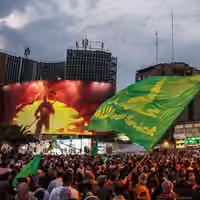
Iran seeks water imports as dams dry up, minister says

Iran is negotiating with four neighboring countries to import water, Energy Minister Abbas Aliabadi said Tuesday, warning that critical reservoirs could run dry within weeks.

Iran is negotiating with four neighboring countries to import water, Energy Minister Abbas Aliabadi said Tuesday, warning that critical reservoirs could run dry within weeks.
“We are in talks with Turkmenistan, Afghanistan, Tajikistan and Uzbekistan,” Aliabadi said, adding that five years of drought have left Iran with a 44 percent deficit in rainfall compared to long-term averages.
“There is no water now—we must use it slowly to make it last,” he said. “If your income is low, you spend more cautiously; it’s the same with water.”
The Islamic Republic has long been criticized for its inability to manage drought and water scarcity, and the current crisis is affecting much of the country, including Tehran, Khorasan, Markazi, Hormozgan, and Sistan and Baluchestan provinces.
Aliabadi warned that the capital’s Mamloo Dam may be lost within a month, and conditions at Latian and Karaj dams were also deteriorating. He cited a 30 to 40 percent drop in rainfall and dam reserves across the country.
“We must find different ways to control consumption,” he said.
Meanwhile, residents in Tehran report receiving exorbitant water bills. The CEO of the Tehran Water and Wastewater Company, Mohsen Ardakani, urged households to prepare storage tanks and pumps, saying disruptions may occur in coming days.
“With limited resources, we have no choice but to manage supply,” Ardakani said. “Water will only reach the first and second floors of buildings.”
Behzad Parsa, who heads the Tehran regional water authority, said this year marked the fifth consecutive year of low precipitation in the province. “Rainfall this year has been unprecedentedly low in the past 60 years,” he added.
Official data shows 80 percent of Iran’s groundwater has already been depleted.

Five Iranian nationals were arrested earlier this month near Mooers Forks, New York, while attempting to enter the United States from Canada illegally, a Customs and Border Protection spokesman said Tuesday.
"On July 1… agents located a minivan occupied by five citizens of Iran and two citizens of Uzbekistan," CBP's Swanton Sector said in a statement as reported by Fox News. "They are currently detained and pending removal proceedings."
All seven men had previously been apprehended for unlawful entry into the US, CBP said. The arrest occurred near the Champlain Station, a border patrol unit operating in a rural stretch of northern New York, near the Canadian border.
Fox News Digital highlighted renewed warnings earlier this month from former FBI special agent Jonathan Gilliam, who suggested Iranian-linked operatives may already be embedded in the US. “Where these sleeper cells may be is in plain sight,” Gilliam said. “And that's the real terrifying part.”
This comes as the US airstrikes in June targeted Iranian nuclear infrastructure and there are growing concerns around individuals tied to Iran entering Western countries under unclear pretenses.
In recent weeks, Iranian hardliners and clerics have repeatedly threatened to kill US President Donald Trump.
A December 2023 US State Department report documented plots by Iranian operatives in the US and Europe, including a foiled assassination attempt in New York and attempts to collect information for terrorist purposes on the London-based Iran International.
Other European states—including Albania, Belgium, Denmark, and the Netherlands—have taken actions in recent years against Iranian-linked actors accused of involvement in similar schemes.

Iran has seized a foreign oil tanker in the Gulf of Oman for allegedly smuggling 2 million liters of fuel, the chief justice of Hormozgan province said on Wednesday, according to state-linked media.
“In the course of monitoring suspicious fuel smuggling activity in the country's maritime borders in the Sea of Oman, a foreign oil tanker was inspected and seized due to incomplete legal documents related to its cargo,” Mojtaba Ghahremani said, according to a statement carried by the judiciary’s public relations office.
Ghahremani said a criminal case has been opened in the public and revolutionary prosecutor’s office in Jask and legal proceedings are ongoing. “Based on the report of the authorities, a case has been filed, and judicial investigation into the charges continues,” he said.
He added that 17 people, including the ship’s captain and crew, were arrested. “Seventeen suspects, including the captain and crew of this foreign tanker, are currently in detention for further investigation and legal procedures,” Ghahremani said.
Authorities are now collecting evidence to verify the total volume and nature of the cargo. “Sampling and relevant testing of the tanker’s fuel cargo, and inquiries into the authenticity of its documents, are underway,” he said. Results will be announced by the judiciary when the investigation concludes, he added.
Iran has not named the ship or its country of origin.
Iran has stepped up maritime enforcement in recent months, especially in waters near the Strait of Hormuz and the Persian Gulf, where fuel smuggling remains a persistent issue. In April, Iran’s Revolutionary Guard Corps (IRGC) Navy said it had seized a tanker carrying 100,000 liters of smuggled fuel and detained six people, according to Fars News Agency. That followed a separate operation in which two tankers allegedly transporting more than 3 million liters of diesel were intercepted and taken to the port of Bushehr.
The IRGC regularly announces such seizures as part of what it calls efforts to curb fuel trafficking in the region, a key route for global oil shipments. Iran has also seized tankers over maritime disputes or in response to international sanctions enforcement.

United Nations sanctions on Iran will be restored via the so-called "snapback mechanism" if no nuclear deal is reached by end of August, the US, British, French and German foreign ministers agreed in a Monday call, according to a report by Axios.
The European countries now plan to engage with Iran in the coming days and weeks with the message that Iran can avoid the snapback sanctions if it takes steps to reassure the world about its nuclear program, the report said citing two informed sources.
The snapback mechanism is part of UN Security Council Resolution 2231, which endorsed the 2015 Joint Comprehensive Plan of Action, or JCPOA. It allows any participant in the nuclear agreement to reimpose sanctions if Iran is deemed non-compliant. If no resolution to maintain sanctions relief is passed within 30 days, all previous UN measures return automatically.
The Trump administration supports activating snapback mechanism and sees it as leverage in the talks with Iran, the report added citing a US official.
The US official said Trump is highly frustrated that the Iranians haven't come back to the table yet, adding that US Special Envoy to the Middle East Steve Witkoff has made it clear to the Iranians that any future talks must be direct, rather than mediated by a third party, to avoid misunderstandings and expedite the process.
Earlier on Tuesday, French Foreign Minister Jean-Noel Barrot said the E3 — France, Britain, and Germany — will activate the United Nations snapback mechanism against Iran by the end of August if no tangible progress is made on a nuclear deal by then.

The FBI on Tuesday added three alleged Iranian intelligence officials including Tehran's current ambassador to Pakistan to its Most Wanted list over their alleged role in the disappearance of retired FBI agent Robert Levinson, who is believed to be dead.
The FBI’s Washington Field Office identified the three individuals as Reza Amiri Moghadam, Taghi Daneshvar and Gholamhossein Mohammadnia.
Reza Amiri Moghadam currently serves as Iran’s ambassador to Pakistan. Taghi Daneshvar was described as having a background in intelligence and counterterrorism operations, while Gholamhossein Mohammadnia previously served as Iran’s ambassador to Albania.
All three are linked to Iran’s Ministry of Intelligence and Security (MOIS), according to the FBI, which the United States has labeled a key player in hostage-taking operations and plots targeting Americans abroad.
The individuals were already under US sanctions and listed in connection with cases of alleged hostage-taking and the wrongful detention of American nationals in Iran.
“The FBI is leading the way in holding Iran accountable for the abduction of Bob Levinson, a devoted father and patriotic American,” Senator Jim Risch wrote on X.
“These new posters are seeking information related to his kidnapping. We will never forget Bob and his family, and we will hold those responsible to account for their crimes.”
Levinson disappeared in 2007 while on an unauthorized CIA mission to Iran’s Kish Island. US officials believe he died in Iranian custody, although Tehran has never acknowledged detaining him and continues to deny any involvement.
In 2020, Levinson’s family released a statement saying they had concluded, based on information from US officials, that he had died while in Iranian custody.
The FBI previously announced a $25 million reward for information leading to the arrest of two other Iranian intelligence officers—Mohammad Baseri and Ahmad Khazai—whom US authorities allege orchestrated Levinson’s abduction, detention, and likely death.

Iran may now decide to develop nuclear weapons following the US attacks on its main nuclear sites last month, former US Secretary of State Antony Blinken said in an interview.
“To the best of our analysis, Iran had not decided to weaponize. Now the danger is they might — burying the program deep underground and choosing to weaponize,” Blinken told Christiane Amanpour’s podcast on Tuesday.
Blinken said Iran had been rendered weaker than ever by the attacks, paving the way for a diplomatic breakthrough, but the situation could be even worse than before the conflict if Tehran decided to weaponize its nuclear activities.
“The strike that President Trump ordered clearly set back the program. But here’s the question — for how much, how long, and in what ways?” Blinken said.
The US attacked the Isfahan, Natanz and Fordow nuclear sites with long-range bombers and submarine-launched missiles on June 22, in strikes Trump said "obliterated" the program.
“Every analysis we and previous administrations conducted suggested that, if military action was taken, it might delay Iran’s nuclear program by up to two years — maybe less," Blinken said. "And during that time, Iran could decide to move the program deeper underground and make the decision they’ve so far avoided."
Blinken said that past intelligence assessments concluded Iran had not yet decided to build a nuclear weapon.
The administration under Trump's predecessor Joe Biden initially sought to bring Iran back into the nuclear deal, aiming for a longer, stronger agreement. However, nearly two years of indirect negotiations failed to yield results.
Blinken revealed that, prior to the Israeli and US strikes on Iran’s nuclear facilities, Tehran had presented a series of proposals to European officials — including reducing uranium enrichment to below one percent and opening talks on its ballistic missile program.
“They should put those offers back on the table,” Blinken said. “In fact, I think President Trump now has an opportunity to secure the better deal he wanted from the beginning.”
Negotiations under the Trump administration began with a 60-day ultimatum to Iran. On the 61st day, Israel launched a surprise military campaign.
On June 13, Israel began a series of strikes targeting Iranian military and nuclear sites, killing senior commanders and hundreds of civilians. In response, Iranian missile attacks killed 27 Israeli civilians.