British MPs grill Iran envoy over threats against UK-based journalists | Iran International
British MPs grill Iran envoy over threats against UK-based journalists
Iran’s ambassador to London has dismissed allegations that the Islamic Republic was involved in threats against UK-based Iranian journalists in his first appearance before the UK Parliament.
Ambassador Ali Mousavi was attending a meeting of the UK Parliament’s Foreign Affairs Committee on the Iran-Israel conflict on June 17, where MPs grilled him over what they called Tehran-backed plots against dissident Iranian journalists in Britain.
“These issues are some allegations against and blaming my country,” he said according to an official transcript. “We have some criticism regarding BBC Persian’s activities. They are intervening in Iranian domestic affairs.”
Pressed by MP John Whittingdale on more than 20 plots cited by MI5 targeting exiled Iranian journalists, Mousavi denied Iranian involvement and pushed for bilateral security discussions instead.
“If you have any evidence, please submit it, and we will consider it,” he said.
Iran's ambassador to London Ali Mousavi (left) and Iran's foreign minister Abbas Araghchi
Mousavi said Tehran was ready to co-operate with British agencies but deflected on specific allegations.
In the meeting with Mousavi, MP Whittingdale said he had visited the headquarters of Iran International "whose journalists have been subjected to threats from Iran on a daily basis."
The lawmaker, who leads the All-Party Parliamentary Group on Media Freedom, also cited constant harassment of the families of BBC Persian journalists in Iran.
Mousavi appeared before the UK parliament a few days before the family of an Iran International presenter was detained in Tehran in what the Persian-language broadcaster called an attempt to coerce her resignation.
“This deeply reprehensible tactic marks a dangerous escalation,” Iran International said.
Earlier this month, the BBC also accused Iran of intensifying its harassment of BBC Persian journalists by threatening their families inside Iran. The broadcaster described the actions as “a sharp and deeply troubling escalation” of its long-running campaign of intimidation.
RSF urges global action
Reporters Without Borders (RSF) on Wednesday called for global action over what it described as Iran’s escalating use of transnational repression, which appears to have intensified in response to the uncensored coverage of the Israel-Iran conflict.
In a statement, the RSF said it has documented the targeting of hundreds of Iranian diaspora journalists abroad, warning that these actions form part of a broader strategy by Iranian authorities to suppress dissent and restrict press freedom beyond their borders.
In March, the UK government decided to place the Islamic Republic’s intelligence and security establishment on the highest tier of its foreign influence watchlist following threats to Iranian journalists over the past three years.
Under the designation, Iran and anybody acting on its behalf would be deemed a potential security threat and compelled to register their activities in the UK. Not doing so would potentially incur a five-year prison sentence.
Iranian authorities said they have executed three men accused of smuggling equipment allegedly used in the assassination of Mohsen Fakhrizadeh, a senior figure in Iran's nuclear program who was assassinated in 2020.
The judiciary’s official news outlet, Mizan, reported on Wednesday that Edris Aali, Azad Shojaei, and Rasoul Ahmad Mohammad were put to death at Urmia Central Prison in northwest Iran.
The three were charged with "corruption on earth" and "enmity against God," accusations often levied in cases involving alleged collaboration with foreign governments.
Authorities said the men had worked to smuggle components hidden in shipments of alcoholic beverages, which they claim were ultimately used in the assassination of a high-ranking Iranian official.
While Iranian state media did not name Fakhrizadeh directly in its recent coverage, the allegations correspond with earlier reports linking the men to his killing.
Fakhrizadeh, a senior officer in Iran’s Revolutionary Guards and a prominent figure in its nuclear development efforts, was shot dead in an attack east of Tehran in November 2020. Iran has blamed Israel for orchestrating the assassination.
Edris Aali, Azad Shojaei, and Rasoul Ahmad Mohammad
Contested confessions and accusations of torture
Human rights organizations have raised concerns about the case. According to an exclusive report by Iran International, all three men—reportedly Kurdish cross-border porters known as kolbars—were convicted based on confessions obtained under severe duress.
Aali and Shojaei were reportedly detained for months in Ministry of Intelligence facilities before being transferred to Urmia Prison.
Family members told media outlets the men denied involvement and said their televised confessions were extracted under torture. Ahmad Mohammad, an Iraqi national from the Kurdish city of Sulaimaniyah, was arrested two years after the killing, allegedly after his phone number was found in Aali’s contact list.
Israel has not officially claimed responsibility for the assassination, though officials have not denied involvement. In the years following the incident, Israeli media and intelligence sources have described it as a remote-controlled, AI-assisted operation using a weapon smuggled into Iran in parts and reassembled inside the country.
An Israeli intelligence officer told Channel 12 in 2022 that the operation relied on facial recognition to avoid harming Fakhrizadeh’s wife, who was in the car with him, and took less than three minutes to carry out.
Iran’s former Intelligence Minister Mahmoud Alavi said in 2022 that efforts to apprehend the main perpetrators had failed, with several suspects fleeing the country shortly after the attack.
Fakhrizadeh, long described by Western intelligence agencies as the architect of Iran’s nuclear weapons program, was sanctioned by the United Nations and had survived previous assassination attempts.
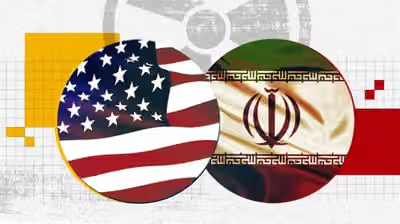
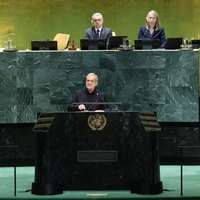
A tense meeting at the United Nations Security Council on Tuesday laid bare the deepening global rift over the Iran-Israel conflict, as member states clashed over the legality of US and Israeli airstrikes and Iran’s nuclear ambitions.
The meeting came just days after a fragile ceasefire ended the 12-day war between Iran and Israel that drew in the United States and marked the most direct military confrontation between the parties in decades.
“Diplomacy and dialogue are the only path to resolving the unnecessary crisis over Iran's peaceful program,” said Iran’s UN Ambassador Amir-Saeid Iravani. He accused the United States and Israel of launching an illegal war on Iran.
Israel’s Ambassador Danny Danon said, "If there were a Nobel prize for deception, the Iranian regime would win it every single year."
Iran’s actions, Danon said, left no room for trust. “While the diplomats and politicians talked, Iran built. While you negotiated, they enriched. While you hoped, they lied.”
“These strikes, in accordance with the inherent right to self-defense, collective self-defense, consistent with the UN Charter, aimed to mitigate the threat posed by Iran to Israel, the region, and to more broadly international peace and security,” said Rosemary DiCarlo, the US Ambassador to the UN.
“We must all urge Iran to seize this opportunity for peace and prosperity and abide by its international obligations.”
US forces attacked Iranian nuclear sites - Fordow, Natanz and Isfahan - on Saturday, in a mission dubbed "Operation Midnight Hammer."
Nuclear material
Germany raised alarms about the aftermath of the strikes, suggesting Iran may be moving sensitive nuclear materials out of view.
“We are particularly concerned by any possible relocation of nuclear material since the recent military strikes,” said Germany’s ambassador to the UN.
Britain's UN Ambassador Barbara Woodward said: “The situation remains extremely fragile... It is critical that Iran does not miss this window for diplomacy.”
Woodward warned that Iran’s enriched uranium stockpile is now “40 times the limit set by the JCPOA” and stressed, “It is urgent that the IAEA have full access, especially on Iran’s enriched uranium stockpiles.”
Russia, in contrast, condemned the Israeli and American airstrikes.
“The actions of the US and Israel directly violated the UN Charter,” said Russian Ambassador Vasily Nebenzya.
“They constitute a direct and very dangerous challenge to the authority of the NPT, especially Iran’s right guaranteed under Article 4 of the treaty to use nuclear energy for peaceful purposes, including uranium enrichment.”
The Islamic Republic will not return to what it was before the Israeli and American airstrikes, but what comes next is uncertain, experts tell Iran International.
The experts say Iran now faces a defining choice: abandon its decades-old doctrine of hostility toward Israel and the US, or double down and risk collapse.
“It's Ali Khamenei, whose worldview is arguably at the heart of why we ended up in this conflict,” said Alex Vatanka, Senior Fellow at the Middle East Institute and founding director of its Iran Program.
Once seen as untouchable, the clerical state is now reeling—its authority at home weakened and its future uncertain, several Middle East analysts told Iran International.
“What pushback comes from within the regime?” Vatanka asked. “The policies of hardliners, of flexing muscle, having ballistic missiles, acts of resistance, fighting the good fight against US and Israel. That brought this disaster on Iran.”
Tehran failed to defend its airspace, protect officials and loyalists, or safeguard its nuclear and missile programs.
While Iran has long fomented regional instability, this is the first time in decades that war reached its own soil. That may prove a turning point.
“So the war against Israel and the United States, that was sold as something you do outside of Iran's borders. That war suddenly was happening on Iranian soil, literally in cities and towns where people live,” Vatanka said.
Change is coming
That internal tremor may not lead to collapse—but it could produce serious transformation.
“I do expect significant aftershock waves within the structure of the regime,” said Avi Melamed, a former Israeli intelligence official and founder of Inside the Middle East: Intelligence Perspectives.
“Change within the regime, not the regime change,” Melamed said. “But again, it may be that the change within the regime will result in dynamic, that will result in, at the end of the day, change of the regime.”
Meanwhile, the Trump administration is taking a victory lap. President Trump posted Tuesday on Truth Social that China can now resume buying oil from Iran—a sharp turn from his previous threats.
“China can now continue to purchase Oil from Iran,” Trump wrote. “Hopefully, they will be purchasing plenty from the US, also. It was my Great Honor to make this happen!”
Only a month after warning the world against buying Iranian oi, Trump told reporters he hopes Iran will be “a great trading nation.”
Experts say the fact that Iran and Israel accepted a ceasefire signal that neither side wanted a prolonged conflict.
Some level of political change now appears unavoidable, according to Kamran Matin, Associate Professor of International Relations at the University of Sussex.
“The kinds of concessions that Iran will be compelled to make in the likely post-ceasefire talks over its nuclear and missile projects far exceeds the political ideological constraints of the current leadership of Khamenei,” Matin said.
“He has been forced to contradict himself on major matters of national security on a rather frequent basis since October 7.”
For now, observers are watching closely to see whether the Islamic Republic—feeling weakened—lashes out internally.
“The regime might seek to alleviate its utter humiliation by dramatically intensifying its repression of dissidents and even repeat the 1988 mass execution of political prisoners,” Matin warned.
Such a move could spark widespread protests—potentially pushing an already fragile Islamic Republic toward collapse.
The airstrikes may have ended, but the real battle for Iran’s future is only beginning. Israeli strikes shook the Islamic Republic to its core. Its leadership is bruised, its power structure exposed, and its legitimacy at home deeply eroded.
The United Nations warned on Monday that Israeli and Iranian actions may violate international law, with civilians—especially in Iran—suffering mass casualties, displacement, and widespread destruction.
The ongoing war began on June 13 with waves of Israeli airstrikes across Iran.
“Hundreds of civilians, including women and children, have been killed in the Israeli airstrikes and millions have fled major cities for fear of further attacks,” the UN Fact-Finding Mission on Iran and the UN Special Rapporteur on Iran said in an online statement, describing the Iranian population as “traumatized.”
Israel says it is targeting military objectives. However, UN experts say some of Israel’s actions appear to violate the principle of distinction under international humanitarian law, including the strike on Iran’s state broadcaster (IRIB), and the targeted killing of scientists.
At least 950 people have been killed and 3,450 injured in Israeli strikes across Iran, according to the Human Rights Activists News Agency (HRANA). The dead include 380 civilians, 253 military personnel, and 317 individuals of unknown status. Israeli attacks have hit 25 provinces, damaging homes, hospitals, and critical infrastructure.
Lack of 'effective' advance warning
The UN Human Rights Council’s Fact-Finding Mission and the Special Rapporteur on Iran have also raised concerns. Among those reported killed were residents of an apartment complex, three aid workers from the Iranian Red Crescent, and patients at a hospital in Kermanshah, according to the report. Other sites struck include a clinic for children with autism.
The UN said a lack of effective advance warning may have prevented civilians from reaching safety, raising concerns over compliance with the principles of proportionality, distinction, and precaution.
Airstrikes and evacuation orders have triggered mass displacement in Iran, with millions leaving Tehran. Limited access to shelters, fuel shortages, and disruption of essential services have increased civilian vulnerability.
Iranian counterstrikes have caused casualties and damage in Israel, with at least 24 killed and 1,217 injured, according to authorities. One missile struck a hospital in southern Israel, injuring staff and patients and forcing evacuations. Other strikes hit residential areas, prompting sirens across the country.
While many projectiles were intercepted, some got through, causing fires, power outages, and structural damage.
Internet blackout
On June 18, Iran’s Ministry of Communications imposed widespread internet restrictions, further complicating efforts by civilians to coordinate evacuations or contact family. The UN says this digital blackout has made it more difficult to assess the full scale of the humanitarian impact.
UN experts have also noted reports of arbitrary arrests of journalists, activists, social media users, and Afghan nationals accused of espionage. At least two people have reportedly been executed, and Iranian authorities have announced expedited trials, raising concerns overdue process.
Target: Evin Prison
One of the sites hit in Tehran on Monday was Evin Prison, which houses political prisoners and human rights activists, among other inmates. Iran’s judiciary said the strike damaged parts of the facility. State television broadcast footage of emergency responders carrying casualties and searching through rubble.
Israel’s defense minister said the military struck “regime targets and agencies of government repression,” including Evin.
Amnesty International condemned the attack, calling it a potential war crime, and urged Iranian authorities to release those arbitrarily detained and relocate others away from sites at risk of future strikes. The group also warned against the use of force by prison officials in response to unrest among detainees.
The UN called on Iranian authorities to relocate prisoners held near potential strike sites and urged all parties to respect international humanitarian law.
“The escalating hostilities pose grave risks to civilians across the region,” the Fact-Finding Mission and Special Rapporteur said, “with ordinary families and communities bearing the brunt of a conflict that threatens their safety, livelihoods, and daily lives.”
Three family members of an Iran International TV presenter were detained in Tehran by the Revolutionary Guards forces seeking to force her resignation as the channel continues its uncensored coverage of the Iran-Israel conflict amid an official internet blackout.
The presenter's mother, father and younger brother are being held in an unidentified location.
The presenter received a phone call from her father early Saturday morning urging her to resign. The voices of security agents could be heard in the background telling her father what to say.
“I’ve told you a thousand times to resign. What other consequences do you expect?” he told her. "You have to resign”.
"Iran International strongly condemns the Islamic Republic's recent abduction of family members of one of our journalists, an appalling act of hostage-taking aimed at coercing our colleague into resigning from their post," a spokesperson for Iran International said.
"This deeply reprehensible tactic marks a dangerous escalation in the Islamic Republic's ruthless campaign to silence dissent and suppress independent journalism."
Exerting pressure on the families of Iran International staff is not new. Many have faced ongoing harassment, surveillance, and intimidation over the years. However, this latest development crosses a new threshold.
The deliberate detention of a relative, coupled with the use of psychological torture, represents a cruel and calculated effort to break the will of our journalists by targeting their loved ones.
This tactic is a violation of international human rights law. It is also an alarming indicator of the lengths the Islamic Republic will go to silence independent reporting and suppress truth.
Iran International is increasingly concerned that the Iranian government is entering a new phase of unchecked repression, in which individuals linked to independent media outlets or international organizations risk being taken hostage and subjected to cruel treatment.
Iran International calls upon the UN and its member states, international human rights bodies and media watchdogs to condemn this act of state-sponsored intimidation and to exert maximum pressure on the Iranian authorities for the immediate and unconditional release of the family of Iran International’s presenter.
Iran International remains undeterred by attempts to silence it and remains committed to its mission of providing independent and accurate news to the Iranian people.
Iran International is an independent television news channel broadcasting to Iran, offering unbiased and uncensored news and analysis to a wide audience. It is the most-watched news channel in Iran.
Based in London, it aims to provide a platform for diverse voices and foster informed public discourse on events concerning Iran and the wider region. Iran International is managed by Volant Media UK Limited.