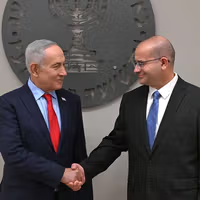
"We removed two immediate existential threats — a nuclear threat and a ballistic missile threat, Israel's prime minister Benjamin Netanyahu said in a televised address on Tuesday.
:If we had not acted, we would soon be facing the danger of annihilation," he added.
“(This) victory will be remembered for generations."
Netanyahu praised US president Donald Trump for backing Israel "in an unprecedented way."
Israel’s ambassador to the UN, Danny Danon, said his country had delivered a “severe blow” to Iran’s military leadership and dismantled key strategic sites, removing what he called an imminent threat.
Speaking ahead of the UN Security Council session on Iran’s nuclear proliferation, Danon confirmed Israel had agreed to a ceasefire “in full coordination with President Trump", and thanked the US for its support.
He said Israel remains open to diplomacy but warned that any future threat “will be met with a forceful response.”

Eleven Iranian nationals, including a suspected former army sniper and an individual with admitted ties to Hezbollah, were arrested by US Immigration and Customs Enforcement (ICE) over the weekend.
The arrests, made across multiple states, highlight what officials say is a broader crackdown on individuals with ties to Iran and potential national security risks.
Among those detained is Mehran Makari Saheli, a former member of Iran’s Islamic Revolutionary Guard Corps (IRGC) who was convicted of firearm offenses in Minnesota and admitted to having ties to Hezbollah.
He had been ordered removed in 2022 but remained in the country illegally, according to Homeland Security.
ICE also arrested Ribvar Karimi, an alleged former sniper for the Iranian army found in Alabama with an Iranian military ID, and Yousef Mehridehno, labeled a known or suspected terrorist after US officials revoked his legal residency over alleged visa fraud.
Other arrests spanned Texas, Arizona, Mississippi, Colorado, California, and New York, involving individuals with histories of drug trafficking, firearms offenses, domestic violence, and prior removal orders.
One US citizen, Linet Vartaniann, was also arrested for allegedly threatening to shoot ICE agents while harboring an undocumented Iranian man.
All individuals are now in ICE custody pending removal proceedings.
Homeland Security officials say the operation is part of President Trump’s directive to proactively remove threats before they escalate.
Iran's President Masoud Pezeshkian said Israel had been dealt a “severe and historic punishment” as it agreed to halt its military campaign, in a message to the nation on Tuesday following a 12-day war.
“Today, the enemy aggressor was forced to stop its warmongering under conditions where it suffered a harsh and historic punishment,” he wrote.
“This war ended through the will and strength of the great Iranian nation,” he added.

President Trump’s campaign of maximum pressure on Iran took an unexpected turn on Tuesday when he announced on social media that China can now buy Iranian oil.
“China can now continue to purchase Oil from Iran,” Trump wrote on Truth Social, “Hopefully, they will be purchasing plenty from the US, also. It was my Great Honor to make this happen!”
In May, Trump had threatened to bar any country that bought Iranian oil from doing business with the United States.
China remains the dominant buyer of Iranian crude, accounting for the bulk of the country’s 1.7 million barrels per day in exports, according to data from Kpler, data and analytics firm that tracks global commodity flows.
Trump’s announcement comes after nearly two weeks of fighting between Iran and Israel, which began with Israeli airstrikes on Tehran on June 13. A ceasefire agreement was reached Monday evening, following US airstrikes on three Iranian nuclear sites over the weekend. The US said its objectives had been met.
Speaking to reporters aboard Air Force One, Trump said Iran “is not going to have enrichment and they're not going to have a nuclear weapon,” adding, “They're going to get on to being a great trading nation.”
Oil prices have now tumbled to levels last seen before the Israeli strikes began, as investor fears of a major supply disruption in the Middle East ease.
Initial concerns had surged after the US joined Israel’s campaign, prompting speculation that Iran might retaliate by targeting oil flows from the Persian Gulf.
Traders were particularly watching whether Tehran would attempt to close the Strait of Hormuz — the narrow waterway linking the Persian Gulf and the Gulf of Oman — through which 20% of the world’s crude flows.
It remains a critical artery for oil exports from Iran, Saudi Arabia, the UAE, Iraq, Kuwait, and Bahrain.
“We are at the conclusion of a significant chapter, but the campaign against Iran is not over. We are moving to a new chapter based on the achievements gained in the current campaign,” Israeli military's chief of staff Eyal Zamir said on Tuesday.
In a statement released by the military, Zamir said Israel had significantly set back Iran’s nuclear and missile programs during the recent conflict.
“Now the focus returns to Gaza – to the return of the hostages and the dismantling of Hamas's rule,” Zamir added.