Khamenei aide calls US hopes of accessing Iran nuclear sites a fantasy
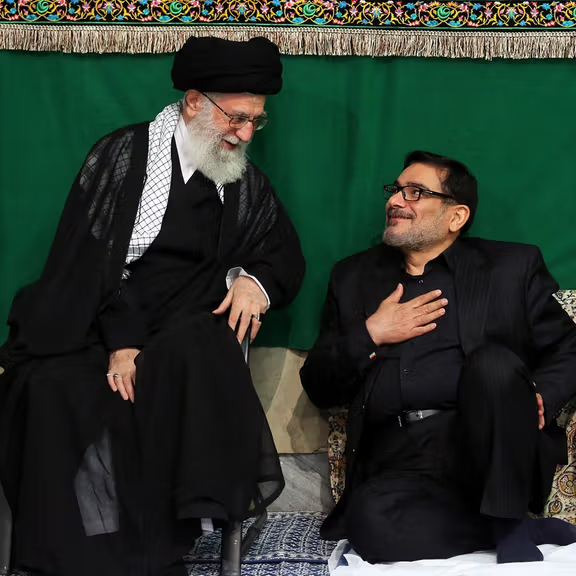
A senior adviser to Iran’s Supreme Leader Ali Khamenei said the idea of accessing or destroying Iran’s nuclear facilities has long been a fantasy held by American leaders.
“The dream of accessing Iran’s nuclear facilities and ‘blowing up installations’ is a fantasy previous US presidents were also delusional about,” Ali Shamkhani said on X.
“Iran is an independent country with a strong defense structure, a resilient people, and clear red lines. Negotiation is a tool for progress and safeguarding national interests and dignity—not for coercion and submission.”
Israeli Prime Minister Benjamin Netanyahu has instructed the military to continue preparations for a potential strike on Iran’s nuclear facilities, despite US President Donald Trump’s opposition, Israeli media outlet Ynet reported on Thursday.
According to the report, the decision has raised tensions between Washington and Tel Aviv. US officials say Israeli military preparations are increasing regional instability and complicating nuclear negotiations with Tehran.
Israeli officials believe that even if a strike occurs without coordination, the United States would ultimately assist in the event of Iranian retaliation. The report also said Israeli forces are on high readiness and capable of launching an operation with limited notice.
Netanyahu continues to insist that only a full dismantling of Iran’s enrichment program would be acceptable—a position Iran has long rejected. While the US pushes for a negotiated agreement, the Israeli government views the current conditions as a narrow window of opportunity for action.
Israeli Prime Minister Benjamin Netanyahu speaks during a press conference, in Jerusalem, May 21, 2025.
Former Iranian President Hassan Rouhani said on Thursday that US President Donald Trump’s main condition for reviving the nuclear agreement during his first term was a personal meeting with him, an offer Rouhani claims he was willing to accept.
“There was a path to resolve the issue with Trump in 2018. It was difficult, but there was a way,” Rouhani said in comments reported by Iranian outlet Roydad24. “Trump didn’t care much about the other conditions. He just wanted to meet me.”
Rouhani, who served as president from 2013 to 2021, said he told Iranian officials at the time that he was prepared to meet Trump and take responsibility if the meeting failed. “Let me meet him. If it fails, I will take the blame—for the sake of the country and the people,” he said. “But it didn’t happen.”
Rouhani also accused Israeli Prime Minister Benjamin Netanyahu of playing a key role in pushing Trump to withdraw from the deal. “Netanyahu has even written in his memoirs that he persuaded Trump to leave the agreement,” Rouhani said. “Israel wants war and is trying to convince the U.S. to join it.”
He added that during his administration, diplomatic efforts helped avert possible military conflict under both President George W. Bush and Trump. “In 2003, we were close to war, but we avoided it through negotiation. In 2013, we reached the Geneva interim deal within100 days of starting talks,” Rouhani recalled.
President Donald Trump shakes hands with Yousif Al Obaidli, director of Sheikh Zayed Grand Mosque, as he tours the mosque grounds in Abu Dhabi, United Arab Emirates, May 15.
Leaders from Saudi Arabia, the United Arab Emirates and Qatar privately urged US President Donald Trump to avoid military action against Iran’s nuclear facilities during his recent Middle East visit, Axios reported.
Citing fears of regional retaliation and instability, Saudi Crown Prince Mohammed bin Salman, UAE President Mohammed bin Zayed, and Qatari Emir Tamim Al Thani all expressed strong support for continued diplomatic efforts to resolve tensions with Tehran, sources familiar with the talks told Axios.
The leaders warned that any strike could provoke Iranian attacks on their countries, all of which host US military bases.
“They told Trump that Persian Gulf states would be hit first,” one source with direct knowledge said.
Gholamreza Ghasemian receives a welcome from supporters in Tehran following his release on May 29, 2025.
Iranian Foreign Minister Abbas Araghchi confirmed on Thursday that cleric Gholamreza Ghasemian, detained earlier this week in Saudi Arabia for criticising Riyadh, had been released following diplomatic intervention.
Ghasemian, a senior hardline religious figure, had posted a video from Medina during the Hajj pilgrimage accusing Saudi authorities of transforming Islam’s holiest cities into commercialized entertainment hubs.
“We continue our brotherly relations with Saudi Arabia and will not allow any disruption to affect them,” Araghchi said in a statement carried by IRNA.
He added that Tehran was in close coordination with Hajj officials to ensure the uninterrupted participation of Iranian pilgrims.
In the footage, recorded shortly before his arrest, Ghasemian said Mecca and Medina had become substitutes for casinos, brothels, and obscene concerts, alleging a Saudi-led erosion of Islamic values by the country which safeguards Islam's holiest sites.
Saudi authorities detained Ghasemian in Medina, but Iranian officials say he was freed without charges and returned to Iran via Dubai early Thursday.
Majid Rezapanah, head of consular affairs at Iran’s foreign ministry, said Saudi officials granted consular access twice during his detention.
“The matter was resolved through high-level engagement and reflects the seriousness of both sides in preserving recent diplomatic gains,” Rezapanah told state media.
Ghasemian, 52, is no stranger to controversy. He was previously linked by filmmaker Javad Mogouei to a fiery speech delivered ahead of the 2016 mob attack on Saudi diplomatic missions in Tehran and Mashhad.
The assault, triggered by the Saudi execution of prominent Shia cleric Nimr al-Nimr, led to Riyadh severing diplomatic ties with Iran until their resumption in 2023.
Since then, the two regional rivals have resumed direct flights, reopened embassies, and exchanged senior visits—including an April trip to Tehran by Saudi Defense Minister Prince Khalid bin Salman.
Iranian officials have sought to downplay the Ghasemian episode, emphasizing the broader stakes. “No one will approve of bad or offensive speech,” Iran’s ambassador to Riyadh, Alireza Enayati, posted in Arabic, aiming to reassure his Saudi hosts.
Ghasemian, now back on Iranian soil, thanked consular staff for securing his release in a post on X.
Iran will not back down from its position on preserving its nuclear enrichment cycle and peaceful nuclear knowledge, the country’s top security official said during a visit to Moscow, according to Iranian media.
“Iran will not retreat from its principles in maintaining the enrichment cycle and the peaceful use of nuclear knowledge,” said Ali Akbar Ahmadian, secretary of Iran’s Supreme National Security Council, during talks with Russian Security Council Secretary Sergei Shoigu.
Ahmadian said Tehran remains committed to resolving issues through dialogue but stressed its nuclear policy was non-negotiable.