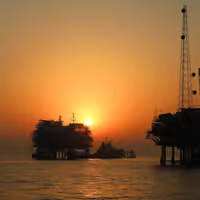
Workers during operations at Iran’s South Pars field
Iran hopes to revive offshore oil and gas exploration after a six-year hiatus as regional rivals Saudi Arabia and the United Arab Emirates have made significant recent discoveries and deals on their own patches.
The director of exploration at the National Iranian Oil Company said earlier this month that offshore oil and gas exploration in Iranian waters will resume after a six-year halt.
"For the first time in five years, we’ve signed a contract for an offshore exploration rig," Mohiyeddin Jafari said, according to the oil ministry's news website Shana. "We hope to begin operations in shared maritime border zones by 2025."
Jafari cited a “shortage of rigs” as the reason for the suspension of offshore oil and gas exploration.
However, reports from OPEC and Iran’s Ministry of Petroleum indicate that the number of drilling rigs in the country has remained stable over the past years, hovering around 160 units, with about 20 of them dedicated to offshore drilling.
Nonetheless, it remains unclear how many of Iran’s drilling rigs—most of which were built by Western companies decades ago—are still operational. In 2020, Reuters reported that Iran was struggling to obtain spare parts for Western-made rigs, and that a quarter of its drilling platforms were out of service, with many others operating only partially.
That same year, the state-run IRNA news agency quoted oil officials as saying that 85% of Iranian rigs required repairs and parts replacement.
Another major challenge for Iran is the lack of financial resources. The Iranian Parliament’s Research Center previously reported that annual investment in the country’s upstream oil and gas sector (exploration and production) has halved following US sanctions imposed in 2018, dropping to around $3 billion, compared to the previous years.
For comparison on a larger scale, annual investment was around $19 billion in the 2000s during the peak of Western companies’ involvement in Iran’s oil and gas projects.
Exploration and drilling costs are significantly higher offshore than onshore and given the government's financial constraints, developing offshore fields has not been a priority.
Belal joint oil field in southern Iran
Caspian Sea Iran is the only Caspian littoral state with no offshore oil or gas production, and Iran’s only seismic vessel in the Caspian Sea, named Pajvak, was destroyed in a fire in 2005.
The country’s only offshore drilling platform in the Caspian, named Amirkabir, was moved to Iran’s Caspian coast a decade ago for maintenance and remains inactive, just a few kilometers from shore. As such, the discovery of new gas fields in the Caspian waters appears impossible for Iran.
Ilham Shaban, head of the Caspian Oil Studies Center in Azerbaijan, told Iran International that last year Azerbaijan produced 580,000 barrels per day (bpd), Kazakhstan 350,000 bpd, Turkmenistan and Russia both than 100,000 bpd from their respective offshore Caspian fields.
Azerbaijan also produced around 50 billion cubic meters of gas from the Caspian Sea, half of which was exported—mainly to Europe. Russia produces annually 1.5 bcm gas from the Caspian fields.
Meanwhile, Arab countries south of Iran have increasingly participated in developing the Caspian offshore projects of the three Turkic states. Over the past two decades, the UAE’s Dragon Oil has invested $10 billion in Turkmenistan’s offshore sector and extended its investment agreement until 2035.
In 2023, Abu Dhabi National Oil Company (ADNOC) purchased a 30% stake in the Absheron gas field—Caspian’s second-largest offshore gas field—in Azerbaijani waters, becoming a partner with France’s TotalEnergies in the project.
Just last month, Kazakhstan’s national oil company KazMunayGas officially invited ADNOC to invest in its offshore fields.
Southern waters of Iran
Unlike the Caspian Sea, where Iran has no joint fields with neighbors, all of Iran’s southern neighbors share offshore oil and gas fields with Iran. Not only do they produce several times more than Iran, but they are also rapidly developing these joint projects.
Iran currently extracts only 35,000 bpd from the joint Forouzan (Marjan) field with Saudi Arabia. In contrast, Saudi Arabia produces 18 times more than Iran from this field and has signed contracts worth $12 billion with foreign companies to increase daily oil output to 800,000 barrels and gas production to 70 million cubic meters within the next four years.
Another joint field between Iran and Saudi Arabia is Farzad (Hasbah), from which Iran has no production. Saudi Arabia began producing 30 million cubic meters of gas daily from this field in 2013 and plans to increase it to 75 million cubic meters in coming years.
Saudi Arabia and Kuwait also share two other fields with Iran: Esfandiar (Lulu) and Arash (Dorra). They have already developed the former and signed agreements to develop the latter. While Iran claims a share in these fields, both Arab nations have rejected that claim.
Moreover, Saudi Arabia and Kuwait have developed two more shared fields—Khafji and Wafra—with a combined production capacity of 500,000 bpd over the past decade. The mentioned fields are not joint with Iran.
Iran and the United Arab Emirates share the Salman and Nosrat fields. Each country produces around 50,000 bpd from Salman, but the UAE extracts 20 times more than Iran from Nosrat—about 65,000 bpd.
Iran also shares the Hengam field with Oman, with both countries producing around 10,000 bpd each.
However, the most important offshore field for Iran is South Pars—the largest gas field in the world—which it shares with Qatar. Qatar began gas production from the field a decade earlier than Iran and has so far extracted 2.5 times more gas than Iran from what it calls the North Dome.
While the Iranian portion of the field entered its second half of life last year—meaning production will decline by 10 billion cubic meters each year—Qatar has signed $29 billion in new contracts with international companies to boost its gas production from the field by 65% by the end of this decade.