• العربية
  • فارسی
Brand
  • Iran Insight
  • Politics
  • Economy
  • Analysis
  • Special Report
  • Opinion
  • Podcast
  • Live TV
  • Iran Insight
  • Politics
  • Economy
  • Analysis
  • Special Report
  • Opinion
  • Podcast
  • Live TV
  • Theme
  • Language
    • العربية
    • فارسی
  • Iran Insight
  • Politics
  • Economy
  • Analysis
  • Special Report
  • Opinion
  • Podcast
  • Live TV
All rights reserved for Volant Media UK Limited
volant media logo

Tehran says president to discuss nuclear, regional issues in Moscow

Jan 17, 2025, 11:12 GMT+0
Iran's President Masoud Pezeshkian attends a wreath-laying ceremony at the Tomb of the Unknown Soldier by the Kremlin Wall in Moscow, Russia on January 17, 2025.

Iran's foreign ministry spokesperson on Friday said President Masoud Pezeshkian will discuss Iran's nuclear program with Vladimir Putin during his ongoing trip to Moscow.

Without providing further details, Esmaeil Baghaei, the spokesperson for the Ministry of Foreign Affairs, added in an exclusive interview with RIA Novosti that "developments in Syria and Gaza will be key points of discussion during the Iranian president's visit to Moscow." He also emphasized the expectation that "Russia will play a more prominent role in pressuring Israel to uphold its commitments and stop the violence."

The visit comes at a time of significant regional upheaval. Last month, Iran and Russia lost their key Middle Eastern ally, Bashar al-Assad of Syria, when Islamic insurgents swept down from the north and seized Damascus within days.

Meanwhile, Iran’s nuclear program remains a contentious issue. The Islamic Republic began violating the enrichment limits set by the 2015 JCPOA nuclear agreement after the US withdrawal from the accord in 2018. Following President Joe Biden’s election, Tehran announced it would increase uranium enrichment to 20% purity, later escalating to 60%—a level widely regarded as just short of the threshold for producing fissile material suitable for nuclear weapons.

Negotiations with the US and the European E3 countries—the UK, France, and Germany—failed to resolve key differences, revive the JCPOA, or establish a new agreement. As a result, Iran is now believed to possess enough 60% enriched uranium to potentially produce four to five atomic bombs, should it choose to pursue nuclear weapons.
Most Viewed

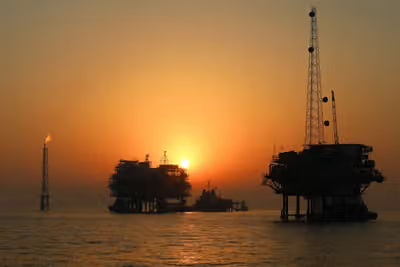
Iran’s oil industry has too many masters
1
OPINION

Iran’s oil industry has too many masters

2
INSIGHT

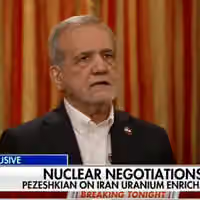
Pezeshkian’s Fox News nuclear overture draws hardline backlash

3
PODCAST

Trump may be buying time on Iran until after the midterms

4

Tehran seeks negotiated way out as Washington maintains pressure

5
ANALYSIS

Why Trump said no to Iran’s Hormuz proposal

Banner
Banner

Spotlight

  • Iran’s oil industry has too many masters
    OPINION

    Iran’s oil industry has too many masters

  • Iran wrong to expect midterms to restrain Trump, former US official says

    Iran wrong to expect midterms to restrain Trump, former US official says

  • Trump may be buying time on Iran until after the midterms
    PODCAST

    Trump may be buying time on Iran until after the midterms

  • Pezeshkian’s Fox News nuclear overture draws hardline backlash
    INSIGHT

    Pezeshkian’s Fox News nuclear overture draws hardline backlash

  • US and Iran want a deal, but neither wants to move first
    ANALYSIS

    US and Iran want a deal, but neither wants to move first

  • Rushdie returns to the fatwa that nearly cost him his life

    Rushdie returns to the fatwa that nearly cost him his life

Banner
Banner