Presented to parliament by Ahmadreza Dastgheib, the head of the SAC, the budget deviation report for Iran's fiscal year ending in March 21 highlights a dramatic escalation in financial mismanagement, with losses exceeding earlier projections by large margins.
According to the report, the government estimated that 17 state-owned companies would incur losses, amounting to 210 trillion rials ($300 million). Instead, the actual figures soared to 3,540 trillion rials ($5.057 billion) in total losses, spread across 134 companies.
"Eighty percent of these losses are concentrated in just six companies, including the Government Trading Corporation of Iran and the Targeted Subsidies Organization," the report added.
The second, an organization affiliated with the National Budget and Planning Organization, is responsible for implementing the provisions of the Targeted Subsidies Law and managing the funds related to this legislation.
Among the worst-performing entities was the Government Trading Corporation of Iran, a state-owned company implicated in multiple corruption scandals. Its losses jumped from 390 trillion rials ($557 million) in 2021 to 1,370 trillion rials ($1.957 billion) by 2023, according to the report.
Despite the figures, the corporation continues to receive significant state-backed loans, ranking as the second-largest loan recipient among executive bodies.
The Ministry of Agriculture, under whose purview the company operates, has also faced repeated allegations of corruption, including irregularities in livestock feed imports and scandals such as the Debsh Tea case.
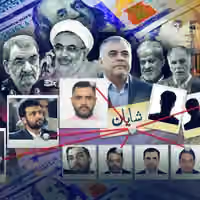
The Debsh Tea scandal, which emerged in 2023, is one of Iran's most significant corruption cases. The Debsh Agriculture and Industrial Group, led by CEO Akbar Rahimi, received approximately $3.37 billion in government-subsidized foreign currency between 2019 and 2022, intended for importing tea and related machinery. Instead, the company diverted about $1.4 billion of these funds, selling the currency on the open market at higher rates, resulting in substantial illicit profits.
While the Government Trading Corporation of Iran has faced public scrutiny, the problem is far from isolated. Other significant loss-makers include the Islamic Republic of Iran Broadcasting (IRIB) and the Iranian Health Insurance Organization. Collectively, these entities represent a growing financial burden on the state amid an already strained economy.
Supporters of the Raisi administration have portrayed its policies as a lifeline for struggling businesses and industries. However, the audit report starkly contradicts this narrative, exposing deep financial mismanagement and a growing crisis among state-owned enterprises.
As Iran grapples with economic constraints and public discontent, these revelations could fuel further scrutiny of the Raisi administration’s stated goal of revitalizing the country’s industries.