'Another storm is coming,' new Tehran mural says in Hebrew
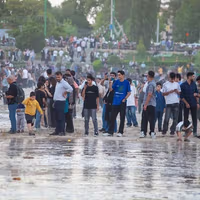
A Hebrew caption on a new mural installed in Tehran's Palestine Square reads, 'Another storm is coming,' according to images published by Iran's state-run media, hours after Israeli airstrikes against multiple Iranian military sites.
The first 'storm' is believed to refer to the October 7 attack launched by Iran-backed Hamas militants, during which around 1,200 Israelis were killed. That operation was dubbed 'Al-Aqsa Storm' or 'Al-Aqsa Flood'.
US Vice President Kamala Harris on Saturday reaffirmed her country's desire for de-escalation following Israeli airstrike against Iran.
“We're also very adamant that we must see de-escalation in the region going forward, and that will be our focus,” she said, telling reporters she just discussed the issue with Biden and their national security aides.
“Of course, we maintain the importance of supporting Israel’s right to defend itself.”
Israeli F-35 fighters entered Iran's airspace for the first time in raids earlier on Saturday, an informed Israeli source told Iran International, adding that they flew over Tehran and bombed targets in the area.
The General Staff of Iran's Armed Forces had earlier said in a statement that Israeli aircraft used the airspace provided by the US military in Iraq to launch several long-range air-launched missiles towards some border radars in the provinces of Ilam, Khuzestan, and around Tehran province.
Israel launched the airstrikes in the early hours of Saturday in retaliation for Tehran's October 1 missile barrage, which Iran called a response to the Israeli assassinations of Hamas chief Ismail Haniyeh in Tehran and Hezbollah chief Hassan Nasrallah in Beirut, among others.
The Israeli airstrikes only targeted Iran's military sites and facilities, following weeks of US efforts to dissuade Israel from targeting nuclear and energy infrastructure in Iran in a bid to avoid further escalation of conflict in the volatile region.
US President Joe Biden on Saturday said it appeared Israel had only struck military targets in its attack on Iran, and that he hoped they were "the end."
The Israeli attacks killed at least four Iranian army personnel, including two officers working in the missile unit, according to IRGC-affiliated Tasnim News.
Air defenses, missile program component hit by Israel
"Four S-300 air defense batteries that were in strategic locations and protected Tehran and nuclear and energy facilities in Iran were attacked," Axios quoted the sources as saying, confirming an earlier report by The New York Times about Israel's targeting of the Russian-made defense system.
The report also said that 12 'planetary mixers' that are a critical component in Iran's ballistic missile program were attacked in the Israeli air raids. "The planetary mixers are used to produce solid fuel for long-range ballistic missiles, and their destruction severely damages Iran's ability to renew its missile stockpile," the report explained.
The Israeli sources speaking to Axios said that the mixers are highly sophisticated equipment that Iran cannot produce on its own and must purchase it in China. "Remanufacturing of the mixers could take at least a year."
Iran downplaying the Israeli attack
The General Staff of Iran's Armed Forces says the Israeli attacks resulted in "limited and minimal" damage thanks to the "timely performance of the country's air defense." It acknowledged damages to several radar systems, saying that some of the radars were immediately repaired, while others are in the process of being repaired.
Iran's Foreign Minister Abbas Araghchi said on Saturday that Tehran "has no limits in defending its interests and territorial integrity, and we will defend not just every inch but every centimeter of our land.
Speaking in an interview with the official website of Iran's Supreme Leader, Araghchi emphasized that the Iranian government will continue its policy of confronting Israel with determination but refrained from talking of revenge or retaliation.
"The Islamic Republic is trying to downplay the intensity of Israel's attacks... Essentially, the idea of revenge has been removed from the political rhetoric of its leaders, and they are not looking to show a reaction," political analyst Jamshid Barzegar told Iran International.
The recent Israeli attack appears to be a "temporary endpoint" to the tensions between the two countries, and we are unlikely to see any direct confrontation between them until the upcoming US elections, he added.
"One of the key targets Israel attacked in its retaliatory strike against Iran was 12 'planetary mixers' that are a critical component in Iran's ballistic missile program," Axios journalist Barak Ravid reported on Saturday citing three Israeli sources.
"The planetary mixers are used to produce solid fuel for long-range ballistic missiles, and their destruction severely damages Iran's ability to renew its missile stockpile," the report explained.
The Israeli sources speaking to Axios said that the mixers are highly sophisticated equipment that Iran cannot produce on its own and must purchase it in China. "Remanufacturing of the mixers could take at least a year."
"The Israeli airstrikes cripple Iran's missile production capability," Axios quoted a senior American official as saying.
Axios also confirmed an earlier report by The New York Times about the targeting of Iran's S-300 air defense batteries, citing Israeli sources as saying, "Four S-300 air defense batteries that were in strategic locations and protected Tehran and nuclear and energy facilities in Iran were also attacked."
A factory for the production of drones was also targeted in the Israeli airstrikes, the report said, adding that Israel conducted a "symbolic" strike on a facility in the city of Parchin that was used in the past for the research and development of nuclear weapons.
Smoke billows amid ongoing hostilities between Hezbollah and Israeli forces, as pictured from Marjayoun, Lebanon, near the border with Israel, October 26, 2024.
SOUTH LEBANON—The vast Hezbollah tunnel system built below the Shiite village of Rab El Thalathine is less than 2.5 kilometers from the northern Israeli city of Kiryat Shmona.
Ten shafts in this underground labyrinth stretch from the bowels of this formerly Hezbollah-controlled village into civilian homes, where ammunition, rocket-propelled grenades, and AK-47 assault rifles were found, said an Israel Defense Forces (IDF) spokesman.
Iran International gained access to the tunnel during a journalist embed with the Israeli military from the evening of October 21 into early the following day. The tunnel system, discovered by Israeli forces who entered Lebanon just a week ago, spans over 1 km in length and ranges between 12 and 40 meters deep. An Israeli soldier commented, “It’s the largest one we’ve found so far.”
Author Benjamin Weinthal inside the Hezbollah tunnel in South Lebanon. Oct. 21, 2024
Intense firefights took place within the tunnel between Israeli forces and Hezbollah militants before Israeli soldiers neutralized the last four militants there, according to an army spokesperson. Clearing the tunnel of Hezbollah fighters took several days. Meanwhile, Israel ‘captured three terrorists’ about 3 km from the tunnel.
As troops moved deeper into Lebanon, Israeli artillery fire echoed overhead. Inside the tunnel, descending in pitch darkness to avoid alerting Hezbollah, they encountered a highly advanced underground complex designed for militant residence and storage.
One Israeli soldier described Hezbollah’s tunnel system as more “stable and sophisticated” than the “Gaza metro,” a vast underground network used by Hamas, estimated at 500 km in length. Compared to Gaza’s narrow passages, Hezbollah’s tunnels are notably larger and more structurally sound, he added.
Hezbollah’s main strategic partner, the Islamic Republic of Iran, played a key role in filling many of the rooms of the tunnel system with armaments, an IDF soldier said.
“Here are Iranian weapons systems,” he said, pointing to a stockpile of weapons. “We can obviously see the fingerprints here of the Iranian regime with the loads of weapons that have been flown into here by them instead of helping Lebanon become a beautiful country,” he added in political tit-for-tat familiar in the decades-long Arab Israeli conflict.
The IDF spokesman said: “We found long-range missiles here that can easily be fired into the Galilee.”
Weapons inside the Hezbollah tunnel displayed by Israeli forces.
The Hezbollah gunmen, “dressed up as civilians, came into here and got their uniforms and weapons systems and their plans to infiltrate Israel,” said the spokesman. The battle to seize the tunnel “saved the lives of thousands of Israelis,” he emphasized.
After 17 years of relative calm between Israel and Hezbollah, skirmishes began one day after the October 7 Hamas invasion of Israel when more than 1,000 civilians were killed and 250 taken hostage. Hezbollah began shelling northern Israel in support of Hamas once the Israeli military began attacking Gaza.
After one year of relentless air strikes and ground fighting, Israel has been able to seriously weaken Hamas and to an extent the Hezbollah, but in the process tens of thousands of people were killed in Gaza, including more than 17,000 militants, according to Israel. Hundreds of Hezbollah militants have also been eliminated. The Lebanese government says that hundreds of civilians have lost their lives and hundreds of thousands have become refugees.
The provisions for the Hezbollah fighters:
The tunnel system can lodge more than 500 gunmen, and the food storage was enough to last for weeks, the IDF said. Crates of canned food filled a sizable part of one room.
One large room was filled with mattresses and in others, mattresses were on the floor. The tunnel is equipped with “lights, backup lights, generators, toilets, washing machine, and a small kitchen,” an IDF spokesman noted. In short, enough “supplies to survive here for months.” Medical provisions and a large shower area were part of the tunnel project.
Israeli officers said they believed the tunnels were only built as a platform for accumulating forces to invade Israel. But in the aftermath of October 7, Hezbollah chose to use its vast arsenal to fire rockets and launch drones into Israel, forcing tens of thousands to evacuate.
Part of the Hezbollah tunnel photographed by the author on Oct. 22, 2024
An Israeli officer said, “We came here with specific intelligence to find this tunnel.”
Almost all of the 22,492 residents of Kiryat Shmona, leaving only around 3,000 behind, were forced to flee after Hezbollah began firing missiles into Israel on October 8, 2023. The town is now nearly deserted. Over 60,000 Israelis have been compelled to leave their homes across 43 northern communities due to Hezbollah's attacks.
Hundreds of pro-Hezbollah Shiites lived in the village where the tunnel was discovered, according to the Israeli military.
Brig.-Gen. Guy Levy, the commander of the IDF’s 98th Paratroopers Division, said, “Our main goal here is to find and locate each and every terrorist site in the village and in the underground site and destroy them and make sure we can bring our citizens back to a normal life in the north. We will do whatever it takes.”
Above ground, the late October night required a light jacket or sweater. However, after a short stay in the tunnel, the oppressive air there caused light sauna-like sweating. Unplugged fans and ammunition dotted the pathways of the tunnel.
As I departed, a member of the division’s 35th Paratroopers Brigade said the operation to root out Hezbollah and their infrastructure was being carried out “to ensure that an October 7 never happens again for future generations of Israelis.”
Hezbollah attacks on northern Israel since October 2023 have killed 30 civilians—28 Israelis, one Thai citizen and one Indian citizen. A total of 45 Israeli soldiers and reservists have died since the IDF entered southern Lebanon in late September. The IDF says it has killed more than 1,500 Hezbollah fighters and wounded more than 11,000 others in Operation Northern Arrows, the third Lebanon war.
IDF’s Maj. Doron Spielman remarked in the back of the military transport that the disadvantage for Israel is that “Lebanon has the advantage because it is higher [on the landscape] and anti-tank weapons can be fired.”
He said the Kibbutz—Misgav Am—and other small border communities that attract tourists, including his family, with Airbnb offers, were swiftly closed in October 2023. The Kibbutzim and towns in the Upper Galilee in northern Israel on the border were declared a closed military zone in late September as the IDF started its ground offensive into south Lebanon.
As the journalists waited for the heavily armed military transporters to take us back to the Israeli side, a full moon slightly covered by a sliver, gray cloud provided some light. An Israeli drone with a piercing green light hovered in the sky.
The journey back to Israel was rocky along the rough hilly terrain of south Lebanon. A kind of sandstorm reminiscent of a scene out of the English Patient engulfed the IDF military vehicles along the dusty dilapidated roadways.
Upon arrival in Kiryat Shmona, a taxi driver for the media said two sirens had sounded, prompting him and the soldiers at the meet up location for the press to flee into an underground garage for safety. The driver said the Iron Dome intercepted Hezbollah rockets.
"Israel’s elimination of top leaders from Hezbollah and Hamas has received significant praise from counter-terrorism experts and the Israeli public for advancing efforts to dismantle these Iran-backed militant groups."
In an interview with Iran International, Yigal Carmon, a former counter-terrorism advisor to two Israeli prime ministers, warned that “In the case of Islamist terrorist organizations that are self-indoctrinated by the worst brand of Islam, the loss of leadership does not necessarily imply a breakdown of the spiritual power to continue, particularly in that they have prepared themselves for a long-term fight. “
Carmon, who famously predicted the time frame of the Hamas invasion of Israel, added “Therefore we are not expecting to see a breakdown in Hezbollah’s overall power to continue as long as they have the capabilities, which we saw they have. Israel will have to for the foreseeable future eradicate Hezbollah politically, militarily and economically.”
Carmon highlighted Hezbollah leader Hassan Nasrallah’s flawed military judgment before October 7, noting that if Nasrallah had attempted a Gaza-style assault rather than limited cross-border bombings, Israel could have faced an existential threat. He argued that Israel’s preparedness against Hezbollah was due to Nasrallah's miscalculation, which spared Israel from a greater crisis.
He continued, “Israel was virtually saved from an existential crisis. The existential threat would have forced Israel to use cataclysmic powers against Iran.”