Criminal charges filed in Tehran for 'inciting fear' on social media
People walk in Grand Bazaar, in Tehran, Iran, September 8, 2024.
The Tehran Prosecutor's Office has filed criminal charges against individuals accused of "creating fear to harm the psychological security of society" and "spreading lies" on social media, state media reported on Friday.
Iranian citizens lack the freedom of speech enjoyed in democratic countries. Without independent courts, the government and its judiciary can interpret laws or issue regulations with minimal accountability, particularly on political or religious matters.
According to the Iranian judiciary’s Mizan News Agency, in recent days, certain social media accounts on platforms like X (formerly Twitter), Telegram, and other online activists have been involved in spreading such content. However, no concrete examples or clear definitions of "false news" or "creating fear" have been provided. Some individuals have faced legal action, while others have been warned following monitoring of online activities, Mizan reported.
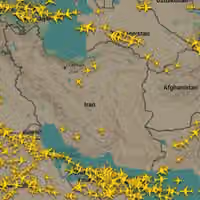
The latest announcement came in the wake of Iran's missile attack on Israel on Tuesday night, after which the Revolutionary Guards warned that social media posts interpreted as "support for Israel" would be treated as a crime.
This is not unprecedented. The Islamic Republic's judiciary has previously pursued legal cases against citizens, journalists, and media outlets for commenting on events such as the death of Hassan Nasrallah, Hezbollah’s chief, Ismail Haniyeh, the death of Iranian President Ebrahim Raisi, and the ongoing conflict between Iran and Israel.
Although Khamenei declared a five-day period of national mourning for Nasrallah, videos obtained by Iran International revealed a contrasting public reaction. Some Iranians were seen celebrating his death, distributing pastries in the streets and raising toasts. Similar defiance appeared on social media, where users openly challenged the state’s narrative, underscoring a sharp divide between public sentiment and the official line.
Also, in the aftermath of Raisi's death, dozens were arrested for "insulting" officials and "disturbing public opinion" as many celebrated the helicopter crash that killed him and his companions. The government and state media portrayed Raisi and his companions as "martyrs," while trying to suppress any criticism after the crash amid a leadership crisis.
A notable example of narrative control and pressure on free expression occurred in August when blogger Hossein Shanbehzadeh was sentenced to 12 years in prison for posting a single dot in response to a tweet by Supreme Leader Ali Khamenei. His post, which received more likes than Khamenei’s tweet, resulted in his arrest weeks later.