Head of Iran's Supreme Court rebukes female journalist over morality police remarks
Maryam Shabani, a journalist with Andisheh Pouya magazine, at President Masoud Pezeshkian's inaugural press conference on September 16, 2024.
The head of Iran's Supreme Court has made a veiled threat after a female journalist mentioned the morality police at President Masoud Pezeshkian’s inaugural press conference.
Mohammad Jafar Montazeri stated, "If the morality police are to be addressed, then the 'inappropriateness' of that journalist should also be considered," seemingly alluding to Maryam Shabani's headscarf, which revealed a small portion of her hair.
Iran has been named by Freedom House as the world's most oppressive nation for press freedom, with dozens imprisoned in the wake of the 2022 uprising.
At Pezeshkian's press conference on Monday, held a month after his coming to office, Shabani began her question by mentioning that she had to navigate various alleys and back routes to avoid encounters with the morality police on the streets.
In response, Pezeshkian downplayed the seriousness of her remarks, saying, "Are they still bothering you? They were supposed to stop that. We’ll tell them to stop."
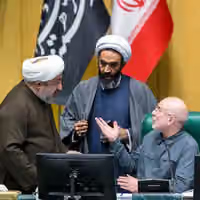
Criticizing Pezeshkian's approach, Montazeri remarked that while Pezeshkian emphasizes national unity as his slogan, such “unity should not come at the expense of relinquishing our core beliefs and fundamental principles.”
Maryam Shabani (R), Iranian President Masoud Pezeshkian (L), September 16, 2024.
During his pre-presidential campaign, Pezeshkian had criticized the presence of the morality police. However, the police have reaffirmed their commitment to Project Nour, the establishment's hijab enforcement initiative that has been in effect since April, insisting that it remains a binding law.
Despite scaling back for a short time after the death of Mahsa Amini in 2022 - a tragedy that sparked months-long protests in Iran known as the "Woman, Life, Freedom" movement - the morality police continue to maintain a presence on the streets.
Following Amini's death, more than 550 Iranians were killed as the government responded with full force to what has been the most significant challenge to the establishment's legitimacy since the founding of the Islamic Republic in 1979.
Badri before and after being shot by the police in July
The most recent publicized instance of the ongoing pressure on women in Iran involves 31-year-old Arezou Badri. After allegedly violating hijab rules, she was shot by police and suffered severe injuries to her spine and lungs. While hospitalized in extreme pain and unable to sit or eat, she was coerced into making a confession.
Two years after the protests ignited by Mahsa Amini’s death, a UN Fact-Finding Mission report released on Friday highlighted the persistent human rights violations in Iran, particularly targeting women.
Ahead of the anniversary, Amnesty International also raised alarms, condemning the Iranian authorities' brutal crackdown on the "Woman, Life, Freedom" movement. The organization emphasized the establishment's ongoing "war on women and girls," noting the intensified repression of those defying stringent veiling laws and the increased use of the death penalty to stifle dissent.
The rights group highlighted the country's persistent culture of impunity for crimes under international law.