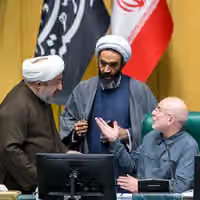
This mode of defense has become central to the parliamentary hearings, where legislators are tasked with ratifying the ministerial appointments made by the newly elected president, Masoud Pezeshkian.
In theory, the president and his cabinet are required to present a comprehensive governance agenda. In practice, however, the discourse has largely bypassed substantive policy discussions, focusing instead on the ministers' loyalty and compliance, especially their willingness to align with Ali Khamenei's directives.
Contrary to parliamentary expectations, Pezeshkian has not presented a detailed road map for his administration. Instead, he has merely cited the Seventh Development Plan—a continuation of the framework approved during Ebrahim Raisi's tenure in November 2023—and reiterated his commitment to the policies endorsed by Khamenei. Critics say that the Seventh Plan itself is an unrealistic document, full of economic wishes that simply cannot be realized. It is the continuation of the previous failed plan.
Iran's Sixth Five-Year National Development Plan, originally slated to conclude in 2021, was extended to mid-2024 due to its failure to achieve its intended economic objectives. According to an analysis by the Parliament Research Center, only 30% of the plan was partially implemented, 40% remained unaddressed, and the remaining 30% could not be accurately assessed. Despite its formal approval, the parliament has deemed the latest plan deficient.
Pezeshkian's strategy appears to be a mere perpetuation of this existing plan, coupled with a vague adherence to Khamenei’s orders, devoid of any substantive detail. MPs defending the proposed ministers similarly lean on this rationale, equating loyalty to the establishment with a sound governance strategy, effectively rebranding familiar rhetoric as policy.
While the overwhelming majority of the proposed ministers are expected to receive parliament’s endorsement—dominated as it is by hardline factions—there have nonetheless been murmurs of discontent within the legislative body.
In their addresses, a few dissenting MPs expressed concerns that Pezeshkian has failed to present an independent policy framework separate from the Seventh Development Plan, limiting the scope for meaningful debate or opposition.
Alireza Salimi, a Tehran representative, took issue with Pezeshkian's approach, noting that he has merely reiterated the Seventh Development Plan as his own rather than offering a novel or detailed strategy. Salimi emphasized, "The Guardian Council has already approved the Seventh Development Plan. Thus, debating support or opposition to it is a futile exercise."
Another parliamentarian, Mehdi Kouchakzadeh, raised a procedural objection, underscoring that the primary objective of the session was to "examine the government’s program." Addressing Mohammad Bagher Ghalibaf, the Speaker of the Parliament, the lawmaker, inquired, "Has Pezeshkian’s plan been submitted to you for dissemination among us?"
He further highlighted that Pezeshkian has claimed his agenda is grounded in the Nahj al-Balagha—a centuries-old compilation of sermons, letters, and sayings attributed to the first Shia Imam, Ali, which Pezeshkian often recites in Arabic—and the vision of the Supreme Leader. Kouchakzadeh then provocatively questioned, "Are the dissenting MPs opposing the Nahj al-Balagha and the Seventh Development Plan?"