Iranians question new ministers' competence and record
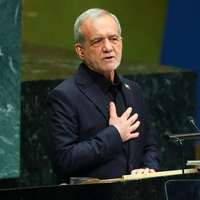
President Masoud Pezeshkain with a group of aides on August 13, 2024
Amid widespread criticism from the media and public regarding the composition of his cabinet, President Masoud Pezeshkian has urged the nation to withhold judgment and evaluate the cabinet based on its future performance.
Sunni leader Molana Abdolhamid said that the list of Pezeshkian’s ministers has disappointed the people. Abdolhamid also wrote that not including religious and ethnic groups in the cabinet leads to disappointment and prevents national accord.
Earlier, many journalists and social media activists criticized Pezeshkian’s choices and expressed the belief that this cabinet is likely to be short-lived.
The centrist Entekhab website has quoted President Pezeshkian as saying that he and his aides have made every effort to select the most suitable candidates from the available pool.
However, critics have already expressed concerns about the appointment of Intelligence Minister Esmail Khatib, a leftover from the previous administration and other military officials appointed to ministerial posts.
Senior Iran International analyst Morad Veisi saidthat the choice of ministers has proved three things: First, that the majority of people who refused to vote in the election and believed that voting will not change anything were right. Second, even the reformists who encouraged others to vote have now realized that voting has not changed anything in Iran. And third, it proved that the main problem in Iran is the system and the fact that Supreme Leader Ali Khamenei controls everything.
Veisi argues that potential voters have come to realize that even changing presidents won't bring any significant change as long as Khamenei holds power. The selection of candidates in Pezeshkian's cabinet, according to Veisi, proves that the election has brought no real change.
For instance, the appointment of IRGC General Eskandar Momeni as Interior Minister suggests that the government's stance on suppressing protests and enforcing the compulsory hijab will remain unchanged. Veisi notes that Momeni's role, which includes heading the National Security Council and overseeing provincial security, will continue to be dominated by IRGC influence, just as it was under the previous administration, where key security positions were also held by IRGC generals.
Momeni's background as Iran's deputy police chief and a senior commander of the Special Forces, responsible for quelling dissent, further indicates a continuation of hardline tactics. Additionally, Veisi highlights that Momeni previously commanded the Morality Police, the main force enforcing the hijab mandate, signaling that the repressive measures against women who defy this law are unlikely to change.
"This comes after Pezeshkian had pledged during his campaign to relax the compulsory hijab rules and ease restrictions on Iranians' access to the Internet, particularly social media. Meanwhile, as debates and criticisms about the new cabinet continue, the previous cabinet remains in place. On Monday, incumbent Culture Minister Mohammad Mehdi Esmaili announced that his ministry has finalized a document to regulate movie supervision. In essence, Esmaili's statement suggests a further tightening of censorship in Iran, allowing the outgoing government to implement these measures without the new administration being held accountable."
These two examples justify the concern that is being expressed by many Iranians, particularly on social media about their fears of further repression on social activism and freedom of expression in Iran. Instead of addressing the concerns, Pezeshkian wants Iranians to wait for another four years and then judge the cabinet based on their performance, mindless of the fact that nearly all of the proposed cabinet members have already a track record of inefficiency as ministers, deputy ministers and state officials. A few have also a record of having been implicated in financial corruptioncases and this leaves little hope in the future for many Iranians.