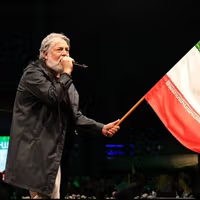
Houthi leader: delay in response to Israel is tactical
The leader of the Iran-backed Yemeni Houthis stated on Thursday that their delayed response, along with that of Iran’s other regional allies, to Israel’s recent actions was “purely tactical.”
He emphasized that the goal is to deliver a “genuinely impactful response,” taking into account the preemptive defense measures implemented by Israel and the US.
“The decision to respond is made collectively, at the level of the entire axis [of resistance],” he noted. Axis of resistance refers to Tehran-backed proxy forces in the region, including Palestinian militant groups, the Syrian regime, the Lebanese militant group Hezbollah, and other factions.
Iran’s President Masoud Pezeshkian has nominated sanctioned human rights offender Esmaeil Khatib to continue as Iran’s Minister of Intelligence as he forms his new administration.
IRGC-affiliated Tasnim News reported that Pezeshkian’s proposal will be submitted to the Iranian Parliament for a vote of confidence.
Khatib, sanctioned by the US Treasury Department, was first designated on September 9, 2022 “for having acted or purported to act for or on behalf of, directly or indirectly the MOIS [Ministry of Intelligence and Security].”
In another round of US sanctions on Khatib on September 22, 2022, Khatib, alongside Iran’s Morality Police and its senior leaders, was added to the US Treasury’s list of individuals for “being a person acting on behalf of the Government of Iran who is responsible for or complicit in, or responsible for ordering, controlling, or otherwise directing, the commission of serious human rights abuses against persons in Iran or Iranian citizens or residents, or the family members of the foregoing, on or after June 12, 2009.”
Khatib has also threatened the London-based Iran International news network. In an interview published on Supreme Leader Ali Khamenei's website, he said: "England will pay for the measures it has taken to make Iran insecure and [the] Iran International network is recognized by Iran as a terrorist organization and its operatives and affiliates will be pursued."
Khatib's comments came in November 2022 at the peak of Iran's nationwide Woman Life Freedom protests, one year after he was nominated the position under the Ebrahim Raisi administration.
Sparked by the death of 22-year-old Mahsa Amini in morality police custody for alleged hijab violation, Iranian state security forces killed over 500 protesters including teenagers and children with tens of thousands of arrests.
Last year, the offices of Iran International had to temporarily relocate to Washington as the UK's security authorities said they could not guarantee the staff's safety.
Iran’s Intelligence Ministry has also been sanctioned by the US for “its support to multiple terrorist groups and for being responsible for, or complicit in, the commission of serious human rights abuses against the Iranian people.”
Hamas leader Yehya Al-Sinwar looks on as palestinians Hamas supporters take part in an anti-Israel rally over tension in Jerusalem's Al-Aqsa mosque, in Gaza City October 1, 2022.
Yahya Sinwar, Hamas's leader in the Gaza Strip and now its political chief, has vowed to never cut ties with Iran as he takes over from assassinated political leader Ismail Haniyeh.
In a speech to Palestinian youth in Gaza, Sinwar said, "we will never cut our relations with Iran and other parties."
Iran is one of Hamas's biggest sponsors, funding the group designated by countries including the UK and US with at least $100m a year. Iran also gives Hamas military training, weapons and strategic support.
Sinwar, the architect of the October 7 atrocities in which over 1,100 mostly civilians were murdered in Israel, asserted that no force could disarm Hamas, explicitly rejecting any notion of peace talks that would lead to the recognition of Israel.
Al-Mayadeen News Network reported him as saying, "We are fighters for the liberation of Palestine and revolutionaries for granting freedom to our nation. We fight against the occupiers according to human rights laws and will continue to strengthen our military power to protect our people."
Haniyeh, assassinated in Tehran last week, had personally cultivated the deep ties with Iran all the way up to its Supreme Leader, since taking the political helm in 2017.
Unlike Haniyeh, who lived between Turkey and Qatar, Sinwar is in hiding in Gaza's 5,000km network of tunnels and unable to undertake the high level meetings afforded to Haniyeh, who on the day of his assassination boasted of his freedom of movement.
Iran’s involvement with Hamas is part of a strategic partnership aimed at extending Tehran’s influence across the Middle East and also part of the Supreme Leader's plan to eradicate the Jewish state, Iran's archenemy.
Iran is reluctant to engage in a war with Israel due to its severe economic challenges in spite of the brazenness of the assassination on Iranian soil which has brought embarrassment to Tehran's security apparatus.
Within the past week, Iranian officials have upped the ante and threatened to take definitive revenge for the assassination of the Hamas leader. However, warnings by world powers and a recent report of internal strife between the newly elected President Masoud Pezeshkian and Supreme Leader Ali Khamenei suggest that Iran has seemingly backed down from its harsh rhetoric of revenge.
In a recent meeting with Supreme Leader Khamenei, President Pezeshkian urged the 85-year-old ruler to prevent any direct Iranian attack on Israel to avoid escalating tensions into an unwanted war, informed sources told Iran International. Pezeshkian warned that such a conflict could severely disrupt his presidency and lead to significant problems at home.
Pezeshkian cautioned that an Israeli decision to launch harsh retaliatory attacks against Iran's national infrastructure and energy resources could cripple the Iranian economy and potentially lead to the country's collapse in a time when the government faces immense challenges to its legitimacy.
According to a report by Politico on Wednesday, Iran may be rethinking launching a multi-pronged attack on Israel, US officials say. The Biden administration has in recent days worked through diplomatic channels, bringing in its Middle East allies to lobby Tehran to reconsider moving forward with a military attack on Israel. They’ve warned Iran that a massive strike would only inflame tensions and risk a direct confrontation between the two countries, two senior US officials said.
However, with Iran's proxies surrounding Israel, there are now increasing chances that military retaliation will come from one of Iran's militant groups such as Hezbollah in Lebanon or the Houthis in Yemen.
US officials have sent messages to Tehran through various intermediaries that if the attack that killed Haniyeh was caused by a covert Israeli operation and did not kill any Iranian citizens, then Iran should reevaluate its plan to launch a military attack on Israel.
The officials said they now think Tehran has recalibrated with the US not expecting an attack on Israel imminently.
However, the talk from Tehran remains defiant. Iran’s permanent mission to the UN said in a statement on Wednesday, “We have pursued two priorities simultaneously: first, establishing a durable cease-fire in Gaza and the withdrawal of the occupiers from this territory; second, punishing the aggressor for the assassination of martyr Haniyeh."
Retired diplomat Qasem Mohebbali warned that “any retaliation causing fatalities could lead to serious conflict. In such a war, Israel will not be alone, and the entire West, led by the US, will support Israel."
He told Roydad24 on Thursday that a potential war would bring back UN sanctions and create harsher conditions domestically. He says, "The JCPOA and nuclear agreement are still in limbo. We must accept our commitment to a peaceful nuclear program as an NPT member. The only way is to reach an agreement with the West, the IAEA, and the US and avoid war."
He said that Iran should neither be "influenced by regional extremist groups" or fall "into the criminal Israeli government's trap".
He said, "These governments thrive on war. For a secure Iran, we need a secure Middle East."
Australian Greens Leader in the Senate Larissa Waters has taken political sponsorship of Iranian labor activist Sharifeh Mohammadi, who has been sentenced to death.
In a letter addressed to the Embassy of the Islamic Republic of Iran in Australia, Waters expressed deep concern over reports indicating that since Mohammadi's imprisonment in December 2023, she has been subjected to physical and mental torture, endured months of solitary confinement, and has been denied visits from her family, including her young son.
The death sentence for Mohammadi, a labor activist imprisoned in Iran on trumped-up charges of armed rebellion, has sparked widespread condemnation from activists. They maintain that the sentence is based on the pretext of her membership in an independent, public, and legal labor organization from a decade ago, highlighting the perceived unfairness of the verdict.
In her letter, Waters requested an urgent update on Mohammadi's welfare and case status and added that it is critical that Mohammadi is "granted an unbiased trial and that the death sentence is overturned immediately."
An IRGC-linked newspaper has criticized President Masoud Pezeshkian for the "consequences" of his repeated statements that Supreme Leader Ali Khamenei will be heavily involved in the appointment of his cabinet.
Pezeshkian, who is expected to present his cabinet to Parliament for a vote of confidence in the coming days, possibly on Sunday, has, along with his newly appointed parliamentary liaison Shahram Dabiri, emphasized that he will consult with Khamenei and secure his “approval” for the nominees before submitting them to Parliament.
Pezeshkian has consistently emphasized that his policies will be shaped by the overarching directives set by Khamenei. He also insists that his administration’s performance should be judged on how closely officials adhere to these guidelines and how effectively they utilize the resources at their disposal.
However, an editorial note in Javan newspaper Wednesday saidthat Pezeshkian's statements about getting Khamenei's approval “can provide excuses to certain people to avoid bearing responsibility for ministers’ performance” and to shift “responsibility and [need for] accountability” to Khamenei.
It has long been understood that no president can form a government without Khamenei's approval of individual candidates. However, Pezeshkian has taken an unprecedented step by openly emphasizing this reality, making it clear that Khamenei also shares responsibility for the administration's performance. This tactic sets him apart from his predecessors, who typically kept such matters behind closed doors.
“Such an approach, obviously, cannot be right neither politically nor ethically,” the Javan editorial charged. It also maintained that Khamenei does not get involved in “executive affairs” or “interfere in other entities’ activities” claiming that he even avoids interfering when directly requested to express his opinion.
Similar accusations are widely made by hardliners and ultra-hardliners on social media against Pezeshkian and his right-hand man, Mohammad-Javad Zarif, who he appointed to the newly created position of ‘strategic deputy’ last week to the huge disappointment of his critics.
“No president’s cabinet should be evaluated on the basis of the approval or disapproval of the Leader of the Revolution,” the Javan editorial argued while stressing that the responsibility for the performance of government officials only lies with the president.
“Opposition to and criticism of no minister can be taken as opposing the Leader,” Javan wrote referring to the very high possibility of strong opposition of the hardliner-dominated parliament in the review process of some of Pezeshkian’s proposed candidates.
However, while tightly controlling the core of the regime, Khamenei usually pretends he is not involved in the decisions and actions of the executive branch and tries to avoid responsibility for failures.
“We are certain that appointment to these positions will not be possible without consultation with the Supreme Leader,” Alaeddin Boroujerdi, a veteran conservative lawmaker and former head of the Parliament’s National Security and Foreign Policy Committee, said last week.
Pezeshkian is the first Iranian president to inform the public of such a step in the formation of the cabinet and to say he would discuss not only candidates for these five positions but also all others with Khamenei.
Javan’s editorial also referred to “some pessimists” who believe that Pezeshkian’s parliamentary deputy highlighted the Leader’s involvement in the selection of the ministers to put pressure on the Parliament and limit lawmakers’ independence.
Pundits say highlighting Khamenei’s role in setting guidelines for the government and shedding light on his deep involvement in the selection of its officials is indeed a step towards transparency and would allow the president to be held only responsible for what he has freely and independently chosen to do.
German newspaper Bild published in a piece on Wednesday titled "Mullahs threaten attacks on 22 Israeli targets," predicting that it is no longer a question of whether Iran will bomb Israel but rather when they will order the attack.
The report appears to draw from a state-affiliated Iranian website, Defapress, which detailed potential targets that the "Resistance Front," an alliance of Iran-sponsored militias including Hezbollah, could strike in Israel.
These targets purportedly include vital oil and gas fields, power plants, military bases, and government buildings in Jerusalem and Tel Aviv, including the Knesset parliament building and Prime Minister Benjamin Netanyahu's office. Additionally, they include three airports and three ports.