Saudi wealth fund makes $36.8B profit, outshining Iran's oil revenues
Model of petrol pump is seen in front of US and Iran flag colors in this illustration taken March 25, 2022.
Saudi Arabia's Public Investment Fund (PIF) reported a profit of 138.1 billion riyals ($36.81 billion) for 2023, a significant turnaround from the $15.6 billion loss it posted a year earlier.
The leap highlights the kingdom's successful diversification of its economy away from oil dependency, driven by the Vision 2030 plan.
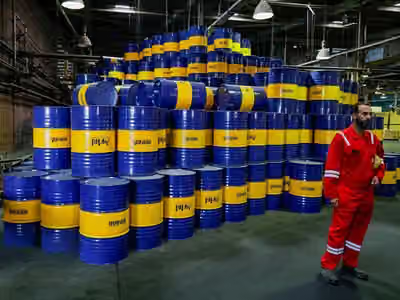
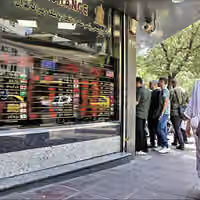
In contrast, Iran's economy continues to suffer under the weight of international sanctions, which have crippled its oil revenue streams. Iran's annual oil revenue stands at around $37 billion, almost on par with Saudi Arabia's PIF profit, but the actual cash income from crude exports to China remains undisclosed, raising suspicions about the transparency and efficiency of Iran's economic and oil export policies.
Total revenues for PIF more than doubled to $88.3 billion last year from $44 billion in 2022, driven by improvements in investment and non-investment activities across sectors such as banking, telecommunications, and gaming. Increased dividends also played a significant role in the growth. This diversification showcases Saudi Arabia's strategic approach to reducing its reliance on oil, which contrasts with Iran's continued dependence on fossil fuel revenues.
Iran's National Development Fund (NDF), established in the early 2000s to save part of oil revenues for future generations, has seen its reserves depleted. Iran's autocratic policies and economic mismanagement have led to repeated withdrawals from the NDF, especially during times of international sanctions. Despite the NDF's original purpose, the fund has been used to offset the country's budget shortfalls, highlighting a lack of foresight and planning.
Saudi Arabian flag with stock graph and an oil pump jack miniature model are seen in this illustration taken October 9, 2023.
With around $925 billion in assets under management, PIF is Crown Prince Mohammed bin Salman's chosen vehicle to drive an ambitious economic agenda aimed at diversifying Saudi Arabia's economy. The Vision 2030 plan has funneled hundreds of billions of dollars into projects like NEOM, a massive urban and industrial development along the Red Sea coast. This project alone aims to create a high-tech hub nearly the size of Belgium, underscoring the kingdom's commitment to a future less dependent on oil.
Critics argue that Iran needs to shift towards knowledge and technology to create a sustainable economic model. However, research investment in Iranian companies remains below one percent, a contrast to the four percent recommended by experts. This lack of investment in innovation further hampers Iran's economic prospects.
Despite the lifting of most crippling sanctions in 2015 following a nuclear agreement, Iran continued to tap into its NDF reserves. During President Hassan Rouhani’s tenure (2013-2021), $30 billion was withdrawn. As former US President Donald Trump re-imposed sanctions, Iran increasingly relied on its reserves, resulting in a negative cash flow in the NDF. This persistent reliance on the NDF to shore up government finances has left the fund in a precarious state, undermining its intended purpose of providing for future generations.
Under late hardliner President Ebrahim Raisi, the pace of withdrawals from the NDF has only accelerated, further undermining Iran’s economic stability. His administration faced criticism for failing to implement necessary economic reforms and for continuing policies that have led to increased international isolation and economic hardship. This mismanagement stands in contrast to Saudi Arabia's strategic investments and economic reforms through the PIF, which showcase a forward-thinking approach that has strengthened its financial standing on the global stage.
The Iranian government's prioritization of its nuclear program and regional proxy conflicts over domestic well-being has left the country economically vulnerable and politically isolated, while its regional rival Saudi Arabia looks to a future of more investments and growth.