An Iranian woman walking past a huge mock ballot box in Tehran (June 2024)
Many Iranians are still deliberating whether to boycott the "neither fair nor free" elections or to vote. The only candidate with the potential to sway some of these voters appears to be the pro-reform Masoud Pezeshkian.
Pezeshkian’s chance of being elected as the Islamic Republic’s next president largely depends on a high voter turnout. However, predicting public sentiment for the June 28 election is challenging due to the lack of reliable and independent surveys. So far, there is little evidence on social media or from reports inside Iran to suggest a shift in the public’s generally indifferent attitude toward the elections.
Three government agencies – the intelligence and interior ministries and the state broadcaster (IRIB) – conducted separate surveys in all previous elections. Results were not publicly announced but were often leaked to the media which referred to them only as “poll by a reliable state agency”.
In these elections, however, poll results are being tightly guarded, likely to prevent evidence of a possible low turnout from reaching the public. Authorities have also warned about unofficial online polls, labeling them as “falsified,” and have arrested at least twenty people for conducting such polls.
At this stage, former nuclear negotiator Saeed Jalili and newly re-elected speaker of the parliament, Mohammad-Bagher Ghalibaf, both of whom are hardliners, appear to be the strongest contenders with Pezeshkian closely following them in most unofficial, online polls.
Pezeshkian supporters in Sanandaj
Pundits say Pezeshkian has a chance of winning against his rivals if both hardliners remain in the race and around 60 percent of eligible voters go to the polls. Jalili and Ghalibaf have both insisted that neither will withdraw in favor of the other.
The chances that the three other candidates -- hardliners Alireza Zakani and Amir-Hossein Ghazizadeh, and conservative Mostafa Pourmohammadi – make a significant difference in the outcome of the elections is too small unless they withdraw in someone else’s favor, pundits say.
Pezeshkian, an independent politician with views close to reformists, is being supported by the Reforms Front and some moderate conservatives, including former Foreign Minister Mohammad-Javad Zarif. In the three highly controlled debates aired by the state television so far, Pezeshkian has presented a rather conservative image.
Zarif announced his support for Pezeshkian on June 17 and accompanied him to the second televised debate of the candidates where he delivered a fiery speech. Zarif’s support could increase Pezeshkian’s popularity among some of the voters but also has the potential to damage his position among other groups of the Iranian society.
Since then, he has actively promoted Pezeshkian on social media, Club House discussions and campaign meetings. Zarif also traveled to Kashan in central Iran on Friday where ultra-hardliners tried to disrupt his speech.
Pezeshkian supporters in Shiraz
In the past few days Pezeshkian’s popularity appears to have increased on social media. Google Trends also suggests he has been looked up more than the other candidates by more people since the first televised debate.
On Saturday, Pezeshkian received a rather warm welcome in Sanandaj, the capital of Iran's Kordestan Province, and then in Shiraz, the capital of Fars Province. Thousands also gathered for his speech in Ahvaz, the capital of the oil-rich but poverty-stricken province of Khuzestan, in the evening of the same day.
In Shiraz, thousands of supporters filled the stadium where he spoke, reiterating his promises to fight for social freedoms and try to solve the problem of crippling sanctions and corruption.
These, some Iranian social media users say, are only empty promises because they believe it is Supreme Leader Ali Khamenei who has the final say in all matters of importance and there are other centers of power, including a hardline dominated parliament and the Revolutionary Guards (IRGC), that can sabotage Pezeshkian’s efforts as they did when Hassan Rouhani was president.
Pezeshkian supporters in Ahvaz waiting for his arrival outside a packed hall
Those in favor of boycotting elections also argue that voting for Pezeshkian, whether he merits being chosen president or not, is tantamount to acknowledging the legitimacy of the Islamic Republic and its elections that they believe are “engineered”.
Others say he is not so different from the other candidates and politicians because throughout his campaign he has insisted in his speeches and election debates that if elected, he will not introduce any new economic plans and only carry out the existing ones that have been “approved” by Khamenei.
Critics also say Pezeshkian, 70, is out of touch with the younger generation who were the driving force of the anti-government protests of 2022-23.
Pezeshkian appears to be betting on the votes of ethnic groups and the Sunni minority who are mainly Kurdish, Turkmen and Baluchi speakers.
He has advocated the teaching of Turki, the Turkic dialect spoken in Iran's East and West Azarbaijan provinces, as well as other ethnic languages such as Kurdish in schools and says he will champion the rights of all ethnic groups and the Sunni minority.
Pezeshkian was born to a Kurdish mother and Azari father in the Kurdish city of Mahabad and is fluent in Turki and Kurdish languages. Some of Pezeshkian’s campaign posters have been printed in these two languages and he delivered part of his speech in Sanandaj Saturday in Kurdish.
An Iranian newspaper has denounced the arrest of four journalists during the presidential election campaign, suggesting that it was orchestrated by "one conservative candidate," further dampening public interest in voting.
In an article published on Saturday, the newspaper singled out Parliament Speaker and presidential candidate Mohammad Bagher Ghalibaf, detailing how three of the arrested whistleblowers were directly involved in exposing cases pertinent to him.
Experts interviewed by Ham-Mihan daily in Tehran opine that these measures, seemingly intended to silence whistleblowers and bolster Ghalibaf's candidacy, have ironically backfired, as the whistleblowers are well-known figures, making the actions appear more like attempts to suppress dissent.
“In recent years, these detained journalists have disclosed information concerning one of the candidates, which appears to hold validity. In addition, they were arrested during the election period. As a result, it has fueled speculation that the arrests were orchestrated to benefit one of the primary fundamentalist candidates in the elections,” Kambiz Nowrouzi, a lawyer, told Ham-Mihan.
“In my view, this action serves neither the interests of the Judiciary nor those of the candidate they aim to help. Instead, it exacerbates the crisis, prompting questions about why punitive measures are being taken now rather than earlier,” Iranian journalist and political activist Abbas Abdi told Ham-Mihan.
"The failure to address [whistleblowers'] revelations could precipitate a crisis that akin to a last-minute blow significantly undermines the electoral atmosphere," Abdi said.
Meanwhile, Ghalibaf has denied the allegations, explaining in an interview, "These cases have been through various courts, with private plaintiffs involved. I did not personally file complaints against the media."
The individuals detained include journalists and whistleblowers Vahid Ashtari, Yashar Soltani, Saba Azarpeik, and Hadi Kasaeizadeh.
Security forces arrested social media activist and whistleblower Vahid Ashtari to begin serving his jail term shortly after the release of documents implicating Galibaf on Thursday. Ashtari has publicly exposed corruption allegations against Ghalibaf and his associates. In April 2022, Ashtari’s revelations triggered the Layette-gate scandal, prompting calls for Ghalibaf’s resignation and renewed scrutiny of alleged corruption involving his family.
Earlier this month, the judiciary detained journalists and whistleblowers Saba Azarpeik and Yashar Soltani to serve pending sentences.
In 2016, Memari News, led by prominent whistleblower Yashar Soltani, reported that Lavizan Park in Tehran had been closed for several days to host the wedding celebration of Ghalibaf's daughter while he served as mayor. The report detailed how municipal resources were used, including illuminating the park at the expense of local authorities in Tehran's fourth district.
In 2019, Soltani was incarcerated for uncovering financial irregularities within the Tehran Municipality during Ghalibaf's tenure and for disclosing information about the wedding.
The husband of imprisoned journalist Saba Azarpeik alleges that conservative politician Ghalibaf, along with former MP Mohsen Dehnavi, initiated legal action against her.
Hadi Kasaeizadeh, editor-in-chief of Meydan-e Azadi Monthly, was arrested on Friday. He had been accused of “disclosure of particulars surrounding Nika Shakrami's death, a 16-year-old murdered by the Iranian security forces in 2022 amid nationwide protests.
“While the frequent occurrence of journalist arrests has become commonplace in the country's news cycle in recent years, the timing of such arrests on the eve of the presidential election casts a somber shadow over the forthcoming event. It can potentially stir up suspicions and rumors that specific election candidates may be attempting to conceal information or suppress dissenting voices,” Ham-Mihan wrote.
Over the past week, the Iranian government has been actively encouraging reluctant voters to engage with the presidential election campaigns for the six hand-picked candidates featured on state TV.
Nonetheless, the latest polls in Iran show that some 60 percent of eligible voters are still adamant not to take part in the June 28 election. Also, a new survey conducted by one of the country's most reliable polling agencies ISPA, resulted in total embarrassment for the government as it showed that more than 73 percent of Iranian chose not to watch the televised debatesbetween the candidates.
Voter turnout began to decline in the 2020 parliamentary elections, when hundreds of insider politicians who did not belong to the hardliner camp were barred. The same politically motivated vetting by the un-elected Guardian Council was repeated in the 2021 presidential and the March 2024 parliamentary elections. From a high of 70% in 2017, turnout has declined to around 40%.
The government has tried many tricks and techniques to grab TV viewers' attention including a sneak preview of candidates' family life by bringing the daughters of the candidates to the studios to talk about their father and other matters. Massoud Pezeshkian, Mostafa Pourmohammadi and Mohammad Bagher Ghalibaf sent their daughters to state TV studios.
Pourmohammadi's daughter Monireh, outshined the other two as a Ph.D. candidate in Economics who explained her father's economic policies.
In an odd behavior, Saeed Jalili sent his likeminded former chief of staff at the Supreme Council of National Security, Amir Hossein Sabeti, now one of the new "revolutionary" lawmakers, instead of his daughter. Persian social media burst into all kinds of jokes and ironiesabout the episode.
Even more significant than the fight is the fact that the hardliner-dominated state TV, where Jalili's brother happens to be in charge, allowed a personae non grata like Fazeli to enter its live TV studios.
If this seems odd, consider that selected intellectuals and commentators are now being allowed to give interviews to Persian-speaking satellite channels outside Iran about the elections. Previously, they were warned that speaking to those channels was illegal and could land them in jail.
One well-known outspoken commentator told Iran International that authorities approached him, saying it was now permissible to talk with foreign-based television channels. He agreed to do so only if they provided a written guarantee that he would not be punished or criticized for it after the election. Unsurprisingly, the guarantee never materialized.
Another commentator, a leading reformist figure, told a London-based channel that the government gave the commentators the go ahead to talk to the foreign-based channels to prepare the mood for a high turnout in the election.
Despite all this and more, the Iranian state TV cannot be certain by any means that it can help attract more attention to the election and encourage voters to go to the polls. The 73 percent that did not watch the first debate on TV are only some of the viewers who do not trust the broadcaster. The state TV's viewership has been constantly decliningduring recent years.
A drone aiming for a US military base in Syria's Al-Tanf was intercepted and destroyed on Saturday, months after Iran-backed militants suspended such attacks following the deaths of three US troopers in an attack on a nearby base.
The Al-Tanf base, located within a 55-kilometer exclusion zone at the convergence of the Syrian, Jordanian, and Iraqi borders, engaged its air defenses after the drone ventured in from the east, the Syrian Observatory for Human Rights reported on Saturday.
The incident occurred less than 24 hours after airstrikes that hit an Iranian-backed militia in the Al Bukamal area near the Syrian-Iraqi border, reportedly killing one and injuring two militants.
While no group has claimed responsibility for the drone attack on the US base, such assaults are typically claimed by the Islamic Resistance in Iraq, a coalition of Tehran-backed militants.
The ongoing strikes underscore the escalating tension between US forces and Iranian-supported groups in the region.
The groups have been criticized for their recklessness, which led to a regional flare-up in January when a drone strike by the Islamic Resistance in Iraq killed three US troops in a US base in Jordan, close to the one in Al-Tanf.
The breach of several regional and US red lines prompted a response involving a series of US airstrikes across Iraq and Syria.
The risk of escalation became so serious that the commander of Iran's elite Quds Force made a trip to Baghdad to instruct the factions to reduce their attacks, according to Iranian and Iraqi sources who spoke to Reuters.
Following the intervention, there was a temporary cessation of attacks on US forces. However, after a brief period of calm, the focus of the attacks shifted towards Israel.
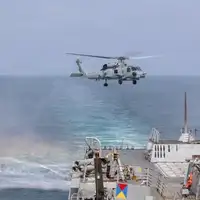
Yemen's Iran-backed Houthi rebels say they have attacked the US aircraft carrier USS Eisenhower in the Red Sea, but the US says the claim is false.
A US official told Reuters that the claim by the rebel group is false, and no such attack has been carried out.
On Saturday, the Yemeni Houthi group announced that its forces had launched attacks on the US aircraft carrier Eisenhower in the Red Sea and the "Israeli-linked" Transworld Navigator ship in the Arabian Sea.
The exact timing of the attacks was not specified.
According to a statement from the Houthis, the Transworld Navigator was struck directly by a missile.
The group also declared that the operation targeting the Eisenhower had successfully met its objectives, though further details were not provided.
The Houthis' claim comes on the same day as the US Central Command has announced the return of the Eisenhower Carrier Strike Group (IKE CSG) to the United States.
"After flying over 30,000 hours and sailing more than 55,000 miles, the IKE CSG has shown our dedication to regional stability and safeguarded freedom of navigation across the Red Sea and Gulf of Aden," the command stated in a tweet on Saturday.
The Houthis have increased their maritime assaults, including the recent sinking of the ship Tutor, marking a new phase in their strategy against international shipping routes since the beginning of the Israel-Hamas conflict in Gaza.
The attacks began after Iran's Supreme Leader Ali Khamenei called on Muslim nations in early November to blockade Israeli trade in the wake of the Gaza war.
The Houthis claim over 60 targeted attacks on vessels and numerous other missile and drone launches since November, leading to the deaths of four sailors and the capture or sinking of several ships.
Despite Houthi claims of targeting vessels connected to Israel, the US, or Britain, many of the attacked ships reportedly have minimal or no links to the Israel-Hamas war. In response, a US-led airstrike campaign has been targeting Houthi positions since January.
The Biden administration has once again permitted Iran's government to establish absentee ballot stations across the US for the upcoming Iranian presidential election on June 28.
The decision, first reported by the Voice of America, has sparked outrage among critics who view it as legitimizing the Islamic Republic’s "authoritarian rule".
Alireza Mahmoudi, an official from the Iranian Foreign Ministry, earlier confirmed plans to set up 30 voting locations, including at venues such as the Iranian Interests Section at the Pakistani embassy in Washington DC and a location in New York.
The move comes despite the US State Department’s acknowledgment that Iran’s elections are "neither free nor fair", as it only allows candidates loyal to Supreme Leader Ali Khamenei to run.
"Preposterous. The concept of a free and fair election under the Islamic Republic is a fallacy," said Iranian-British activist and actress Nazanin Boniadi.
"While regime opponents are advocating for a boycott, the US inexplicably permits absentee ballots for this farce?" she added in reaction to the Biden administration's decision.
The locations for these ballot stations have raised further concerns. In 2021, several US and British hotel properties and Islamic centers were used as polling stations, though there is no confirmation if these venues will be used again.
Critics, including Cameron Khansarinia, vice president of the National Union for Democracy in Iran (NUFDI), argue that those participating in and operating these stations should be “publicly shamed” for their role in supporting what many consider a “sham election”.