Saeed Jalili registering as presidential candidate on May 30, 2024
Iran's handpicked presidential candidates are facing scrutiny from the media and social media users for their unrealistic plans, promises, and the false claims their supporters have made about their character.
Most criticism on social media revolves around former nuclear negotiator Saeed Jalili and his rival, Parliament Speaker Mohammad Bagher Ghalibaf. Both candidates hail from the so-called “Principlist” or hardliner camp, but their supporters are currently fighting an intense war on social media.
Jalili, for instance, has been widely criticized for promising voters to remedy “hundreds of years of lack of development in a few years” in contradiction to his statement less than two years ago that “enemies” were worried by Iran's progress because it was “near the peak”.
“What has happened close to the election time that we are [now] not only not close to the peak but are also hundreds of years behind, so people must vote for you to compensate?” the moderate conservative Asr-e Iran news website asked him.
Jalili with former president Ebrahim Raisi in August 2021
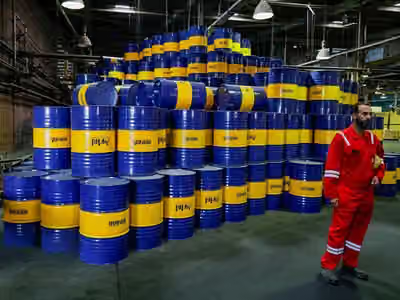
Jalili is also widely accused of proposing unrealistic plans with huge confidence. In a televised program, he claimed that Iran would not need to sell oil if it built “ten oil refineries” like the Persian Gulf Star Oil refinery with private sector investment.
Critics say Jalili must be ignorant of the fact that the said refinery processes gas condensates, not oil, and that hundreds of billions of dollars of investment is required for such massive projects. The private sector, they argue, has no interest in such projects and would rather invest in other countries where investment is safer and more profitable than in Iran.
Ghazizadeh-Hashemi, another ultra-hardliner candidate, similarly contended in a television discussion with experts that Iran must be one of the “global producers of the Internet”.
Jalili’s campaign has also been widely criticized for “hypocritically” emphasizing his “very simple lifestyle” because his supporters claim he drives a domestically produced vehicle instead of a luxury car, or commutes by public transport with no bodyguards.
Critics, however, have posted photos of Jalili that prove he has been using not one, but at least three different vehicles of the same make and color with different registration numbers in the past few days. Some also claim his very ordinary-looking vehicle has in fact been bulletproofed.
Recent comments by Jalili’s advisers including the newly elected lawmaker Amir-Hossein Sabeti have also stirred great controversy. Sabeti who has joined Jalili’s campaign and participates in televised and radio discussions alongside him or on his behalf earlier this week unintentionally disclosed information not meant for the public’s knowledge.
All lawmakers are struggling in the parliament because there are no foreign currency to pay for importing gasoline, he said. “Blackouts will begin in a couple of weeks because we have no power plants,” Sabeti who blamed the Rouhani administration for the shortages said.
Critics say Sabeti describes the situation as if the country is in a “state of war” and argue that those from the rival camps would have been accused of undermining national security if they had made similar disclosures. In fact senior regime officials and clerics have repeatedly said that candidates should not exhibit negativity about the country in their campaigning.
Besides abundant criticism and allegations of corruption against him, Speaker Mohammad-Bagher Ghalibaf’s advisers have also provoked strong criticisms in the past few days by making false claims and condescending remarks about others.
When speaking of government employees, Ghalibaf’s economic adviser, Amir-Sayyah, accused them of ignorance and wasting their time for a meager salary instead of running their own businesses. Sayyah had to release a video to claim he was only speaking about “corrupt civil servants” but did not apologize.
A key question is whether 'moderate' candidate Masoud Pezeshkian can motivate reform-minded and other voters, who have abstained from voting in the last three elections in Iran, to return to the polls.
The six handpicked candidates in the upcoming presidential election, including Pezeshkian, have yet to offer any new or interesting solutions to potential voters about reversing their declining economic well-being.
Pezeshkian's candidacy raises questions about whether he represents the Iranians who have become disillusioned with the government after several rounds of protests and violent confrontations in recent years. There is uncertainty about whether voters will trust him after so many years of the government barring all hundreds of candidates from elections. His sheer presence might not be enough to bring disillusioned voters back to the polls.
The situation has plunged Iranian society into deep despair about their demands not being met by the government and concerns about the future of the country. Desperation and protest have been the main characteristics of Iranian society since 2017 when the first in a series of large protests began. These sentiments have led to the lowest voter turnouts in the history of Iranian elections over the past 45 years.
Presidential candidate Masoud Pezeshkian during a campaign event in Tehran (June 2024)
Yeganeh acknowledged voters' frustration with the electoral process but emphasized that voting and pursuing gradual reforms remain the only solutions. Meanwhile, Armaki argued that intellectuals must convince the public that gradual reforms can be effective; otherwise, Iranian society risks a dangerous collapse.
Yeganeh said that as a result of the government's approach to elections Iranians have lost hope in political change through voting. He reiterated that forecasts indicate a low turnout in the upcoming election. The expectations are about a maximum turnout figure of around 50 percent of eligible voters, he said, adding that reformists have lost a major part of their vote basket anyway. The voters know that the candidates are not going to be able to meet their promises about improving the people's situation.
He also said that it is difficult to rebuild the ties between the people and the government. Yeganeh added that if the reformist figures who want to vote do not say that loud and clear during the next week, the turnout will hardly reach 50 percent.
Meanwhile, Dr. Armaki said that a large part of the society no longer listens to the government due to increasing dissatisfaction. They ask themselves why they should interact with a government that does not pay any attention to their problems. Even if they decide to vote at the last moment, that will not change anything.
Armaki added that Iranians have been demanding change during at least the past 15 years. If Pezeshkian can present himself as the advocate of change while other candidates advocate the status quo, then he might have a chance.
This comes while many voters who are vocal on social media do not believe in Pezeshkian's abilities as a change maker. Some social media activists criticize him for not responding to some questions and saying that experts will tackle them. Arash Sepehri wrote: "No one expects him to be an expert on everything. He is surrounded by experts with often conflicting ideas about the economy."
Another social media activist and journalist, Mohammad Parsi criticizedall of the candidates about their views on a variety of matters, "From distribution of meat in the market to eliminating the filtering of social media and sorting out the problem of housing. You are presenting the bare essential needs as dreams and promises." He charged that "after 45 years, the candidates have given up the dream of turning Iran into an Islamic Japan, instead becoming the North Korea of the Middle east!"
Yet other social media users, mocked Pezeshkian for responding to a question about his economic plans with a long verse in Arabic that would make sense to very few Iranians as Persian speakers. In the video that went viral, even the interviewer, a seasoned businessman and former Trade Minister Yahya Al-e Es'haq, looks bewildered by the answer, let alone the man in the street who probably does not know there is going to be an election soon.
In the lead-up to Iran's presidential election, candidate Mohammad Bagher Ghalibaf has laid out a foreign policy that continues to bear the hallmark of Tehran's war-mongering.
Parliament speaker Ghalibaf, building on policies from the Ebrahim Raisi administration, insisted in a televised debate that "regional authority" is the cornerstone of Iran’s foreign relations, a stance that may further isolate Iran internationally amidst an ongoing war led by Iran's proxies.
He said, "Our issue is Iran and Iran's positioning in international relations," suggesting a focus on strengthening the so-called 'axis of resistance, Iran's terror proxies such as Hezbollah in Lebanon and the Houthis in Yemen.
With Hezbollah currently at war with Israel and the Houthis blockading the Red Sea region in support of Iran-backed Hamas's war with Israel in Gaza, his campaigning shows a certain continuation of Iran's warmongering.
Iran's Supreme Leader, Ali Khamenei, founded the proxies in a bid to fight Iran's archenemy Israel and the West and any presidential hopeful must be sure to align with the theocratic dictator's policies in order to succeed in the upcoming June 28 poll.
Though he did not give details of how he proposed this, the former military officer also promised to leverage negotiations to ensure the lifting of global sanctions in a way which is "real and measurable," focusing on revitalizing oil sales, banking operations, and foreign trade.
”Given that we are under sanctions, priority should be given to small companies to lift the sanctions, as they provide us with good capacities," he said, as Iran continues to find ways to evade international sanctions. Iran has been sanctioned for its ongoing nuclear program, human rights abuses and support of Russia's war on Ukraine.
The upcoming elections follow the sudden death last month of President Ebrahim Raisi who was killed in a freak helicopter crash along with his delegation.
Iranian journalist and political activist Abbas Abdi says a significant number of Iranians are not inclined to vote in the snap presidential elections on June 28, disillusioned with the political system.
In an op-ed for the Etemad newspaper on Sunday, Abdi stated, "the ice of boycotting the elections has not yet begun to melt.”
He added that “one should not need to provide reasons or arguments for not participating, but rather, reasons and analysis are required for deciding to participate.”
The sentiment underscores the broader public dissatisfaction that was evident during the historically low turnout in the March parliamentary elections. Many Iranians, disenchanted with continuous economic struggles and government oppression, feel alienated from the political process. Key issues fueling voter apathy include rampant inflation, crackdowns on protests and dissent, and a pervasive sense of ineffective governance.
Since 2020, the core of the clerical regime loyal to Supreme Leader Ali Khamenei have barred other insider from running in elections, giving control of the parliament and the presidency to hardliners. Seeing little choice among candidates, voters have stayed away, bringing participation well below 50%.
With the presidential election approaching following the sudden death of Ebrahim Raisi in helicopter crash, the lack of enthusiasm suggests that many in Iran continue to see no value in participating in what they perceive as a flawed and predetermined electoral system.
The system faces a challenge in convincing a disillusioned populace that their votes matter and can lead to tangible changes, a task made even more daunting in the current climate of widespread discontent and economic hardship.
Former political prisoner Abolfazl Ghadiani has condemned proponents of reforming Iran's clerical establishment, insisting it is beyond redemption and fervently promoting an election boycott as a bold act of civil resistance.
In his analysis on the Zeitun website on Friday, Ghadiani, once an ally turned vocal adversary of Iran’s Supreme Leader, branded him a "power-loving dictator," casting his reign as a "tyrannical rule, scarred by the atrocities of the fall of 2022 and the scandalous parliamentary elections of March."
In 2022, nationwide protests, ignited by the death of Mahsa Amini in police custody and dubbed the Woman Life Freedom movement, resulted in security forces killing over 550 civilians followed by harsh crackdowns. Women and minorities endure relentless persecution, with executions surging to unprecedented levels.
Ghadiani emphasized that President Ebrahim Raisi's "unexpected" death presents a prime chance for opportunists to exploit the electoral vacuum.
The death of Raisi and his delegation, including the foreign minister, in a helicopter crash last month has precipitated a snap election slated for June 28.
Ghadiani asserted that "participation in these controlled elections won't bring any real change," underscoring that "the inefficiency of Ebrahim Raisi's government, coupled with economic and social crises, international political shifts, and the potential resurgence of the women's rights movement, has compelled Khamenei to pursue" another sham election with the hope of preventing a further decline in the regime's legitimacy.
The outspoken critic posited that these "sham elections" serve to cement the clerical establishment's grip on power and acquire international validation, potentially ushering in a semi-reformist government in a bid to reclaim lost legitimacy.
Reflecting on previous elections, Ghadiani lamented how the “ruling dictator” has "ratcheted up his purification agenda with each passing day," orchestrating elections devoid of competition and marred by predictability in the manipulated outcomes.
In recent years, Iran has seen a decline in voter turnout during parliamentary and presidential elections. Many attribute this trend to segments of the electorate losing faith in elections to address their worsening economic conditions. As a result, there's speculation that these disillusioned voters could potentially sway in favor of a 'reformist' candidate seeking change amidst challenging times.
The only pro-'reform’ candidate among the six hand-picked by the un-elected 12-member Guardian council is Massoud Pezeshkian.
“Even if the name of Massoud Pezeshkian were to emerge triumphantly from the ballot boxes and he, against all odds, earnestly endeavors to revolutionize our nation's governance, shadowy forces will swiftly sabotage such aspirations," Ghadiani wrote.
Ghadiani stated, "No government or parliament in this corrupt authoritarian structure possesses the capacity to impede the epidemic's march."
The activist implored all "democratic forces" to shun the elections and encouraged "political, civil, trade union, and cultural activists" to "seize every opportunity to denounce these sham elections."
Before the March parliamentary elections, Ghadiani issued a similar rebuke, decrying it as "staged, scripted, and engineered."
Ghadiani, 80, has been one of the most vocal and staunch opponents of Iran’s Supreme Leader over the past years. He belonged to a leftist, revolutionary group that was supporting the Islamic Republic and Khamenei until the disputed presidential election of 2009, when the Supreme Leader backed the questionable re-election of Mahmoud Ahmadinejad. Ghadiani, with many others, protested the results and was jailed to become an opposition figure.
Receiving a 10-month jail sentence in July 2023, he said he is ready to go to prison “in Ali Khamenei’s dictatorial regime.” However, he refused to attend the court session and the authorities have refrained from implementing the verdict.
The political deputy of the Islamic Revolutionary Guard Corps expressed concerns over the potential impact of low voter turnout in Iran's June 28 presidential election, attributing it to external threats.
"This issue encourages the enemy to create disturbances, meaning that when the enemy sees a low turnout, it is tempted to create challenges and can describe officials, whether in parliament or the government, as lacking popular support," stated Brigadier General Yadollah Javani.
He said that elections could either enhance Iran's strength or become a point of vulnerability: "Elections can lead to two outcomes; first, becoming a source of power generation, and second, becoming a source of challenge production."
The portrayal comes as recent elections in Iran, particularly the second round of the Parliamentary elections held in March, saw notably low participation, with only a small fraction of eligible voters in Tehran casting their ballots.
As the country prepares to hold a snap presidential election this month, such diminished electoral engagement has been largely attributed to a pervasive dissatisfaction with the political process, exacerbated by economic struggles and social restrictions that further alienate the public from the political establishment.
The situation was aggravated by the nationwide protests following the death of Mahsa Amini in police custody, which led to a crackdown resulting in over 500 deaths. These events starkly highlighted the government's repressive nature and deepened the sense of despair and disconnection from the state, prompting many Iranians to question the effectiveness of the electoral process as a means for achieving reform or influencing government policies.