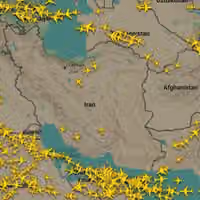
GPS Jammed as Iran's Supreme Leader Goes on Tour

GPS jamming has been seen across Iran as the Supreme Leader goes on tour amid increased security fears on the back of the sudden death of President Ebrahim Raisi.
GPS jamming has been seen across Iran as the Supreme Leader goes on tour amid increased security fears on the back of the sudden death of President Ebrahim Raisi.
Supreme Leader Ali delivered a speech at the mausoleum of Ayatollah Ruhollah Khomeini on the 35th anniversary of his death on Monday, along with other high profile figures, leading to suspicions of jammed GPS signals to protect his whereabouts.
In addition to the ongoing protests against the government, the sudden death of President Ebrahim Raisi in a helicopter crash last month has revived unease about the safety of Iran's leaders, though officially, the government says there was no foul play. Raisi died alongside the country's foreign minister Hossein Amir-Abdollahian, another key figure in the government.
The Iranian navigation app Neshan has described the incident as "the most extensive GPS disruption" recorded to date. Users in Tehran reported anomalies in their location data, with maps inaccurately showing their positions at significant distances from actual locations.
Neshan's public relations team acknowledged the disruptions but did not clarify the cause. The ongoing issues with domestic navigation services, exacerbated by the government’s ban on popular apps like Waze, have forced many to rely on local alternatives, which are now proving unreliable.
After Mahsa Amini died in a morality police detention center in mid-September 2022, sparking nationwide protests, the government responded by blocking several widely used internet services, including Instagram and WhatsApp in a bid to quash the uprising which has proved the greatest challenge to the government since the founding of the Islamic Republic.