Iran Provides Houthis with Anti-Ship Ballistic Missile: IRGC Media

Tasnim News Agency, affiliated with Iran's Revolutionary Guard (IRGC), reported on Wednesday that Iran has supplied the Houthi rebels in Yemen with the Ghadr ballistic missile.
Tasnim News Agency, affiliated with Iran's Revolutionary Guard (IRGC), reported on Wednesday that Iran has supplied the Houthi rebels in Yemen with the Ghadr ballistic missile.
The missile, described as the first Iranian anti-ship ballistic missile, is now in the hands of Yemeni fighters, enhancing their capability to target maritime vessels.
The revelation is significant as it confirms that Tehran has been arming its proxy forces in Yemen with advanced ballistic missiles.
This follows a pattern of Iran's military support to its allies in the region, further destabilizing the Middle East.
Tasnim's report also highlighted the history of the anti-ship ballistic missile's development, pointing out that Iran needs to be able to threaten US and other foreign navies in the broader Middle East.
In March, UK Defense Secretary Grant Shapps accused Iran of supplying ballistic missiles to Russia for use in Ukraine, highlighting Tehran's expanding role in global conflicts.
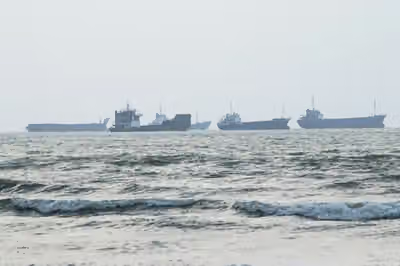
Since November, the Houthis have been using Iranian-supplied missiles and drones to attack commercial ships in the Red Sea, a critical global trade route. The attacks were initially a response to the Israeli military offensive in Gaza but have since severely disrupted maritime trade in the region.
The Houthi campaign in the Red Sea began after Iran's Supreme Leader Ali Khamenei called on Muslim nations to blockade Israeli trade.
Despite US and British military strikes on Houthi targets starting in January aimed at degrading their arsenal, the group’s attacks have continued.
The situation has been exacerbated by the expiration of UN Security Council restrictions on Iran's export of certain missiles, drones, and related technologies in October. However, the United States and European Union have maintained sanctions on Iran's ballistic missile program, citing persistent concerns over the proliferation of Iranian weaponry to proxies in the Middle East and to Russia.
This ongoing transfer of advanced military technology to the Houthis underscores the Iranian regime's commitment to extending its influence and military capabilities through proxy warfare, posing a significant threat to regional and global stability.