Prince Reza Pahlavi speaking urging global support for Iranians opposed to the Islamic Republic.
Iran’s exiled Prince Reza Pahlavi told the international community on Saturday that if diplomacy fails to resolve the current crisis in the region, the only viable option is to support the people of Iran.
The prince who is a top opposition leader, also mentioned that extremist factions on both the right and left within the Iranian opposition are hindering unity among groups with different persuasions.
While the Pahlavi family seems to enjoy a large measure of popularity in Iran, many among the Iranian opposition call themselves republicans and are opposed to the restoration of monarchy. Prince Reza Pahlavi has not advocated a return to constitutional monarchy, always insisting that after the downfall of the Islamic Republic, the people should decide the type of the democratic political system they prefer.
Prince Pahlavi was speaking in London at "The Future of Iran: Challenges and Solutions”, with several political activists in attendance in London.
At the beginning of the meeting, he stated, "The countries of the world should know that if diplomacy has failed, the main solution [to the Middle East crisis] is not military action but rather support for the people of Iran."
Israel has threatened to attack Iran's nuclear facility if the Islamic government obtains nuclear weapons, but Mr. Pahlavi in his speech ruled out the option and urged support for the people to overthrow the Islamic Republic.
An undated photo of protests in Iran
He highlighted the disagreements among the political groups opposing the Islamic Republic, saying, "In a place where we know there are differences of opinion and taste, the people will make the final decision. It is the people who will decide the future of Iran."
However, he highlighted the importance of adhering to "rules of the game," stating that there are certain basic principles, among which "human rights are the most important."
He identified a secular political system and the territorial integrity of the country as other basic principles essential for uniting Iranian secular democratic forces.
Prince Reza Pahlavi emphasized that extremist factions on both the right and left of the opposition to the Islamic Republic prevent unity among the forces opposing the current regime in Iran.
After the 2022 nationwide uprising against the Islamic Republic, the Council of Solidarity for Democracy and Freedom in Iran held its first meeting at Georgetown University in Washington DC on February 10, 2023.
This council, which included diaspora members like Prince Reza Pahlavi, Hamed Esmaeilion, Shirin Ebadi, Abdullah Mohtadi, Masih Alinejad, and Nazanin Boniadi, published its "Charter of Solidarity and Organization for Freedom" on March 10, 2023.
The council eventually disbanded due to the departure of some of its members.
Masih Alinejad, a journalist and civil activist, previously commented on the breakdown of this coalition, saying, "Not only do Westerners have this question, but the people of Iran too, wondering how foreign governments can trust an opposition that is scattered like driftwood."
In February 2024, Hamed Esmaeilion spoke to Iran International about the reasons for his withdrawal from the Solidarity Council, stating that while the majority wanted to advance plans through the formation of specialized committees, a constitution, and mechanisms, there was "resistance from Mr. Pahlavi."
However, Prince Reza Pahlavi stated, "We must be able to show the countries of the world that we are not lacking in capability and management," adding, "We can show the world that there is another way besides attacking Iran's nuclear facilities."
He referred to the changing positions of the reformist forces in Iran, saying, "Even the reformists have become disillusioned with this regime and are looking for a point of connection with the opponents of the regime. Those whose hands are not stained with the blood of the people should have guarantees for the day after the regime's collapse."
In June 2022, the son of Iran's last Shah once again called for the unity of the people to overthrow the Islamic Republic, emphasizing respect for the diverse opinions and groups of the people, saying, "We should disavow those who engage in obscenity and confront ugly behavior with obscenity."
During recent years' nationwide protests, many protesters supported the Pahlavi regime, especially the founder of the dynasty, Reza Shah, chanting slogans like "Reza Shah, may your soul be joyful."
Laleh Sa'ati, a Christian citizen detained in Iran's Evin Prison is being denied access to medical facilities and specialized examinations.
According to a report from the rights group Human Rights in Iran, a recent visit by the 54-year-old's mother revealed that her daughter is experiencing psychological issues due to her imprisonment conditions.
The group claims, "The prosecutor and the Ministry of Intelligence have opposed the conditional release of the Christian convert. Given the circumstances, there is an urgent need for her to be sent to a medical center for specialized neurological examinations."
Arrested in February, Sa'ati was sentenced in March to two years in prison and a two-year travel ban, convicted of "acting against national security through association with Zionist Christian organizations."
The trial was conducted without the option for Sa'ati to choose her own lawyer, charges based on her religious activities after returning to Iran in 2017 from Malaysia, where she converted and sought refugee status. Evidence found on her mobile phone such as a baptism video and participation in church activities abroad was used against her.
In 2021, 53 Christian converts were arrested, according to the United Nations Special Rapporteur on the Situation of Human Rights in Iran, Javaid Rehman, with numbers rising ever faster in the wake of the 2022 uprising.
The 2023 annual report from London-based Article18 shows a rise in the arrests of Christians in Iran, either for the practice or spreading of the faith, increasing from 134 in 2022 to 166 last year.
In Iran, where Shia Islam predominates, only the Abrahamic faiths—Christianity, Islam, and Judaism—are officially recognized. However, under Sharia law, it is illegal in Iran for Muslims to convert to Christianity.
Ali Javdaneh, the head of Iran's national mapping organization, has raised alarm over the escalating issue of ground subsidence affecting urban areas across the country.
"The images of cracked roads and collapsed streets are just the surface manifestations of deeper geological processes that might not be immediately apparent," Javdaneh explained, recent scientific assessments showing that subsidence is not merely an above-ground occurrence but happens deep within the earth.
He says the phenomenon, often underestimated in its impact, “could pose challenges even at minimal rates such as two centimeters per year", with approximately 380 cities and 9,200 villages throughout Iran under threat.
The ancient archaeological site of Naqsh-e Rostam in Iran's Fars Province also faces imminent danger. The site, which houses the tombs of prominent Achaemenid kings like Darius the Great and Xerxes, has seen extensive damage due to recent heavy rainfall exacerbating the subsidence. Fissures as deep as 70 centimeters have been reported near the historical monuments, threatening their stability.
The broader implications of subsidence are severe, potentially leading to a depletion of water resources, reduced agricultural outputs, and transformation of fertile lands into barren deserts. The phenomenon has worsened over the past five years, with the affected area in Iran reportedly tripling in size. The situation is so precarious that even a minor earthquake could trigger significant disasters, especially in areas like Isfahan, which supports a population of over 2.7 million.
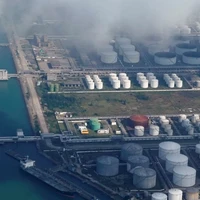
In defiance of US sanctions, illicit Iranian oil is reportedly being offloaded once again in China, as Iran continues to find ways to circumvent international restrictions.
The advocacy group United Against Nuclear Iran (UANI) has disclosed through satellite imagery that two vessels, HECATE and ELVA, are involved in the unloading of sanctioned Iranian oil at Dongjiakou port in China.
According to Claire Jungman, Chief of Staff at UANI, "HECATE was loaded from the Iranian tanker DOVER on March 25 and was designated as an SDGT (Specially Designated Global Terrorist) entity on April 4. ELVA, known for previous sanctions violations, loaded oil from Kharg Island, Iran, on April 2."
Jungman added, "China's continued disregard for counterterrorism sanctions is enabling Iran's financing of terrorism."
Iran utilizes a complex network of entities and intermediaries to sell its oil to third parties, thereby evading the imposed sanctions. Iran reportedly channels some of its oil revenues to state organizations such as the Revolutionary Guard to support their budgets indirectly, circumventing direct financial allocations.
The transactions are typically managed by state entities and business figures closely linked to the regime, generating significant profits.
Despite international sanctions, Iran's oil exports have seen a considerable increase, from 400,000 barrels per day post-2019 US sanctions to over 1,500,000 barrels per day currently.
Behrouz Mohebbi Najmabadi, a member of parliament’s budget committee, said in December, "By utilizing the capacities of neighboring and special allied countries such as the Shanghai Cooperation Organization, BRICS, and regional agreements, today Iran's crude oil sales have exceeded 1.5 million barrels per day."
Nechirvan Barzani, the President of Iraq's Kurdistan Region, made an unexpected visit to Iran this week, where he met with top leaders, sparking strong criticism from opponents of the Iranian regime.
During his visit, Barzani engaged with key figures of the government, including the Supreme Leader, heads of executive and legislative bodies, the commander-in-chief of the IRGC, the foreign minister, and the secretary of the Supreme National Security Council.
The timing and nature of Barzani's visit, coming months after the IRGC's missile attack on the Kurdistan Region, raise questions about its motives. The high-profile meetings suggest that the discussions likely focused on mutual security concerns.
This trip took place against a backdrop of three significant issues: Firstly, Iran's missile and drone attacks on targets within the Iraqi Kurdistan Region, purportedly aimed at Israeli agents, elicited protests from both Kurdish authorities and the Iraqi central government. Secondly, the upcoming parliamentary elections in the Kurdistan Region, scheduled for June 10, 2024, face controversy as the Iraqi Kurdish Democratic Party (KDP) has announced its intention to boycott the elections. Lastly, the Islamic Republic of Iran (IRI) has made a request for the disarmament and complete expulsion of Iranian Kurdish armed groups sheltering in the Kurdish regions of Iraq.
Am Iranian missile attack on the Kurdish city of Erbil in Iraq in 2022
The backdrop of recent events provides context for the objectives of the Iraqi Kurdish leaders' trip to Iran, though the outcomes remain uncertain due to the reticence of both parties involved.
This visit aimed to achieve three main objectives: 1) renegotiate mutual security arrangements, 2) mitigate threats posed by Tehran against the Iraqi Kurdish region, and 3) facilitate mediation by the Islamic Republic among conflicting political entities to reduce regional tensions.
In the realm of security, the Kurdistan Regional Government, whose high-ranking members have maintained long-standing relationships with Tehran, seeks to halt the regime's missile attacks. For this purpose, President Barzani aimed to reassure Iranian authorities that the regional government would not permit any group, faction, or country to launch actions against Iran or other neighboring nations. Additionally, following the unsuccessful independence referendum in 2017, the Kurdish authorities are attempting to mitigate Iranian threats through dialogue, promoting a narrative of a united Iraq.
In terms of political mediation, the Kurdish authorities are seeking Iran's intervention to reconcile differences between the two major Kurdish parties—the Iraqi Kurdistan Patriotic Union and the Kurdistan Democratic Party—and the Iraqi central government, particularly concerning disputes over regional elections.
Which objectives can be achieved?
The first goal—re-establishing a stable security relationship—seems attainable given the generally tension-free relations between the regional authorities and the Islamic Republic, unless the latter opts to demonstrate its strength by targeting structures within the Iraqi Kurdistan Region. However, there are significant doubts regarding the Iraqi Kurds' ability to fully avoid provocations from the Iranian regime, which sometimes launches attacks on its neighbors for reasons of prestige and maintaining its image.
Regarding the third objective, Tehran’s influence is constrained; it tends to favor military actions over diplomatic engagements with countries like the United States and Israel, and often does not take steps towards easing regional tensions. This preference for military approaches over diplomacy underscores the challenges in achieving mediation and conflict resolution in the region.
Reactions
Two prominent reactions to Barzani’s visit to Iran have emerged on social media. The first comes from Kurds who oppose Iran’s Islamic government; they expressed their discontent with Barzani for seemingly disregarding Tehran’s attacks on Kurds in the region and accused him of pandering during his meeting with Khamenei. Additionally, some Iranian opposition constitutional monarchists are also displeased with the visit, perceiving it as potentially encouraging separatist sentiments among Iraqi Kurds, which they fear might influence Iranian Kurds as well.
In another development, Iraqi journalist Ahmad Abdulsadeh reported that during the visit, Barzani provided a written commitment to the Iranian authorities, wherein Erbil officials pledged to disarm "terrorist groups" and ensure their removal from the Kurdistan Region. This commitment reportedly also includes a promise to curb attacks on the Iranian regime by media outlets like Rudaw and Kurdistan 24, and to control their coordination with foreign media entities. However, implementing these commitments could prove challenging and may lead to internal tensions within the region.
Shopping malls in Tehran are removing urinals, branding them as "un-Islamic" and indicative of "Westoxification."
A fatwa by Iran's Supreme Leader Ali Khamenei says it is Makrooh (disliked but not sinful) to urinate while standing or on a hard surface, forcing men to use the pit latrines instead.
The move has sparked widespread discourse and critique on social media. One user expressed frustration, remarking, "This is ridiculous! If they'd spend more time worrying about the economy, the starving people, the water shortage, they wouldn't have to worry about how men urinate."
Another user sarcastically said, "I hope the level of your demands always remains this profoundly high, and that your minds never get bogged down with demands for trivial matters like city beautification, increased security, or economic improvements. Demands should only be for issues like hijab and the Islamic way of dressing, as these are what truly elevate people's quality of life."
The removal of urinals is just one example of how the Iranian regime continues to exert control over the minor details of the population's personal lives, from dress codes and family planning to restroom habits.