• العربية
  • فارسی
Brand
  • Iran Insight
  • Politics
  • Economy
  • Analysis
  • Special Report
  • Opinion
  • Podcast
  • Iran Insight
  • Politics
  • Economy
  • Analysis
  • Special Report
  • Opinion
  • Podcast
  • Theme
  • Language
    • العربية
    • فارسی
  • Iran Insight
  • Politics
  • Economy
  • Analysis
  • Special Report
  • Opinion
  • Podcast
All rights reserved for Volant Media UK Limited
volant media logo

Iranian Proxies Threaten To Resume Attacks Against US Forces

Iran International Newsroom
Feb 10, 2024, 08:42 GMT+0Updated: 11:05 GMT+0
IRGC general Qasem Soleimani's portrait displayed by pro-Iran groups in Iraq.

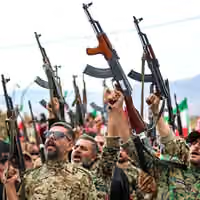
Iran-backed armed groups in Iraq announced Friday that they will resume attacks on US forces in response to the targeted killing of a senior militia figure earlier this week.

Wisam Mohammed Saber al-Saedi (aka Abu Baqer) was killed by a US drone strike in Baghdad Wednesday, reportedly for his role in the drone attack on a US base in Jordan that killed three American soldiers and wounded forty more.

In a statement Friday, the umbrella group of Iran proxies, Islamic Resistance in Iraq (IRI), said the killing of Abu Baqer “violated all the rules of engagement” and proved that the Americans only understand the “language of weapons.”

Iran-backed groups, including Abu Baqer’s Kataib Hezbollah, had announced a suspension of attacks against US troops following the large-scale retaliatory strikes by the US military on dozens of targets in Iraq and Syria on February 3. The decision, they claimed, was made not to embarrass the Iraqi government any further. But the pledge for a unilateral ceasefire didn’t last long.

“The opportunity of the past few days revealed with certainty to the Iraqi people, friends, and responsible authorities, that the occupying enemy does not abandon its meanness and treachery, and does not understand anything other than the language of weapons,” the IRI said in their statement.

The fight will now continue until the Americans are “expelled from the country,” it added, “forced to submit and be defeated”.

The IRI announcement seems to validate assessments that the US retaliatory strikes would likely fail to end the conflict unless it inflicts pain on Iran’s IRGC and forces it to pressure its proxies to stop.

Biden critics have repeatedly warned that his reluctance to confront Iran would further embolden the regime to push its malign adventures to the limit, getting to a point where the administration is left with no choice but to use even more force than what could have established deterrence and prevented escalation at an earlier stage.

“The fact that we had three servicemen killed is a failure of deterrence,” former US Special Operations Commander Gen. Tony Thomas told CBS. “Clearly, our adversary wasn’t getting the message that we weren’t going to tolerate that… I don’t know the measures so far have sent that message, and certainly with five days of telegraphing that we’re going to do something, and also with the caveat that we don’t want this to boil over into a bigger event –I think that’s your hold card. You don’t say that going into it.”

The Biden administration waited five days before responding to the deadly drone attack on the US base in Jordan, all the while speaking of its intention to strike back, which many believe took the element of surprise out of the operation and allowed Iran to move its interests out of harm’s way.

That surprise element seems to have been delegated to the Israelis.

Early hours of Saturday Syria time, the Israeli military targeted a building west of the Syrian capital Damascus, according to multiple local sources.

The Syrian Observatory for Human Rights reported “violent explosions'' in Dimas. Sabereen News, affiliated with Iran’s IRGC, said two people had been killed and several injured.

“The Zionists are trying to kill an important individual but haven’t succeeded in the last few days,” Sabereen posted on their Telegram channel. “We should wait and see if they have gotten to their target in Dimas or the assassination has failed again.”

Despite long years of financial and military support to Hamas, the Iranian regime has avoided direct involvement in the Gaza war. Instead, its proxies in Iraq, Syria, Lebanon and Yemen have unleashed attacks against US and Israeli targets, and strikes against international shipping in the Red Sea.

Most Viewed

Iran negotiators ordered to return after internal rift over Islamabad talks
1
EXCLUSIVE

Iran negotiators ordered to return after internal rift over Islamabad talks

2
ANALYSIS

US blockade enters murky phase as tankers spoof signals and buyers hesitate

3
ANALYSIS

Why the $100 billion Hormuz toll revenue is a myth

4

US tightens financial squeeze on Iran, warns banks over oil money flows

5
ANALYSIS

US blockade targets Iran oil boom amid regional disruption

Banner
Banner

Spotlight

  • Hardliners push Hormuz ‘red line’ as US blockade tests Iran’s leverage
    INSIGHT

    Hardliners push Hormuz ‘red line’ as US blockade tests Iran’s leverage

  • Ideology may be fading in Iran, but not in Kashmir's ‘Mini Iran'
    INSIGHT

    Ideology may be fading in Iran, but not in Kashmir's ‘Mini Iran'

  • War damage amounts to $3,000 per Iranian, with blockade set to add to losses
    INSIGHT

    War damage amounts to $3,000 per Iranian, with blockade set to add to losses

  • Why the $100 billion Hormuz toll revenue is a myth
    ANALYSIS

    Why the $100 billion Hormuz toll revenue is a myth

  • US blockade targets Iran oil boom amid regional disruption
    ANALYSIS

    US blockade targets Iran oil boom amid regional disruption

  • Iran's digital economy battered by prolonged blackout
    INSIGHT

    Iran's digital economy battered by prolonged blackout

•
•
•

More Stories

China's Housing Project In Tehran Stirs Legal, Economic Concerns

Feb 10, 2024, 03:59 GMT+0
•
Iran International Newsroom

Tehran’s municipality has announced that China will soon start building housing units in the capital, raising question about surrendering public land to foreign companies and other issues.

Mayor Alireza Zakani, who has recently visited China, announced earlier in February that several contracts have been signed with Chinese companies to revamp the capital’s infrastructure, including construction and transportation projects.

The Iranian capital grapples with severe housing and transportation challenges, characterized by exorbitant real estate prices that are beyond the means of ordinary Iranians, who can barely afford rent. Daily congestion on Tehran's main streets and highways often transforms short journeys into hours-long ordeals.

Zakani announced plans for the construction of hotels, buildings, amusement parks, and water parks within Tehran, adding, "We have finalized agreements to develop five five-star hotels in collaboration with Chinese companies, building 200,000 housing units, and establish two amusement parks and two water parks in Tehran." In January, Hamidreza Saremi, Zakani’s deputy, said that parcels of land exceeding one hectare in size in the southern regions of Tehran have been allocated to Chinese firms. In December, Hassan Tizmaghz, an advisor to the Minister of Roads and Urban Development, said that Chinese and Belgian companies have presented housing construction proposals, ranging from $200 to $300 per sq meter across Iran, well below construction costs in neighboring Turkey, where the minimum rate is $500 per sq meter.

Economic journalist Reza Gheibi  (undated)
100%
Economic journalist Reza Gheibi

Of course, some observers take the news with a grain of salt. First, there has been no word from the Chinese side confirming such a deal. Second, building affordable housing has always been an election season promise in Iran, with incumbent Ebrahim Raisi promising in 2021 that he would build one million units. Now, parliamentary elections will take place on March 1, a good time to renew housing promises.

Economic journalist Reza Gheibi told Iran International that Chinese encroachment into Iran's construction sector would have adverse effects related to opacity in the financial details of the scheme and its impact on local companies.

It is not clear what concessions the Iranian government will offer the Chinese and how it is planning to pay for their services, given that it faces a financial crunch.

Gheibi explained that the Chinese housing project is in line with the 25-year cooperation agreement between Tehran and Beijing. The pact, signed in 2021, has been very controversial in Iran because its details have never been disclosed. A leaked copy of the final text is very general, but Tehran officials, beleaguered by economic crisis they cannot solve, hope it will bring $400 billion in investment.

According to Gheibi, even without a strategic and long-term agreement, the Islamic Republic would welcome the Chinese housing scheme because it faces serious economic issues, especially attracting foreign investment, with no solutions in sight. He believes that Iran seeks to export oil and other products to China in return for construction projects, characterized by “a barter of oil for technical, engineering and construction services.” There is a catch, however, Gheibi says, highlighting that China has the upper hand in such deals, therefore it will impose its prices and terms, including more discounts on Iran’s crude and higher prices for its contractors.

With over $390 billion in debt in total, according to a New York Times report in 2023, Chinese construction companies' entry into the Iranian housing sector bears the risk that these companies announce bankruptcy after launching projects in the country, creating myriads of legal issues. Iran, of course, offers opportunities for Chinese firms. According to Tejarat news website in Tehran, most of Iranian construction companies are in slump or went bankrupt due to rising costs, inflation and a lack of demand in the country’s housing sector. Geibi said, “The Iranian market is a golden opportunity to reduce the accumulated debt of some of these companies.”

He also expressed concern about the “allocation” of public lands in Tehran to Chinese companies, pointing out that according to the Iranian constitution no foreign entity is allowed to own land in Iran. Gheibi said the Iranian authorities have not elaborated what they mean by allocating land to Chinese firms, underlining that the Islamic Republic prefers to have China as a stake holder in Iran. “Some analysts have said that the Iranian regime would like China to own assets in Iran, particularly in Tehran, so that in sensitive situations, such as a possible war, backs the Islamic Republic to protect its own properties.”

Leading Sunni Cleric In Iran Demands Release Of Political Prisoners

Feb 10, 2024, 00:57 GMT+0

In the Friday prayer sermons on February 9th, the outspoken Sunni Friday prayer leader of Zahedan has once again demanded the release of political prisoners.

Mowlavi Abdolhamid, also raised the issue of detained security forces who had opened fire on protesters in September 2022, killing around 90 civilians. Demanding a real trial, he stated, “the people expect those who committed crimes to be prosecuted regardless of their affiliations.”

Iran International reported on Wednesday that the first session of the trial of the security forces who have been released pending the conclusion of their trial. 

Meanwhile, the Halvash website, covering news from Sistan and Baluchestan province, reported on Friday that this week's prayers in Zahedan were held amidst the deployment of military forces and intense security measures in the city streets.

According to the report, a citizen holding a banner that read "Whoever Votes is Either a Traitor or Ignorant," encouraged citizens not to participate in the upcoming parliamentary elections scheduled for March.

In recent weeks, Zahedan citizens, following more than a year of continuous street protests and demonstrations, heeded Mowlavi Abdolhamid’s call for silent processions.

In his Friday prayer sermons this week, coinciding with the 45th anniversary of the Revolution of 1979, Abdolhamid emphasized, "We hope that officials will change policies in favor of the nation and the people."

Iran's Female Political Prisoner Deprived Of Medical Care

Feb 9, 2024, 23:33 GMT+0

Zeinab Jalalian, the longest-serving female political prisoner in Iran, is facing dire conditions as she marks the end of her sixteenth year behind bars without proper medical attention.

Despite suffering from multiple physical ailments, Jalalian has been denied furlough and has not been segregated from common prisoners according to regulation in Yazd prison.

According to reports from the US-based Human Rights Activists News Agency (HRANA) citing a source close to Jalalian's family, she was supposed to be transferred to Yazd hospital for the treatment of an eye infection on Tuesday. However, due to negligence from prison authorities, she was not sent to the hospital.

Jalalian's health continues to deteriorate, with her vision severely declining due to the progression of the eye infection. Additionally, she suffers from kidney and digestive diseases, but she has not received proper medical care.

Arrested in 2008, Jalalian was initially sentenced to death by the Revolutionary Court on charges of belonging to an armed opposition group. The sentence was later commuted to life imprisonment in 2011.

Throughout her detention, Jalalian has repeatedly denied the accusations and has spoken out about torture and harassment she has endured, including physical assaults and threats of sexual assault.

Jalalian's case highlights the broader issue of the lack of medical attention given to political prisoners in Iran and the denial of their right to proper treatment by prison authorities. Many political prisoners, including activists like Sasan Niknafs and Behnam Mahjoubi, have lost their lives in similar circumstances, with the Islamic Republic refusing to accept responsibility for their deaths.

Social Media Users Call On Musk To Close Khamenei’s X Accounts

Feb 9, 2024, 21:53 GMT+0

Many Iranians, who welcomed Meta’s decision to remove the Iranian Supreme Leader’s Instagram and Facebook accounts, are now urging Elon Musk to follow suit and deactivate his X accounts.

Meta took the step of shutting down the Iranian leader's Instagram and Facebook accounts on Thursday. A spokesperson for Meta stated that this action was taken due to repeated violations of Meta's policies concerning "dangerous organizations and individuals."

A post on X suggested a tweet storm to ask Musk to follow Meta’s example and shut down Khamenei’s accounts, a demand long pursued by Iranian activists and many social media users. “A country that bans something for its populace should not have the right to use it,” the tweet said.

“A dictator who denies people the right to use social networks should not have the right to access them,” another tweet said.

Iranians can only access Instagram and other major social media and instant messaging platforms such as X, Facebook, WhatsApp, and Telegram if they have installed anti-filtering software on their devices. They need to circumvent government filters that make these apps inaccessible in the country.

Khamenei's Persian and English Instagram accounts boast over five million and 200,000 followers, respectively. His accounts in Persian and English on X each have one million and 727 thousand followers. Additionally, he maintains X accounts in various other languages, including Arabic, French, Urdu, and Azerbaijani.

Meta has not offered details of the instances of violations of its policies by Khamenei’s accounts, but there are speculations the decision was prompted by these accounts voicing support and praising regime entities designated as terrorist by the United States and other western countries. Middle East Eye attributed the closure of the accounts to pressure from pro-Israel groups.

Instagram is the second most popular social platform in Iran after Telegram with over forty million users. Both platforms are used by millions of small and home-based businesses for marketing.

Khamenei has repeatedly called for the "eradication of Israel" and commended the October 7 attack by Hamas on Israel. On the day of the Hamas attack on Israeli cities, Khamenei's former Twitter account, now referred to as X, stated, "the cancer of the usurper Zionist regime will be eradicated at the hands of the Palestinian people and the resistance forces throughout the region."

The ban on Instagram, the only social platform not blocked by authorities, was announced on September 21, 2022, a few days after anti-government protests sparked by the death of 22-year-old Mahsa Amini in the custody of morality police engulfed the country. The ban, along with frequent internet blackouts, aimed to prevent protesters from sharing news and footage of the crackdowns.

For years, many in Iran have relied on VPNs and anti-filtering software to navigate through government censorship and blocked social media and websites. The use of VPNs to help access to banned social platforms and websites, however, surged by 30-fold in the following months.

A recent report by the e-commerce center of the ministry of industries showed Instagram to be the most used social platform in e-commerce with 55 percent of these businesses relying on it, followed by Telegram (41 percent) and WhatsApp (37 percent).

Social media users in Iran have largely shunned domestically developed social media applications such as Wisgoon and Nazdika, designed to replace Instagram, and Rubika, a messaging application, for various reasons including their quality and lack of privacy.

Experts have warned that domestic apps, which the authorities are trying to promote, are very vulnerable to government intrusion and there are serious safety and privacy concerns including the fear that security services could be able to spy on people through them.

Executions Surge In Iran Despite International Appeals

Feb 9, 2024, 21:33 GMT+0

A human rights group has warned about a disturbing trend in Iran's judiciary system, reporting a significant surge in issuing death penalties during January.

According to the US-based Human Rights Activists News Agency (HRANA), Iranian courts issued 35 death sentences, marking the highest number of death penalties issued within a single month in over a year. Meanwhile, a total of 86 people were executed across the country during January alone.

The surge comes on the heels of a similarly grim situation in January 2023, during which at least 63 people were executed in Iran, with 23 death sentences issued.

Despite mounting international calls for the abolition of the death penalty, particularly for non-serious crimes, Iran persists in carrying out executions. HRANA contends that the Iranian government utilizes the issuance and implementation of death sentences as a means to quell dissent. Notably, Mohammad Ghobadloo, a protester detained during the 2022 uprising, was among those executed in January 2024.

The concluding section of the report emphasizes the Islamic Republic's response to global demands for upholding human rights standards. It calls for judges, interrogators, and members of security forces involved in violating the standards to face recognition of their responsibility through international sanctions.

A recent Amnesty International report further underscored the severity of the situation, revealing that from January 1, 2012, to July 31, 2023, over five thousand individuals, including at least 57 children, were executed in Iran.