Iran Increases Minimum Wage By 20% AS Inflation Nears 50%

Iranian workers are set to receive a government approved average salary increase of 20 percent starting in March, amid an annual inflation rate of around 50 percent.

Iranian workers are set to receive a government approved average salary increase of 20 percent starting in March, amid an annual inflation rate of around 50 percent.
The new minimum monthly wage has been set at 115 million Iranian rials or about 230 US dollars.
Ali-Asghar Annabestani, the head of the parliamentary committee on wages and salaries said on Thursday that a “uniform salary increase of 15 million rials is approved for all employees, resulting in a minimum wage of 115 million rials."
The development comes at a time when the purchasing power of consumers is closely tied to the US dollar rate, which is currently at 520,000 rials. The high likelihood of the rial depreciating further in the next year starting in March poses a challenge, potentially diminishing the value of the minimum wage against the dollar.
Persistent inflation and a sluggish economy have significantly diminished the purchasing power of ordinary Iranians, leading to tens of millions falling into the category of "working poor." Experts highlight that the poverty line for Tehran residents is approximately 300,000,000 rials (approx. $600) per month, three times the current minimum wage.
Reports suggest that workers' wages now cover only about 60% of their monthly household expenses. Despite Article 41 of the Labor Law assigning the Supreme Labor Council to determine the minimum wage annually, the government retains the discretion to adjust wages based on its interests. This has contributed to widespread labor protests in recent years.
While a minimum wage increase aims to alleviate financial burdens for workers, it raises concerns about overall business costs. Such increases result in layoffs or a reluctance to hire new employees, further complicating the balance between economic stability and workers' rights.

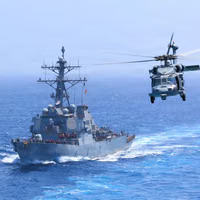
The United States and the United Kingdom conducted airstrikes on Houthis in Yemen in the early hours of Friday local time, after the group's repeated attacks on vessels.
This action was taken after the Houthi group, supported by Iran, disregarded repeated calls to cease its attacks on ships in the Red Sea.
The Houthis have been targeting commercial vessels since mid-November, after Israel began its onslaught on Gaza, effectively closing down a major maritime route and disrupting the global flow of goods. The attacks began after Iran’s Supreme Leader Ali Khamenei called for blockading Israel.
Shortly after the strike, President Joe Biden said he authorized the operation, claiming support from Australia, Bahrain, Canada, and the Netherlands, and hinting that there may be more attacks on Houthi positions.
“These precision strikes were intended to disrupt and degrade the capabilities the Houthis use to threaten global trade and the lives of international mariners in one of the world’s most critical waterways,” Biden said in a statement. “I will not hesitate to direct further measures to protect our people and the free flow of international commerce as necessary.”
Notably, Biden’s statement made no reference to Iran, despite the fact that only a day before, his secretary of state Anthony Blinken had said that Houthi attacks are “aided and abetted by Iran with technology, equipment, intelligence, [and] information.”
There was no immediate reaction from Iran, but the Houthi leader issued a threatening statement, vowing to carry on no matter what and “burn the region.”
“Do the American, British, and the Zionists expect that any aggressive act against Yemen will distract us from defending Gaza,” Abdul Malik al-Houthi asked. “We will continue to target Zionist ships and those going to the Zionist entity. We will confront America, make it kneel, burn its warships, all its bases, and anyone who cooperates with it.
Initial reports suggested that at least ten Houthi sites had been targeted, including “radar systems, air defense systems, and storage and launch sites” for drones and missiles, according to the US Central Command.
“We hold the Houthi militants and their destabilizing Iranian sponsors responsible for the illegal, indiscriminate, and reckless attacks on international shipping,” CENTCOM commander General Michael Erik Kurilla said. “Their illegal and dangerous actions will not be tolerated, and they will be held accountable.”
Houthi forces claimed to have retaliated against western warships, but no independent source verified this. The US military did not reported any such attacks at time of writing.
Many are worried that this operation would aggravate, not deter, the Houthis –leading to further attacks, escalation, and eventually an all-out regional war.
Saudi Arabia was the first to raise such concern shortly after the attack, according to Reuters. The kingdom’s foreign ministry emphasized the importance of maintaining the security and stability of the Red Sea region and called for “avoiding escalation”
Back in the US, criticisms were much more biting.
“The President needs to come to Congress before launching a strike against the Houthis in Yemen and involving us in another Middle East conflict,” Democratic congressman Ro Khanna posted on X. “That is Article I of the Constitution. I will stand up for that regardless of whether a Democrat or Republican is in the White House.”
Another Democratic Representative, Cori Bush, said: “The people do not want more of our taxpayer dollars going to endless war and the killing of civilians. Stop the bombing and do better by us.”
The Republicans, however, seemed more supportive, especially those who had called on President Biden to target the Houthis –and even Iran. Senate minority leader Mitch McConnell, and Roger Wicker and Rick Scott of the Armed Service Committee were among those who praised the attacks, emphasizing that it had come “late” and was not enough.
“Biden must now act every day to end the ability of Houthi forces and all Iran-back terrorists to attack the US and our partners,” Senator Scott posted on X.

Following widespread criticism of Iran’s security failure that led to the deadly blasts last week, the intelligence ministry released further details on the incident.
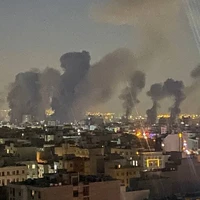
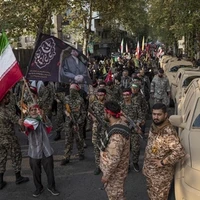
In its second statement after two explosions hit a memorial ceremony for slain Revolutionary Guard commander Qasem Soleimani near his grave on January 3, the Islamic Republic’s intelligence ministry said Thursday that 35 people have been arrested across the country over alleged links and support to the bomb attack. The terror operation was claimed by the ISIS branch in Afghanistan (ISIS-Khorasan). About 90 people were killed and 300 injured in the incident, the biggest terror attack since the Islamic Republic was founded in 1979.
According to the ministry, the main operative who made the explosive vests and oversaw the operation is a man from Tajikistan known by the alias "Abdullah (Abdollah) Tajiki." He purportedly entered the country illegally from southeastern borders on December 19 along with a woman and a child. He was then transferred to Kerman province and settled in a rented house on the outskirts of Kerman city, where the attack took place. The ministry claimed that he left the country two days before the incident after he assembled the explosives.
The ministry also identified one of the two suicide bombers as a Bozorov or Bazirov, a 24-year-old Israeli man and a Tajikistani national. It also claimed that he resided in the Turkish city of Van before crossing through Iran and joined the ISIS-K in Afghanistan, where he underwent training. He came back to Iran after a few months via Saravan in Sistan-Baluchestan province and ultimately joined other agents in Kerman.

In an attempt to downplay the inefficiency of the country's security forces, the intelligence ministry said the perpetrators had decided to carry out the attack at Soleimani’s grave but ultimately had to change their plans and blow up themselves before reaching the inspection gates due to “stringent measures and multiple security layers.” “The first terrorist detonated his suicide vest approximately 700 meters from the cemetery, and the second terrorist detonated his explosive vest approximately 1,000 meters from the graves.”
The ministry also released a video montage featuring various individuals visiting the residence, accompanied by a tour of the premises, purportedly identified as the location where the explosive vests were made. The footage also showed search dogs unearthing equipment that reportedly was for the production of additional explosives.
The authorities, who found themselves in hot water over their intelligence lapse, swiftly reacted with multiple claims about their success in busting terror cells and foiling more attacks to rebuild their credibility. The haphazard response led to conflicting reports with some officials saying that the security apparatus thwarted dozens of bombings planned for the Soleimani’s death anniversary ceremonies and arrested “all people” involved.
Head of the Armed Forces' Judicial Organization in Kerman, Ali Tavakkoli, claimed that over 64 bombs were discovered nationwide, intended to detonate during the memorial for Soleimani.
Addressing the inconsistencies, the intelligence ministry said, “In recent days, statements suggesting the discovery of multiple bombing conspiracies have been released, raising some suspicions. The fact is that in such reports, two elements, namely the quantity and the timing of the discoveries of explosive materials, are not accurate.” It added that the reports were about the foiled bombing attacks in the past months and only one of the arrests was related to an operative linked to the bombing on Soleimani’s death anniversary. The ministry said he was a Tajik ISIS operative who planned a bombing in the city of Mashhad. His arrest was also featured in the ministry's video montage.
The ministry also claimed that it has identified several other people involved in the Kerman blasts beyond the borders, emphasizing that it considers its inalienable right to pursue them wherever they may be.
Although meant to replenish its blemished credibility, the intelligence ministry's move did not address the main questions: if the security apparatus was aware of the threats, why it went along with the ceremony and risked peoples’ lives? A large number of Iranians are of the opinion that the Islamic Republic needed such a deadly incident to justify its tight security measures that mainly target the people, not the enemies of the people.

As concerns grow over a predicted low turnout in Iran's upcoming March parliamentary elections, authorities are ramping up their efforts to mobilize the public.
In a Thursday statement, Habibollah Ghafouri, the Supreme Leader's representative in Kermanshah, west of Iran, framed participation in the elections as "a jihad against the enemy."
Ghafouri emphasized that each vote is akin to “launching a missile towards the enemy's camp.”
During an address to followers on Tuesday, Supreme Leader Ali Khamenei stressed the collective responsibility to mobilize the people, underscoring the pivotal importance of mass participation. Despite turnouts ranging from 20 to 40 percent in the 2020 and 2021 elections, current estimates project a significant dip to 5 to 8 percent in March.
Iranians express deep frustration with the perceived indifference of the regime and officials towards their calls for increased freedom and improved economic conditions.
Officially, the inflation rate hovers just below 50 percent, with essential commodities, notably food, experiencing even higher rates. Dissent within the country has escalated due to the regime's severe crackdown on the 2022 nationwide protests, resulting in hundreds of deaths and hundreds more blinded. Thousands have been arrested by security forces, including families of those killed during protests.
The enforcement of medieval laws on hijab, lashings for women, and restrictions on internet access by hardliners have further fueled discontent among the populace who are now more tightly surveilled than ever.
Khamenei, whose Guardian Council has disqualified almost all moderate and reformist candidates from participating in the March election, narrowing political engagement predominantly to ultraconservatives, acknowledges that he cannot directly request or command the people to partake in the elections. Consequently, he relies on instructing officials and institutions to employ various methods to encourage people to vote.

An Iranian lawmaker said Tehran Municipality continues to work with contractors who abuse child laborers.
Mohammad-Hassan Asafari told ILNA news agency, “These contractors exploit child laborers for their own financial gain as they pay children less and do not insure them,” adding that the Iranian lawmakers have repeatedly warned municipality officials in this regard, but of no avail.
From a legal perspective, the municipality is required to sue those private contractors who violate the law by employing children for such difficult jobs as waste collection and cleaning streets, the lawmaker pointed out.
Iran’s Parliament Research Center released a report in August highlighting an alarming rise in the number of working children.
The report indicated that 15% of the child population is engaged in labor activities. At least 10% of working children do not have the opportunity to attend school, depriving them of essential educational opportunities.
In September, Bahram Zonoubi Tabar, the head of the Labor Coordination Council in Fars Province, warned that Iranian children are being forced out of school and into the workplace as families struggle to make ends meet in the country's worst economic crisis in decades.
Tabar said, “With the commencement of the school year, numerous workers are grappling with difficulties enrolling their children,” adding that the country’s 100% increase in commodity prices within a year, compared to the annual wage increments of around 20% for workers, has made conditions unbearable for large numbers of Iranian families.
While the exact number of working children in Iran remains undisclosed, the Ministry of Labor indicated that in 2017, out of nine million Iranian children, 499,000 were considered “active,” signifying that nearly half a million children in the country were either engaged in labor or searching for work.

The Coordination Council of Iranian Teachers' Trade Associations condemned the recent ceremony on Kish Island, where schoolgirls were forced to carry symbolic coffins on their shoulders.
The event, titled Diver Martyrs, was branded by the association as an "unfortunate and disheartening practice." The council denounced the use of children for political purposes, deeming it a "blatant violation of children's rights."
On Wednesday, social media platforms witnessed the rapid circulation of images depicting schoolgirls employed by the Basij organization to carry symbolic coffins adorned with the flag of the Islamic Republic. The ceremony was organized to commemorate the 175 Iranian divers who were allegedly buried alive with their hands tied during the Iran-Iraq War. The remains of the divers were repatriated from Iraq in May 2015.
Over the past 44 years, the Islamic Republic has methodically developed and maintained propaganda structures across society.
In Iran, propaganda plays a pivotal role in maintaining authoritarian rule. The government's centralized control of cultural narratives stands as a fundamental function in authoritarian regimes. The Iranian state consistently relies on propaganda to assert its dominance, strategically manipulating people's emotions for political objectives.