Iraq's Pro-Iran Shia Coalition Wins Provincial Elections

Iraq's ruling Shia Coalition Framework (CF) has emerged triumphant in the recent provincial elections securing 101 out of 285 council seats in the December 18 vote.

Iraq's ruling Shia Coalition Framework (CF) has emerged triumphant in the recent provincial elections securing 101 out of 285 council seats in the December 18 vote.
The electoral success is seen as a strategic gain for Iran-aligned factions, consolidating their influence in anticipation of the parliamentary elections scheduled for 2025. The CF's success solidifies its control over Iraq's influential provincial councils, responsible for appointing regional governors and allocating budgets for critical sectors such as health, transport, and education.
The top list of the Shia alliance, claiming 43 seats, includes significant Iran-aligned military-political groups like the Badr Organization and Asaib Ahl al-Haq. The second list, led by former Prime Minister Nouri al-Maliki, secured 35 seats, while the third, with 23 seats, features moderate Shia leader Ammar al-Hakim and former Prime Minister Haidar al-Abadi. Together, these allied lists will hold a commanding total of 101 seats in the provincial assemblies, surpassing all other blocs.
The number of eligible voters in this election was reported to be less than 17 million people, with around six thousand candidates.
Since the downfall of Saddam Hussein's regime in 2003, Iran has maintained significant involvement in Iraqi politics. Over a dozen Iraqi political parties are connected to Iran, receiving funding and training for paramilitary groups aligned with these parties. Some of these paramilitary groups, operating under the umbrella of Iraq's Popular Mobilization Forces, have sworn allegiance to Iran's supreme leader, Ayatollah Ali Khamenei. Employing violence, the groups have sought to suppress opposition to Iranian influence and to push for the removal of the remaining US forces in Iraq.
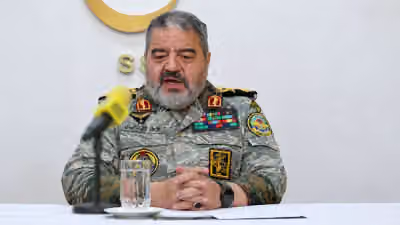

Iran has accused the Stockholm Court of Appeals in Sweden of bias by upholding the life sentence of a former jailor for his role in the 1988 prison killings.
Reiterating the official line that Sweden prosecuted and convicted Hamid Nouri on the basis of false allegation by the exiled opposition group Mujahedin-e Khalq Organization (MEK), the official news website IRNA claimed that Sweden has violated Nouri’s human rights. The website reflecting the government's position alleged that Sweden tortured Nouri by keeping him in solitary confinement and “repeatedly moving him between detention centers”, and putting another prisoner with “serious mental issues” in his cell.
The Iranian foreign ministry has not yet reacted to the Stockholm Court of Appeals decision on Tuesday, which came after months of examining evidence and deliberation.
In a statement, 452 Iranian activists and members of victims’ families welcomed the court’s decision, calling it a “huge victory for the Iranian justice movement.” They believe it paves the way for bringing the regime and other violators of human rights to justice in the future.

“Let us remind that in the summer of 1988, Ebrahim Raisi, who is the president of the Islamic Republic with [Supreme Leader Ali] Khamenei’s firm support, was among the members of the death committee, of which Hamid Nouri was an agent,” the statement said.
Nouri, arrested upon arrival in Sweden in November 2019, was convicted by a Swedish court in July 2022 and sentenced to life for human rights violations as a prison official in the 1980s.
Plaintiffs in the case alleged that Hamid Nouri, 61, an assistant prosecutor and a member of the execution committee at Gohardasht Prison near Tehran, played a key role in the torture, execution, and secret burial of thousands of prisoners, including members of the Mujahedin-e Khalq Organization (MEK) and various Marxist groups, in the summer of 1988. In court, Nouri denied any connection with the executions.

Many, including UN Special Rapporteur on Extra-Judicial Executions Agnes Callamard, called his arrest an "important first step towards justice for the 1988 massacre." This marks the first time someone has been charged in relation to the events that took place in 1988 in Iran and prosecuted in another country.
The execution of thousands of political prisoners, which occurred over a few weeks, is often considered one of the darkest secrets in the history of the Islamic Republic. Many victims, initially sentenced to prison, were executed when they refused to denounce their beliefs.
The regime clandestinely buried victims in unmarked, mass graves. Families were often informed months after the executions and kept unaware of the graves' locations. The regime has prohibited the erection of gravestones at these sites, and family members visiting the mass graves are frequently harassed. Security agents even uproot trees planted by family members to mark the graves.
The decision to purge political prisoners was taken at the highest level and was endorsed by Ayatollah Ruhollah Khomeini, the founder of the Islamic Republic. Khomeini's chosen successor, Ayatollah Hossein-Ali Montazeri (1922-2009), who protested the massacre and called it a crime against humanity was demoted by Khomeini. Montazeri spent several years under house arrest after Khomeini's death in 1989 for criticizing the new successor, Supreme Leader Ali Khamenei, and questioning his legitimacy.
International affairs and human rights deputy of the Iranian judiciary, Kazem Gharibabadi, in July accused Sweden of taking Nouri “hostage” and demanded his release while alleging that Sweden had no evidence against Nouri and was only defending the interests of MEK.
A Swedish EU diplomat, 33-year-old Johan Niels Floderus who was put on trial in December , and a 52-year-old Swedish-Iranian doctor, Ahmadreza Djalali (Jalali), are currently being held in Iran on charges of spying for Israel. Iranian authorities have several times threatened to execute Djalali, allegedly to force Sweden to release Nouri, and brought charges against Floderus that entail a death sentence.

Nine former politicians and civil activists in Iran have demanded the abolition of compulsory hijab, calling it “double suppression” of women.
“The Islamic regime has resorted to hijab to double its discrimination against women in an era when human equality, regardless of gender, race, ethnicity, creed and religion, plays a pivotal role in progressive human discourse,” a statement published Monday by Zeitoun news website said.
“The cruel and violent measures to enforce the mandatory hijab have been disastrous not only for women, but also for their fathers, husbands, and brothers. In other words, Iranian men have also found it difficult to bear so much oppression of women,” said the statement six of the signatories of which are also prominent political and intellectual figures.

Most of the signatories, including prominent female Islamic scholar Sedigheh Vasmaghi, are known as “religious intellectuals” in Iranian politics, meaning they advocate a moderate view of Islam.
Vasmaghi, 63, recently removed her veil after decades and even challenged Supreme Leader Ali Khamenei’s hijab edict, arguing that there is no foundation in the Quran or the Sharia for such an edict.
Zahra Rahnavard, one of the leaders of Iran's Green Movement, is also among the signatories of the statement. Rahnavard and her husband Mir-Hossein Mousavi have been under house arrest since 2011. The seventy- eight-year-old academic and artist chose to wear the hijab before the Islamic Revolution of 1979 and has still held on to it. Mousavi was prime minister in the early years of the Islamic Republic and both were committed supporters of the regime.
Prominent human rights lawyer and Sakharov Prize winner Nasrin Sotoudeh, 60, however, has for years fought against the compulsory hijab and defended other women who were prosecuted for protesting the mandatory hijab.
The statement also criticizes the regime for denying civil and human rights such as the right to work, study, benefit from social rights and services such as healthcare for not abiding by the hijab rules.
“These extreme beliefs and methods have imposed heavy costs on the country, particularly on Iranian women and girls, and caused the shedding of the blood of the likes of Mahsa and Armita,” the statement said.
The death of Mahsa (Jina) Amini, 22, in September 2020 in the custody of morality police resulting from injuries she sustained during her arrest for what the authorities called “inadequate hijab” sparked widespread protests across Iran that went on for months and were heavily suppressed by the government.
Tens of thousands were arrested during the protests, at least 550 protesters including 68 children were killed, and thousands including hundreds that lost their eyes to birdshot bullets fired directly in their faces by security forces, sustained very serious injuries.
Armita Geravand, 16, who sustained a head injury after allegedly being assaulted by hijab enforcers in a metro car in Tehran also fell to the same fate after a month-long coma on October 28.
Fearing another round of protests, authorities forced Armita’s family to bury her as discreetly as possible. Nevertheless, dozens including Sotoudeh and Vasmaghi, two of the signatories of the present statement, attended the burial at Tehran’s Behesht-e Zahra.
Sotoudeh who had previously called Armita’s death a “state killing’ and attended the funeral without a headscarf in defiance of the regime was detained, and Vasmaghi was assaulted by four agents but was reportedly rescued by other people at the scene.
In a commentary entitled “Lesson Taught By the Trumpeter Sadegh” published by the reformist Etemad newspaper last week, reformist commentator Abbas Abdi warned the regime that insisting on imposing hijab by all means including violence would only cause a massive negative reaction from the public.

Jordan's army foiled a plot on Monday by dozens of infiltrators from Syria linked to pro-Iranian militias, who crossed its border with rocket launchers and explosives.
Jordan’s State broadcaster said the army blew up a vehicle laden with explosives as it resisted the biggest armed cross-border operation to smuggle weapons and drugs in recent years.
The army earlier said the infiltrators had fled back across the border after injuring several army personnel in the latest of several major incursions since the start of the month that has left one Jordanian soldier and at least a dozen smugglers dead.
Intelligence sources said Jordanian jets launched rare raids into its northern neighbor Syria against hideouts of Iranian-backed drug smugglers in retaliation against the smuggling operation. Iran controls thousands of fighters in Syria for more than a decade, when it got involved in the country’s civil war to support the Syrian strongman Bashar al-Assad.
They said the bombing targeted homes of leading drug dealers and farms that intelligence showed were safe houses for the heavily armed traffickers who have also used drones to drop their hauls.
Earlier officials had said the Jordanian army was considering conducting pre-emptive strikes inside Syria against those militias linked to the drug trade and their facilities in a bid to stem what they say is an alarming rise in cross-border incursions.
Jordanian officials, like their Western allies, say that Lebanon's Iran-backed Hezbollah group and pro-Iranian militias who control much of southern Syria were behind a surge in drug and weapons smuggling.
"Jordan knows the country that stands behind this. It's Iran that is sponsoring these militias. These are hostile military actions against Jordan on its territory," said Samih Maayteh, a former minister briefed by officials on developments.
Iran and Hezbollah say the allegations are part of Western plots against the country. Syria denies complicity with Iranian-backed militias linked to its army and security forces.
UN experts and US and European officials say the illicit drug trade finances a proliferation of pro-Iranian militias and pro-government paramilitary forces created by more than a decade of conflict in Syria.
War-torn Syria has become the region's main site for a multi-billion-dollar drug trade, with Jordan being a key transit route to the oil-rich Gulf states for a Syrian-made amphetamine known as captagon, Western anti-narcotics officials and Washington say.
The army which said it had seized nearly five million pills of captagon on Monday in one of the largest hauls in recent years, warned it would "continue to track these armed groups and prevent any attempt to undermine the kingdom's national security".
"The last few days have seen a spike in these operations that are changing from infiltration attempts and smuggling to armed clashes with the goal of crossing the border by force and targeting border guards," the army statement added.
Jordan's Foreign Minister Ayman Safadi last week told Iran's Foreign Minister Hossien Amir-Abdollahian during a meeting in Geneva that Tehran should do more to rein in militias it finances that are active along the Syrian-Jordanian border, officials say.
The raids by Jordanian jets come as the monarch, a staunch US ally, discussed bolstering the country's defenses with the top US commander, General Charles Q. Brown, chairman of the Joint Chiefs of Staff.
Jordan has been promised more US military aid to improve security on the border, where Washington has given around $1 billion to establish border posts since the Syrian conflict began in 2011, Jordanian officials say.
Report by Reuters

The deputy foreign ministers of Iran, Saudi Arabia, and China convened in Beijing to discuss Tehran-Riyadh relations after normalization and the ongoing Gaza war.
The sides evaluated the progress in reviving diplomatic ties between The Islamic Republic of Iran and Saudi Arabia that was launched in March with Chinese mediation.
According to the Saudi Arabian Press Agency, Ali Bagheri-Kani, the Political Deputy Foreign Minister of Iran, Waleed bin Abdulkarim Al-Khuraiji, the Deputy Minister of Foreign Affairs of Saudi Arabia, and Deng Li, the Vice Minister of Foreign Affairs of China, were present at the meeting.
In a statement the three sides also urged for the cessation of military operations in Gaza and the flow of "sustainable relief" to Palestinians. Iran has campaigned for an end to the Israeli military operation, which has weakened Tehran's ally Hamas.
While Iran has refrained from direct military involvement in supporting its ally Hamas and denies any role in the October 7 Hamas operation, but has faces accusations of supporting proxies like the Houthis, who have targeted US and Israeli interests, as well as international shipping.
Apart from addressing the Gaza situation, the discussions also centered on the process of reopening the embassies of both Iran and Saudi Arabia. The agenda underscored the importance of steps taken to implement the diplomatic thaw initiated in March. This agreement marked a pivotal moment after seven years of strained relations between the two nations.
While the Iranian Embassy in Saudi Arabia officially reopened in mid-June, symbolizing the restoration of diplomatic ties, the formal opening of the Saudi Embassy in Tehran has faced repeated delays, with no official explanation from Saudi authorities as yet.

A new cultural agreement between Iran and Russia will exclude education, according to an Iranian lawmaker speaking on Friday.
The statement by MP Mohammad Vahidi comes after President Vladimir Putin said on Wednesday he plans to open Russian schools in the Islamic Republic.
Last week, Iran's parliament approved a deal to maintain “cooperation between the government of Iran and Russia through cultural centers”.
On Friday, Vahidi insisted that the move is “not relevant to the Ministry of Education”, but rather to the “institutions that act as cultural advisors for the two countries”.
Putin had stressed the importance of "soft power" in improving Iranian-Russian relations, describing it as a means of promoting culture and education.
“Soft power in the kindest and best sense of this word, the promotion of our culture and our education systems. We will mull this over as well,” he added.
Political, trade and military ties between Russia and Iran have been developing in a relationship which is of growing concern to the US.
Earlier this week, Iran lifted visa requirements for visitors from 33 countries, including Russia.
Russia said on Tuesday that it's working on a major new agreement with Iran without revealing any details.
A rare meeting lasting five hours between President Vladimir Putin and Iranian President Ebrahim Raisi took place last week in the Kremlin during which the two pointed to the "start of a new chapter" in their bilateral relationship.
Tehran and Moscow have become particularly close allies since Iran began supplying Russia with drones and missiles as part of its invasion of Ukraine.
According to analysts, the ongoing Gaza war has helped Russia by diverting worldwide attention away from its war in Ukraine and by allowing it to align itself with nations in solidarity with the Palestinian people.
While Iran has denied any involvement in Hamas’s October 7 deadly assault on Israel, it has praised the militant group publicly. Additionally, its proxies have attacked Israel, including Hezbollah from the border of Lebanon.