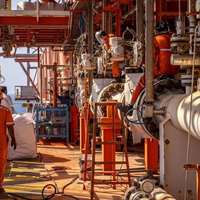
An oilfield worker walks next to drilling rigs at an oil well operated by Venezuela's state oil company PDVSA, in the oil-rich Orinoco belt, April 16, 2015.
Iran's semi-official Fars news agency has stated that Tehran envisions to boost its oil exports to Venezuela, with a target of 860,000 barrels per day within three years.
This plan involves not only exporting oil but also repairing Venezuelan refineries to facilitate this export. The goal is to restore Iran's oil exports to pre-sanctions levels, reaching 2.5 million barrels per day, amid US sanctions.
This is noteworthy given previous efforts by Iranian companies to repair Venezuelan refineries in 2020, particularly the 'Cardon' refinery, which experienced a fire shortly after repairs, and the unsuccessful overhaul of the El Palito refinery.
Iran renewed a €100 million contract for the repair of the El Palito refinery with Venezuela last year, and the facility, operating at 20% capacity, began operations in June 2023. Previously, this refinery had a daily capacity of 140,000 barrels, and it is unclear what its current capacity is.
El Palito refinery which belongs to PDVSA is seen in Puerto Cabello, in the state of Carabobo, March 2, 2016.
In recent years, Iran's non-oil exports to Venezuela have remained around $20 million annually, equivalent to less than 0.1% of Iran's total non-oil exports.
Amid serious economic isolation, the Iranian regime clings to any small and insignificant international economic deal to show audiences at home that the government is successful in fighting sanctions and instill hope that the economic crisis can be overcome. Minor deals with developing countries in Asia and Africa are trumpeted as major successes.
Iran also signed a gas condensate barter deal with Venezuelan heavy oil, starting in the fall of 2021. Data from the Commodity Intelligence Company, Kepler, indicates that Iran delivered 28 million barrels of gas condensate to Venezuela until January 2023 and bought extra-heavy crude oil from the country for resale to China.
However, since February this year, with the reduction of US oil sanctions against Venezuela, the country has not received any shipments of gas condensate from Iran. This indicates that as soon as Caracas was offered a reprieve from sanctions, it began procurement from other sources.
Iran's ambition to repair Venezuelan refineries and export crude oil to the country is significant considering its own domestic refinery challenges. Iranian refineries have experienced a 10% decline in the past decade due to insufficient maintenance and upgrades, leading to the conversion of 30% of received crude oil into mazut and bitumen, compared to just 4% in modern refineries.
For instance, Iran's largest crude oil refinery, Abadan, converts 47% of the crude oil it receives into mazut and bitumen. The operation of this refinery is, in principle, not economically viable.
Iran had agreements with South Korean and Chinese companies in the mid-2010s aimed at reducing mazut and bitumen production from refineries to 10%. However, these deals were canceled following the US withdrawal in 2018 from the Obama-era JCPOA nuclear deal, and Iran has faced challenges in modernizing and repairing its domestic power plants.
Iran’s oil exports fell from 2.2 million barrels per day in 2017, to less than 300,000 in 2019, after full US sanctions came into force. However, recently Tehran has succeeded to boost exports close to 1.8 million barrels per day, as the Biden administration has failed to enforce the sanctions. China is the main customer of Iran’s illicitly shipped crude.
Venezuela, once possessing a refining capacity of 1.3 million barrels, has seen its capacity diminish to less than 190,000 barrels per day due to refinery aging and inactivity, exacerbated by US sanctions over the past decade.