Iranian Doctor Loses Medical Licence For Not Wearing Headscarf

Videos on social media are circulating showing a female doctor appearing in a public ceremony without wearing the hijab enforced by the Islamic regime in Iran.

Videos on social media are circulating showing a female doctor appearing in a public ceremony without wearing the hijab enforced by the Islamic regime in Iran.
The ceremony which took place in celebration of Physicians Day on October 24th in Amol was attended by doctors and members of the medical profession.
Local media has reported that Rajayi-Rad had angered members of the clergy and is now being prohibited from entering the university in Amol.
On Friday, another video of Rajayi-Rad was published on state media in Iran, showing the doctor in full Islamic attire apologizing for her actions.
“I sincerely apologize to anyone who I have offended for not wearing a full hijab.”
“In recent days I have been receiving phone calls from anonymous people offering me [political] asylum [abroad].”
“I will say here and now that I am the child of this soil and water and will stay in Iran where I will be following the rules including wearing the hijab,” said Rajayi-Rad in a video.
Forced confessions and retractions are an intimidation tactic used by authorities in Iran to instil fear amongst the public.

A human rights group has reported that Iran’s judiciary has brought charges against a man that are punishable by death for posting negative comments about the regime.
Hengaw Organization for Human Rights said on Thursday that 39-year-old Ali Akbar Zaz has been accused of ‘Sab Al-Nabi’ or insulting the prophet and ‘Moharebeh’ or enmity against God. These are vaguely defined charges which carry a death sentence.
Zaz was arrested in June 2023 by security forces at his home in Tehran for criticizing the Islamic Republic on social media, according to Hengaw.
The human rights group also reported that Zaz has told his family on a telephone call that during his detention he has been subjected to torture and forced confessions.
The Islamic Republic has been ramping up execution practices since the anti-regime protests began last year after the death of Mahsa Amini. Arrested for not wearing her hijab properly, Amini was found to have been dealt severe blows to the head.
Iran executed protestors for taking part in the nationwide uprising which human rights groups called “horrifying” and “chilling”.
“These executions are designed by the Iranian authorities to send a strong message to the world and the people of Iran that they will stop at nothing to crush and punish dissent.”
“In the absence of a robust international response, the authorities will continue to revel, unabated, in their impunity with lethal consequences for people in Iran,” said Amnesty International regarding the wave of executions in Iran.
Zaz remains in prison with no sentencing reductions made to his case, Hengaw said.

Iranian authorities should stop “the use of unlawful force” against worshippers and demonstrators in the Sunni city of Zahedan, Amnesty International has demanded.
The rights group reported that crackdown on protesters belonging to the Baluchi minority in Zahedan, southwest of Iran, intensified on October 20 as the security forces “resorted to severe beatings, unlawful use of tear gas and water cannons” and “carried out mass arbitrary arrests, enforced disappearances, torture and other ill-treatment.”
According to Amnesty, hundreds of people, including “scores of children” were arrested last week, with many of them still remaining “forcibly disappeared.”
The report also mentioned that many of the arrested individuals, even children, were tortured by security forces.
“Security forces removed detainees’ shirts and made them stand facing the wall while blindfolded before firing paintball launchers at their backs and hips at close range,” read the report by Amnesty International.

The people of Sistan-Baluchestan, with Zahedan as provincial capital, have been holding weekly protests after security forces opened fire at peaceful protesters, killing nearly 100 on September 30, 2022, a day known as the Bloody Friday of Zahedan.
Zahedan is one of the few Sunni-majority cities in predominantly Shiite Iran.
“The authorities are ramping up their brutality to stop Baluchi protesters from gathering each week in Zahedan,” warned Diana Eltahawy, Amnesty International’s Deputy Regional Director for the Middle East and North Africa.
She also called on the international community to urge Iran “to halt the unlawful use of force and firearms against peaceful protesters, stop torturing detainees and release children and all others detained solely for peacefully exercising their rights.”
According to Eltahawy, the systematic impunity of the Iranian officials has allowed them to impose more severe crackdowns on the protesters.
It is essential that criminal investigations be launched into the crimes committed by the Iranian officials “under the principle of universal jurisdiction,” she stressed.
A witness to the October 20 violence told Amnesty International that security forces abandoned a wounded child in the streets even though he had a bleeding gash.
“Many detainees including children sustained fractures to their hands and legs,” the witnessed added.
Another woman also called on the organization to “ensure the voices of Baluchi protesters are heard,” warning that every Friday in the region might witness another heinous bloodshed.
According to reports, on October 20, security was tense around the Makki Jameh Mosque of Zahedan, where outspoken Sunni leader Mowlavi Abdolhamid weekly delivers fiery sermons criticizing the Islamic Republic and its policies.
Abdolhamid has repeatedly called for an end to repression in the past one year and respect for civic and human rights in Iran.
The heavy security atmosphere on October 20 can be related to a wave of crackdowns against the Sunni community, particularly dissident Sunni clerics and their close circles, including arrests and travel bans, especially since the Israel-Hamas conflict began earlier in the month.
Amnesty International also called on the international community to press Tehran to cooperate with the United Nations Fact-Finding Mission and provide it with “unimpeded access.”

The reformist Shargh daily in Iran reported that 84 percent of the over 12,000 respondents to its poll on hijab are opposed to mandatory dress code and headscarves.
The online poll, completed over a period of one month, was conducted after lawmakers, mostly affiliated to the ultra-hardliner Paydari Party, ratified a bill in September that they have named "Protection of Family Through Promotion of Hijab and Chastity Culture".
The legislation, originally prepared by the government and later modified by the parliament’s hardliners, proposed various penalties including heavy cash fines for women who do not abide by the prescribed dress code of the Islamic Republic. This dress code consists of a headscarf covering all hair and the shoulders, a loose long tunic with long sleeves, and trousers that cover the legs to below the ankles.
The constitutionally mandated 12-member Guardian Council which, among other things, has the final say in legislation, rejected the bill on Tuesday in a surprising move and asked the parliament to amend it.
The Council has found several formal shortcomings in the text including vagueness of some of the terms used in it, such as a term translatable as “unchastity” or “corruptness”.

The Council’s rejection of the proposed hijab law has nothing to do with people’s objection to it, Asieh Amini, a Norway-based women’s rights activist, told Iran International. According to Amini, the reason for the Council’s rejection is based on the hardliners’ wish to make the legislation as watertight as possible.
Others believe the Guardian Council may have been apprehensive about increasing the people’s discontent with the regime before the upcoming parliamentary elections in March. The elections four years ago had the lowest participation rate in the four-decade history of the Islamic Republic.
“The outcome of this bill will be nothing other than increasing people’s discontent, decline [of belief] in hijab, and deepening of the rift between the government and the people,” conservative journalist Behrouz Mirzaei-Shirmard tweeted before the Council’s rejection of the bill. He said he hoped “those in the system who are wise and care” would stop the bill, which “is in contradiction with citizen’s rights” from being approved.
In the past few months, hardliners have tried to impose strict hijab rules in government offices, schools and universities, hospitals and other public places. Nevertheless, many women are defying the hijab rules.
For instance, Habib Ilbeigi, the director of the supervision department of the Islamic Guidance Ministry’s Cinema Organization, said that actresses who have defied hijab standards will be banned from acting.

The department has released a list of banned actresses that includes many popular actresses including Baran Kowsari, Vishka Asayesh, Taraneh Alidoosti, Katayoun Riahi, Pantea Bahram, Hengameh Ghaziani and Pegah Ahangarani.
The organization is mandated with the approval of public screening and streaming of all films produced in Iran, and very often implements censorship by rejecting scripts or modifying them.
Sources in Iran say in many places, wearing the hijab now is stranger than not wearing it, as the number of women wearing ordinary clothes and no headscarf has hugely increased.

A worsening crisis of insolvency in Iran's social security system and pension funds, poses an additional threat to the unpopular establishment in Iran.
The reports and videos sent to Iran International demonstrate that retirees in different provinces such as the oil-rich Khuzestan, Kermanshah and Kordestan have launched rallies over the recent days to voice their discontent about the government’s economic policies. The protests are expected to continue as pension funds in Iran are experiencing a full-fledged financial crisis.
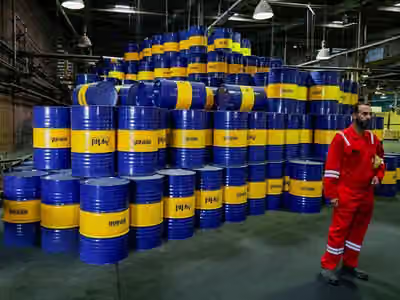
Shargh newspaper in Tehran provided coverage from a gathering of economic experts who discussed the issue, highlighting the challenges faced by Iran's pension funds, with many receiving no funding at present. The government's debts to Iran's Social Security Organization are steadily increasing, leading to concerns that the government might need to transfer the entire oil industry to the Social Security Organization to settle its debts.
Iran’s pension funds find themselves in an unfavorable situation with many of them receiving zero input at the present, Shargh quoted a former director of Iran’s Social Security Organization Mehdi Karabasian as saying.
Hossein Abdoh, economist and former Secretary General of Tehran Stock Exchange, also pointed out that the Iranian government does not fully comprehend the imminent crisis of the pension funds.

He noted that the government’s debts to Iran’s Social Security Organization are increasing steadily.
“It seems that one day the government will have to give the whole oil industry to the Social Security Organization to settle its debts,” Abdoh warned.
Iran has faced a serious economic crisis since the United States withdrew from the JCPOA nuclear accord in 208 and imposed oil and banking sanctions. Its failure to reach a new agreement under the Biden administration has gradually drained government finances and rounds of serious anti-regime protests have taken place.
Iran’s Social Security Organization is a public institution that provides health insurance, pension and unemployment benefits to its members. They range from workers and government employees to self-employed individuals. According to official statistics, 53 percent of the Iranian population receive some type of benefit from the organization.
On October 24, Moslem Salehi, a member of the Economic Commission of Iran's parliament, said in an interview with Tasnim news agency that all pension funds, “except two or three,” have gone bankrupt.
Without the government’s assistance, these funds will not be able to meet the needs of the retirees, he stipulated. However, the issue is not limited emergency funding, but the underlying factor of a weak economy, mismanagement, corruption, and a huge government budget deficit.
According to Shargh, in the current budget, $6.62 billion of public expenditures has been allocated to pension funds. This is while the government still owes $3.4 billion to the pension funds.
Experts have warned against the policy of funding pension funds via annual budgets, saying that this will result in unfortunate consequences in the future.
In May 2023, the then-director general of social insurance in Iran’s Ministry of Labor, Sajjad Badamforoush said that even if the government sells the two southern islands of Kish and Qeshm and Khuzestan province, it will not be able to pay pensioners' arrears.
He was fired a few days after these remarks.
Earlier in the year, a report in Rouydad24 also pointed out that the crisis concerning the pension funds will paralyze Iran and will plunge its economy into a new crisis in less than two decades.
Touching upon the critical condition of the pension funds, Hossein Amerian, general director of steel industry pension fund, revealed in April 2023 that around $400 million was lost either through mismanagement or embezzlement.
There are 800 investigations taking place to identify all those who are responsible for the losses, he added.
In May 2023, Rahim Mombeini, the deputy head of Iran’s Planning and Budget Organization, announced that President Ebrahim Raisi’s administration faces a huge budget deficit this year.
According to Mombeini, the amount of the Iranian government internal debts has increased about 900-fold over the past decade to $60 billion. This amount of debt, which is equivalent to 31% of the GDP, includes government debts to banks, the Central Bank of Iran, pension and social security funds, public and private sector contractors, and bonds that have been issued in previous years.

Amnesty International has called on Iran to cease the "unlawful use of force" in response to the upcoming Friday protests in Zahedan.
In a statement issued on Thursday, the human rights organization urged the regime's authorities to "refrain from unlawfully deploying repressive forces during the upcoming Friday protests and to respect the right to peaceful assembly."
Diana Eltahawy, Amnesty International’s Deputy Regional Director for the Middle East and North Africa, said in the statement, “The authorities are ramping up their brutality to stop Baluchi protesters from gathering each week in Zahedan.”
She called upon governments worldwide to “urgently call on the Iranian authorities to halt the unlawful use of force and firearms against peaceful protesters, stop torturing detainees and release children and all others detained solely for peacefully exercising their rights.”
Earlier, human rights media had reported the names of 112 citizens detained during the protests in Zahedan the previous Friday, including 33 children. Among the detainees is Mowlavi Fazl ul-Rahman Kouhi, the prayer leader of the village of Pashamag in Sarbaz County, Sistan and Baluchestan. No information is available regarding the charges or the whereabouts of these individuals.
Sistan and Baluchestan province was one of the regions with the highest number of protests during the nationwide protests which began last year in addition to the highest number of casualties. During the 'Bloody Zahedan Friday' on September 30 last year, nearly a hundred people, including children, were killed by the regime's security forces.