Questions And Tensions Mount In Wake Of Deadly Shrine Attack In Iran

Questions abound following the deadly shooting Sunday at a religious shrine in southern Iran, with the government announcing arrests as people widely speculate.
Questions abound following the deadly shooting Sunday at a religious shrine in southern Iran, with the government announcing arrests as people widely speculate.
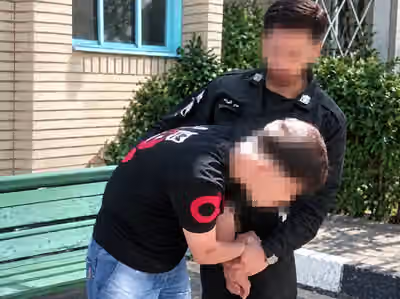
Iran’s judiciary said on Monday that eight suspects have been detained over the attack on Shahcheragh, a funerary monument and mosque in Shiraz that was the site of a similar attack less than a year ago.
Saying that all detained suspects were foreign nationals, the judiciary's Mizan news agency said the main perpetrator was identified as Rahmatullah Nowruzov, a citizen of Tajikistan, while the nationalities of the other suspects remained unknown. Tasnim, a media outlet affiliated with the Revolutionary Guard said 10 foreigners were arrested in relation to the attack.
According to NourNews, a media outlet close to Iran's Supreme Council of National Security, one person was killed and ten people were wounded when the shooter opened fire at the premises of the shrine before being arrested.
The regime’s state broadcaster announced that the Islamic State group (ISIS) has claimed responsibility for the attack, but so far there is no evidence of any statement by the terror group.
In last year's attack when 15 people were killed at Shahcheragh, the Islamic State claimed responsibility. The militant group, which has claimed other attacks in Iran -- including the deadly twin bombings in 2017 that targeted Iran's parliament and the tomb of the Islamic Republic's founder Ruhollah Khomeini – has played the role of boogeyman in regime’s narratives of regional developments to justify its military presence and support of other foreign militias, and strict security atmosphere inside the country.
A large number of regime officials, including parliament speaker Mohammad-Bagher Ghalibaf, Foreign Minister Hossein Amir-Abdollahian and President Ebrahim Raisi as well as several lawmakers and military commanders, vowed revenge against those behind the attack.
In a vague remark, Foreign Ministry spokesman Nasser Kanaani said, “The attack on worshippers is a heinous act of vengeance in response to the significant blows that Iran dealt on terrorists in the battlefields.” The governor of Fars province, Mohammad Hadi Imaniyeh, attributed the motive of the assailant to "vengeance" for the execution of two individuals involved in last year's attack.
In July, Iran publicly hanged two Afghan men who were accused of "providing weapons, procurements, logistics, and guidance of the main perpetrator", which bears uncanny resemblance to the Sunday shooting. The lone gunman, armed with an assault rifle, entered the shrine last October and opened fire, and was subsequently shot and later died in hospital. He was also identified as a Tajikistan citizen. The October attack coincided with anti-regime protests in Iran. This prompted speculation and accusations that the government orchestrated the incident as a diversion from the protests and as a pretext for further crackdown.
Within the Iranian social media sphere, opinions diverge on how to respond to the attack, with some holding the regime accountable for either incompetence or possible involvement, while others echo the regime's stance in condemning the extremists.
A large number of people criticize the regime for focusing its forces and surveillance methods for cracking down on women who refuse to wear the hijab, rather than real criminals. Additionally, some speculate that this attack was orchestrated to divert public attention away from the ongoing political debate regarding the enforcement of new hijab laws, currently undergoing final deliberations in parliament.
In the lead-up to the anniversary of last year's nationwide anti-regime protests in September, Iranian authorities have heightened security measures, resorting to intimidation and threats in an attempt to prevent public demonstrations. Some believe that the attack on Shahcheragh was orchestrated to provide a pretext for tighter security measures.






Tweet unavailable