US Sanctions Iranian Operatives For Overseas Assassination Plots

The United States on Thursday imposed sanctions on members and affiliates of Iran's Islamic Revolutionary Guard and its external operations arm, the Quds Force.

The United States on Thursday imposed sanctions on members and affiliates of Iran's Islamic Revolutionary Guard and its external operations arm, the Quds Force.
Washington accused those sanctioned of participating in terrorist plots targeting former US government officials, dual US and Iranian nationals and Iranian dissidents.
Former US Secretary of State Mike Pompeo and former national security adviser John Bolton have been targets of Iranian assassination plots.
The US Treasury Department said the move targeted three Iran- and Turkey-based individuals and a company affiliated with the IRGC-Quds Force and two senior officials of the IRGC's Intelligence Organization involved in plotting external lethal operations against civilians, including journalists.
The Treasury said the five included Mohammad Reza Ansari, a Quds Force member whom it said has supported its operations in Syria, and Iranian citizen Shahram Poursafi, whom it said had planned and attempted to assassinate two former US government officials.
It also put sanctions on Hossein Hafez Amini, a dual Iranian and Turkish national based in Turkey, whom it accused of using his Turkish-based airline, Rey Havacilik Ithalat Ihracat Sanayi Ve, to assist the Quds Force's covert operations, including kidnapping and assassination plots targeting Iranian dissidents.
The airline was also placed under sanctions.
The Treasury Department also said it had imposed penalties on two people linked to the IRGC's Intelligence Organization, which it described as a domestic and international unit focused on targeting journalists, activists, dual Iranian nationals, and others who oppose Iranian abuses and human rights violations.
It named these as Rouhallah Bazghandi, the former chief of the Intelligence Organization's counterespionage department, and the Intelligence Organization's chief, Reza Seraj.

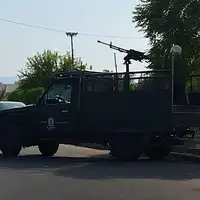
Amid the tensions between Iran and the Taliban over water, the militant group has reportedly deployed a convoy of tanks from Herat to Islam Qala on the border with Iran.
Videos shared on social media show that the Taliban forces are stationed in the region with heavy military equipment.
A video shows a convoy of Taliban tanks moving from Herat towards the Iranian border.
Local sources say the recent tensions between Iran and the Taliban started after they prevented the construction of a road and the installation of barbed wire by the border guards of the Islamic Republic of Iran.
The sources also added that the border forces of the Taliban and border guards of Iran got into a verbal tension last Friday in Islam Qala.
However, the Iranian media wrote on Tuesday evening that the situation at the border is calm.
Tasnim news agency, affiliated with the IRGC, denied any tension between the Taliban and the border guards of the Islamic Republic in the area.
The Taliban authorities have not yet officially commented on sending troops to the border.
The tension at Islam Qala comes as the Taliban and the Iranian border guards clashed on Saturday in Nimroz. Two Iranian guards and one Taliban fighter were killed after shooting broke out near a border post.
It was not immediately clear what had caused the incident, in which several people were also injured, but it came amid tensions over water rights.
Iran has accused Afghanistan's Taliban of violating a 1973 treaty by restricting the flow of water from the Helmand River to Iran's parched eastern regions, an accusation denied by the Taliban.

Israeli President Isaac Herzog and his Azerbaijani counterpart Ilham Aliyev discussed the threat of Iran in Baku on Tuesday.
“We look at the regional security structure that is threatened by Iran - a topic that we discussed in depth,” Herzog said following his meeting with Aliyev, “and we expect to develop cooperation between us in many fields.”
Azerbaijan and Israel have been expanding bilateral relations for many years, with Herzog's visit being the latest step. Israel has had an embassy in Baku since 1992 and in March, Azerbaijan opened its own in Tel Aviv.
“Iran is a destabilizing influence in the region that is working continuously to act against Israel and against the alliance of peace and security that is developing in the region, and I will certainly discuss this,” said the Israeli president.
Herzog will participate in a ceremony celebrating Israel's 75th birthday along with the local Jewish community on Wednesday.
Oil and gas rich Azerbaijan gets 69% of its military weapons from Israel, and Israel imports 40% of its oil from the Caucasian state which shares a border with Iran.
It has been a tense few months between Tehran and Baku. Iran angrily reacted to Azerbaijan’s opening an embassy in Tel Aviv in March, accusing it of aiding Israel in its operations against the regime, in addition to relations souring following an armed attack on Azerbaijan’s embassy in Tehran in January. Iran has also carried out military drills over the border in a bid to intimidate its neighbor.

The US State Department is offering a reward of up to $10 million for information on the IRGC financial distributor to Hezbollah, Muhammad Qasir.
The "Reward for Justice" program affiliated with the US State Department said in a statement on Tuesday that the reward will be given for information leading to the disruption of the financial mechanisms of Hezbollah.
“Muhammad Ja’far Qasir, also known as Shaykh Salah and Hossein Gholi, is a key Hezbollah financier, who provides funding for Hezbollah operations through a number of illegal smuggling and procurement activities and other criminal enterprises,” read the statement.
In addition to funding Hezbollah's activities, Qasir channels funds from Iran's Islamic Revolutionary Guard Corps-Qods Force (IRGC-QF).
It is through him that the IRGC-QF is able to hide its involvement in the sale of oil and other extractives, which is a crucial source of revenue for Hezbollah, the IRGC-QF, the brutal regime of Bashar al-Assad, and others.
Qasir leads Hezbollah’s Unit 108, which coordinates closely with the IRGC-QF to facilitate the transfer of weapons, technology, and other support from Syria to Lebanon.
Qasir was designated a Specially Designated Global Terrorist by the US Department of Treasury in May 2018.
All Qasir's properties and interests under US jurisdiction are blocked as a result of this designation, and US citizens are prohibited from engaging in business with Qasir.
Washington has designated Hezbollah as a foreign terrorist organization, which means providing material support or resources to it is illegal.

The United Arab Emirates said Wednesday that it withdrew from a US-led Middle East maritime security coalition two months ago after evaluating its security relationships.
The UAE move roughly corresponds with Saudi Arabia’s decision in early March to restore diplomatic relations with Iran, which has been much discussed as a shift in Riyadh’s regional policies. The deal was brokered by China which further highlighted a weakening of the decades-long reliance on the United States by Persian Gulf Arab oil producers.
"As a result of our ongoing evaluation of effective security cooperation with all partners, two months ago, the UAE withdrew its participation in the Combined Maritime Forces," the Ministry of Foreign Affairs said in a statement carried by state news agency WAM.
The Combined Maritime Forces is a 34-nation task force, headquartered at the US naval base in Bahrain, working on security, counterterrorism and counter-piracy in the Red Sea and the Persian Gulf areas. But in fact, the US and Israel were trying to forge a regional coalition to contain Iran, including an air defense network.
The region contains some of the world's most important shipping routes where, since 2019, suspected Iranian attacks began against oil tankers amid tensions with the United States. The Obama, Trump and Biden administrations chose not to retaliate against Iranian naval provocations over the years or show a convincing military deterrent response.
Former President Donald Trump was said to have blinked when suspected Iranian drones and missiles hit Saudi oil facilities in September 2019, inflicting heavy damage. Reports at the time said that Trump changed his mind about a military response at the last minute.
The statement said the UAE was committed to dialogue and diplomatic engagement to advance regional security and stability, and that it was committed to ensuring navigation safety in its seas in accordance with international law.
However, five weeks ago, Iran seized two tankers within a week in Gulf waters near the Strait of Hormuz. The second tanker, the Niovi, had been travelling from Dubai toward the UAE's Fujairah port.
The UAE also said that a report by the Wall Street Journal on Tuesday which, citing US and Gulf sources, said the UAE was frustrated by the lack of US response to the recent tanker seizures, was a "mischaracterization" of conversations between the two countries.
However, the UAE decision to leave the maritime coalition and speak about “diplomatic engagement” - possibly referring to Iran - to enhance its security, shows that the WSJ report was not off the mark.
The UAE announcement will be seen in Tehran as a triumph, since the Iranian regime has proclaimed the goal of expelling the United States from the region to be at the top of its agenda.
The White House will face more domestic criticism by Republicans, who have already charged that the administration's flirtations with Iran to revive the 2015 JCPOA nuclear deal, has driven the Saudis to seek alternative security arrangements.
Iran, however, might press its luck too hard. If Tehran was aware of the UAE decision, its new seizure of vessels in the Persian Gulf might demonstrate to the Emiratis that Tehran will not be satisfied with a more neutral UAE position and will use military force to further intimidate regional countries.
With reporting by Reuters

South Korean media say Seoul and Washington are mulling over ways to release Iran’s $7 billion funds frozen due to US sanctions on Tehran.
In an article on Tuesday, the Korea Economic Daily said the move will help Seoul resume its business ties with Tehran as well as President Joe Biden in the 2024 US presidential election.
Citing diplomatic and government sources in Seoul, the conservative business daily said Korean and US government officials are involved in working-level discussions under Washington’s leadership to unfreeze the Iranian funds.
South Korea has blocked $7 billion which it owes for importing Iranian oil prior to full imposition of US sanctions in May 2019. Bilateral ties between Iran and South Korea are frayed because of Seoul's refusal to release the Iranian money held at two commercial banks – Woori Bank and the Industrial Bank of Korea.
South Korea was previously one of Iran's biggest crude oil buyers in Asia. Before the reimposition of US sanctions, South Korean oil companies paid for their oil imports in their own national currency the won through the Iranian central bank account in Seoul and paid government companies involved in selling the oil in rials.
The report quoted unnamed sources familiar with the matter as saying that the release, if implemented, will come “under stringent conditions that Iran use the funds only for public purposes such as UN dues and purchasing COVID-19 vaccines.”
Previously, there have been reports that the US would agree to the release of the funds solely for humanitarian needs, but Washington has never confirmed the existence of such a plan.
“If all goes to plan, we expect our strained relationship with Iran to improve significantly,” a Seoul government official told the newspaper.
According to the source, if talks turn out to be successful, the frozen money will be allowed to be transferred to Iranian bank branches in neighboring Middle Eastern countries, not directly to Iran, to monitor the flow and use of the funds.
The report came three days after Iran International reported that “the Islamic Republic is expected to free hostages with dual nationality in exchange for its assets in South Korea and show more flexibility on issues related to its nuclear program in exchange for the release of its funds in Iraq.”
Currently there are three dual nationals with American citizenship and two individuals with US permanent residency held by Iran on trumped-up charges of espionage. The three citizens are Siamak Namazi, Emad Sharghi and Morad Tahbaz, while Jamshid Sharmahd and Shahab Dalili are US permanent residents.
Confirming the report by Iran International and those of “some local media in the Middle East,” the South Korean outlet also said a transfer of Iranian funds in Seoul would come with conditions that Tehran release “a US hostage held in Iran on spying charges” and limit uranium enrichment levels during nuclear development at 60%.

As South Korea-Iran relations turned sour, Tehran once incited a boycott of Korean products in Iran, targeting Samsung Electronics Co. and Revolutionary Guards briefly seized a Korean oil tanker in 2021.In 2022, a newspaper funded by Supreme Leader said Iran must close the Strait of Hormuz to South Korean vessels until Seoul releases $7 billion frozen funds.
Seoul’s relations with Tehran apparently worsened earlier this year when President Yoon Suk Yeol described the Islamic Republic as the “enemy” of the United Arab Emirates during his trip to the UAE, comparing the threat the UAE faces from Iran to the threat South Korea faces from North Korea. Yoon said, “The enemy of the UAE, its most-threatening nation, is Iran.”
The report quoted Sung Il-kwang, a Korea University professor, as saying that “There is nothing South Korea can gain from becoming an enemy of Iran... Korea will benefit from gaining access to Iran’s huge market.”