Iran Minister Says Hijab Must Be Strictly Observed In Hospitals

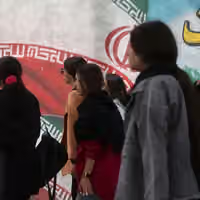
Iran’s health minister says violation of hijab regulations is considered a crime at hospitals and if they do not abide by hijab regulations, they will not receive approval to operate.

Iran’s health minister says violation of hijab regulations is considered a crime at hospitals and if they do not abide by hijab regulations, they will not receive approval to operate.
Bahram Einollahi said in an interview with Fars News Agency on Tuesday that public hospitals have been required to comply with the hijab law and provide services to women by female staff.
“Women's ultrasound should be performed by women, and in some cases that we do not have enough radiologists, we ask female general practitioners and gynecologists to be given short-term training,” underlined the minister.
His comments are made in a situation that the recent protest movement in Iran was triggered by the death of Mahsa Amini, a 22-year-old woman, when she was arrested by the ‘morality police’ for ‘improper hijab.’
During the nationwide protests, many women removed the mandatory hijab and set their headscarves on fire in the streets as a sign of protest.
Western governments, including the United Kingdom, the United States, and Canada, added the hijab law enforcement unit to their list of sanctioned entities.
A lawmaker said in December that the regime is making some changes about hijab rules. He added “it is possible that women who do not observe hijab would be informed via SMS, asking them to respect the law. After notifying them, we enter the warning stage... and last, the bank account of the person who unveiled may be blocked."

The father of Armita Abbasi, a 20-year-old protester who was arrested during Iran's nationwide protests, says his daughter has been released.
Hamid Abbasi wrote on his Instagram Tuesday that "We experienced a very difficult time, but now I am extremely happy."
He did not explain more about the release of her daughter but wishing for the release of other detainees of the protests, he wrote "Hope we won’t have political prisoners anymore."
A week ago, Armita Abbasi's lawyer, Shahla Orouji, said she had been accused of "propaganda against the establishment", and "holding a gathering with the intention of acting against national security".
Orouji stated that although her client's two-month detention term has been served, "the [officials] resist her release on bail".
Armita Abbasi, 21, was arrested in late September during the protests following the death of Mahsa Amini in hijab police custody. According to leaked reports, she was gang-raped many times after being arrested, for which she was taken to hospital. Security forces quickly kidnapped her from the hospital and took her back to prison.
Her family, who were somehow informed she had been taken to hospital went to the hospital in Karaj, but the agents took her out before they arrived.
Alborz province judiciary said on November 8 that "the news published about rape of Armita Abbasi is baseless and not true."

The 2009 Green Movement leader Mir-Hossein Mousavi’s rejection of the reform option in the Islamic Republic has been met with admiration and antipathy alike.
In a rather short statement entitled “To Save Iran” Saturday, Mousavi who has been under house arrest along with his wife Zahra Rahnavard since 2011 underlined his recognition of the ‘Woman, Life, Freedom’ movement and called for a fair and free referendum to decide whether the present constitution should be amended or completely replaced.
He also called for elections to appoint a constitutional assembly to decide the future form of government as well as a further vote to decide whether the new constitution is acceptable to the people or not.
Such a referendum would very likely put an end to Velayat-e Faghih (rule of the Islamic jurist) which gives a cleric such as Ali Khamenei extraordinary powers including the power to overrule all elected bodies and officials and hence, people’s choice.
This comes in contrast to his position in 2009 when in a highly disputed election result he was denied the presidency running against the incumber Mahmoud Ahmadinejad. At that time although millions of people poured into the streets to support him, he refrained from seriously challenging the regime and its leader Ali Khamenei.
Mousavi admitted that he did not know who should decide to hold a referendum, since the current rulers would not, but called for cooperation among all political forces and figures who believe in preserving the country’s territorial integrity and non-violence to clarify these points.

“There were two types of reformists in Iran. Some neither desired nor thought it possible to overthrow the misery [caused by the clerical rule] and sought a share of power. A minority including Mir-Hossein Mousavi believed that the misery of the clerical rule was reformable and could evolve into democracy. Mir-Hossein Mousavi’s courageous new statement showed that he has given up the dream of reform,” US-based academic Abbas Milani tweeted.
Some reformists, including seven prominent political prisoners and over a dozen figures of the ‘religious intellectual movement’, and its mentor Abdolkarim Soroush, have welcomed his proposal, others have strongly rejected it.
Speaking to Iran International, Soroush said Mousavi’s supporters and opponent agree that he “bears a weight” that cannot be ignored.
The political prisoners who have supported Mousavi’s new move have said that they will do their best to advance his proposal to bring a “peaceful and non-violent transition to a completely democratic and developed Iranian structure."

Many of Mousavi’s opponents say as a former prime minister (1981-1989) he is responsible for much of the regime’s wrongdoings and atrocities including mass execution of thousands of political prisoners in 1988 and the Cultural Revolution to expurgate universities from Marxists and militant political groups such as the Mujahedeen-e Khalq Organization.
Arguing that Mousavi has never denounced the Islamic Republic’s founder, Ruhollah Khomeini and his ideology, and still admires him and his “golden era”, pro-monarchy journalist and activist Morteza Esmailpour said in a tweet that Mousavi himself should be put on trial because “the regime was always criminal”.
The prison executions were carried out based on a fatwa by Iran's then-supreme leader, Ruhollah Khomeini, against the MEK which carried out a wave of bombings in Iran and struck an alliance with Saddam Hussein during the 1980-88 war. “Showing mercy to those who take up arms against the Islamic government is being naïve,” Khomeini said in his fatwa.
In June 2010 Mousavi claimed, in a meeting with a group of journalists and political activists, that not only he, but also other top officials -- including the president, chief justice and the speaker as well as Khomeini’s designated successor Hossein-Ali Montazeri – were unaware of what was happening in prisons and blamed the prison purge on others including a former warden of the infamous Evin Prison Assadollah Lajevardi.
He also admitted that many of the prisoners who were executed had not committed any crimes or if they had, they were already serving their sentences. “We even knew some of them, from before the revolution and after that… They were poets, they were writers … They had not taken up arms,” he said.

Eight key Iranian diaspora opposition figures will hold a meeting with the media at Georgetown University Friday titled: The Future of Iran’s Democracy Movement.
Since the start of popular antigovernment protests in Iran last September the issue of forming an opposition leadership council has been a hot topic of discussion among Iranians. This is the first time key figures outside the country join together in one venue to express their views.
Exiled Prince Reza Pahlavi, Nobel laureate Shirin Ebadi and Canada-based Dr. Hamed Esmaeilion, President of the Association of Families of Flight PS 752 downed by Iran’s Revolutionary Guard in 2020, as well as US-based author, journalist and women’s rights activist Masih Alinejad, actresses and activists Nazanin Boniadi and Golshifteh Farahani, former captain of Iran’s national soccer team Ali Karimi and Secretary General of Komala Iranian Kurdish party Abdullah Mohtadi are four women and four men of the group.
The February 10 event at Georgetown’s Institute for Women, Peace and Security (GIWPS) will be moderated by Karim Sajjadpour, Senior Fellow at the Carnegie Endowment and adjunct professor at Georgetown University.
“For the first time since the uprisings began, eight of the Iranian democracy movement’s prominent diaspora leaders will share the stage to talk about the continued viability of the movement, their common vision for Iran’s future, and how democratic change in Iran can change the world,” an announcement by GIWPS said.
The event can become a turning point in shaping a united leadership abroad to represent the democracy movement in Iran, where activists have no chance of publicly defending it. Thousands of protesters are still in prison and dozens face the death sentence.
The event coincides with the 44th anniversary of the establishment of the Islamic Republic, which this year is marked amid political uncertainty as many people in Iran support or sympathize with the protest movement and are caught in perhaps the most difficult economic crisis since the 1979 revolution.
The clerical-military regime finds itself in international isolation, facing multiple domestic crises and beginning to show signs of strain.
Last week, Mir-Hossein Mousavi, the leader of the 2009 Green Movement who has been under house arrest since 2011, issued a strong statement calling for a referendum to decide the future form a democratic Iran. Mousavi who was a top leader of reformists in Iran said that there is no hope the ruling regime can be reformed.

Iranians sang the protest song “Baraye” over rooftops and from windows Monday night after it won the first Grammy Award for Best Song for Social Change Sunday.
Iran International has received many videos showing that the song “Baraye” was played and sung by people in different neighborhoods of Tehran and in their cars after it won the award.
People also celebrated the award in Ahwaz, Jiroft, Esfahan, and Karaj to show gratitude to Shervin Hajipour for creating the song.
The song, which was released in the early days of the protests ignited by the death of Mahsa Amini in 'hijab police' custody, was viewed more than 40 million times in two days on Shervin’s Instagram account, and has since become the unofficial anthem of the women-led uprising.
The word ‘baraye,’ which is translated from Persian as “for …” or “for the sake of”, is repeated at the start of every line of the song, which is composed of a collection of tweets by Iranians bemoaning the situation in their country: “For dancing in the streets; for the fear of kissing; for the students and their future”, and “for women, life, freedom”.
After the impactful song went viral and rocked social media, Shervin was arrested by the regime’s agents and the song was removed from his social media pages. He was released on bail in October after he made a forced confession and an apology on his Instagram page. His case is still going through the 'legal' process, according to the Islamic Republic News Agency.
After winning the Grammy, Hajipour simply wrote on Instagram, "We won." However, a large number of Iranians from all around the world congratulated him for the award, calling it a triumph for the antigovernment protests.
There was no immediate reaction in Iranian state media or from government officials to Hajipour’s Grammy victory. The now popular Iranian singer was among more than 19,600 people who have been arrested during the demonstrations, according to Human Rights Activists in Iran. At least 527 people have been killed.
In the past five months, many parts of Iran witnessed the largest protests since the 1979 revolution.
With the death of Mahsa Amini in the custody of the ‘morality’ or ‘hijab police’, the flames of protests against the Islamic Republic flared up to form what many call the first female-led revolution.
“Women are forced to cover their hair with hijab and their bodies in loose clothing. They cannot dance publicly, cannot drive motorcycles and cannot travel without parental or spousal approval — just to name a few restrictions [because] compulsory hijab is a pillar of the Islamic Republic — without it, the foundation is broken,” wrote Politico.
However, the clerical regime has constantly tried to instill the fear that without the Islamic Republic the alternative is ISIS or civil war, but the people are not buying this narrative saying the time has come for an end to clerical rule and the Islamic Republic must be replaced with a secular, democratic government.
A recent online opinion poll conducted from abroad showed that 80 percent of the people in Iran wanted end clerical rule and opt for secular democracy.

Iranian human rights organizations, activists and defense lawyers have slammed a partial prisoner amnesty for protesters announced by the country’s ruler Ali Khamenei.
Iran Human Rights group in a tweet immediately on Sunday announced that the amnesty claim is a “deceitful” step by Khamenei, demanding that all protesters should be freed “unconditionally”, and instead those responsible for repression should be tried in courts.
Protesters were exercising their right to peacefully demonstrate and arresting them had no legal bases, Iran Human Rights said.
Government media reported Sunday that Khamenei had “agreed” with a proposal by the country’s Judiciary to free those who were “misled” and took part in protests.
It is still not clear how many or which prisoners will be pardoned and whose sentences will be reduced. While thousands of young and teenage protesters were arrested in street demonstrations, hundreds of political activists, journalists and writers or artists have also been detained.

Khamenei’s move came days before the 44th anniversary of the Islamic Republic, as a move to rescue the regime’s image amid a grim economic crisis and mass public rejection of the political system he presides over.
The hardliner judiciary has attached so many pre-conditions for any prisoner pardon, that no one knows how many will be freed, while some state media claimed “tens of thousands” will be released.
Some of the conditions for being pardoned were mentioned in the announcement, including no record of spying for a foreign country, no connection with foreign intelligence services, not facing a charge of murder and no accusation of destroying public property. The regime’s security forces and courts, meanwhile, have held thousands of detainees exactly based on these sorts of charges.
A lawyer defending several detained protesters tweeted that Khamenei’s move was nothing more than “imposing the fake version of reality by the regime,” which attempts to switch the guilt from itself to the victims.
Almost all court proceedings have been held behind closed doors, after many detainees were tortured to confess to trumped-up charges. Also, in most cases defendants were not allowed to have their lawyers in the court or even have access to case files.
A former political prisoner Hossein Qashqai tweeted, “It is us who should issue pardons, not you, who carry the blood of our dearest and best children on your hands. We will never forget and forgive.”
Prison interrogators often demand that detainees to sign self-incriminating apologies and pledge not to engage in antigovernment activities. Shahriar Shams, a former prisoner, quoted one his friends who is still behind bars that if the authorities free them unconditionally, it would be fine, but if they demand any letter of remorse “we will not give them anything. We should be the ones to pardon them.”
A Dutch member of the European Parliament tweeted Monday that “Freedom shouldn’t depend on a dictator’s whims. This is hypocrisy and we won’t be fooled.”
European countries have exhibited tough reactions, compared to the past, to Islamic Republic’s bloody suppression and the hanging of four protesters after sham trials. The European Parliament last month passed a resolution demanding Iran’s Revolutionary Guard to be listed as a terrorist organization by the European Union.
Some Iranian conservative supporters of Khamenei have been surprised by the international backlash and admit that the regime is now more isolated. But Khamenei seems to be determined to make no real concession. In one of his recent speeches he said, “In the old days when wounds did not heal, they cauterized them.”