Iranian Lawyer Wins Award For Activities Against Death Penalty
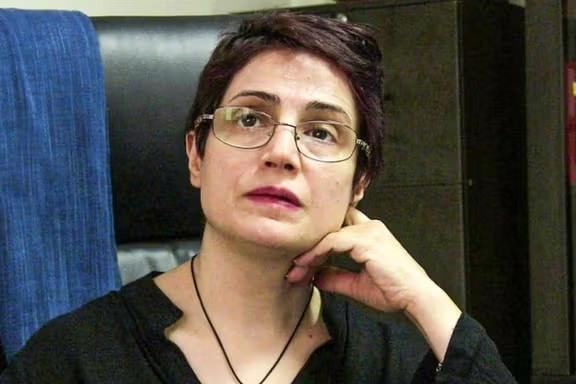
Iranian human rights lawyer, Nasrin Sotoudeh, has won the Robert Badinter Award at the 8th World Congress Against the Death Penalty in Berlin.

Iranian human rights lawyer, Nasrin Sotoudeh, has won the Robert Badinter Award at the 8th World Congress Against the Death Penalty in Berlin.
The award was given to Sotoudeh for her activities in the fight against the death penalty and her efforts to abolish “this inhumane and irreversible punishment.”
Many people were nominated for this award, but Sotoudeh was selected as the winner from among four finalists. She has spent many years in prison in Iran after defending other human rights advocates.
Robert Badinter, the former Minister of Justice of France, has been a long-time activist for the abolition of the death penalty.
Mahmoud Amiri Moghadam, Director of Oslo-based Iran Human Rights Organization received this award on behalf of Nasrin Sotoudeh and recited her message.
Referring to the death sentences issued against Iranian youths for participating in the anti-government protests, Sotoudeh in her message, asked the world to be the eyes and ears of Iranians at this difficult time.
The 8th World Congress against the Death Penalty took place in Berlin 15-18 November 2022. This event brings together more than1,000 participants from 90 countries– human rights activists and public figures who work towards the abolition of death penalty.
Amnesty International on Wednesday said the Islamic Republic is seeking to execute at least 21 people arrested during the protests after “sham trials” to intimidate dissent.
Sotoudeh represented imprisoned Iranian opposition activists and politicians as well as prisoners sentenced to death for crimes committed when they were minors.

Iran has lost $450 billion in oil revenues in a decade because of international and US sanctions, causing a serious economic crisis, a newspaper in Tehran says.
Aftab News website based its calculation of lost revenues on OPEC’s annual oil export numbers and estimated that UN Security Council sanctions that came into play a decade ago and lasted more than 3 years, followed by US sanctions since 2018 cost Iran dearly.
In absence of sanctions, Iran was exporting anywhere between 2.2-2.5 million barrels of crude oil per day, which depending on global prices could generate annual revenues of up to $100 billion. But when sanctions were imposed these exports dwindled to as little as 200,000 barrels per day, as was the case in 2019. Currently, by circumventing existing US sanctions Tehran is believed to be selling up to one million barrels mostly to China.
Around 2010, Iran was generating revenues close to $100 billion while in 2021, OPEC estimated oil export income of just $25 billion, with an average shipment of 763,000 barrels per day. If exports had continued at the 2.5-million-barrel daily rate last year, Iran would have earned $82 billion.
Although our estimate of Iran’s losses in the past decade are much lower than what Aftab news has calculated, it is still considerable. Based on the same OPEC data and other indicators, we estimate that Iran lost around $300 billion, although a substantial part of the sales during sanctions remains hidden from view, especially in terms of actual earnings.
Iran’s losses have a disproportionate impact since the country has not been able to free itself from an oil-export-based economy. About half the government budget depends on oil revenues and a $30 billion annual shortfall is devastating for the largely state-owned and controlled economic system.
That is why the annual inflation rate has stood at more than 40 percent in the past two years as the government has resorted to printing huge amounts of money to pay for its obligations.
The government decided in its November 2 cabinet meeting to allow individuals and companies to sell crude in contravention of US sanctions, according to rules and conditions kept confidential.
This might marginally increase export revenues but first it will enrich government and military leaders who will tightly control who is allowed to act as middleman.
The scheme is not new. During international nuclear sanctions in early 2010s the same method was used with the result that two big embezzlement cases emerged, one in oil exports and the other in petrochemicals.
In one clandestine oil export scheme, a trader named Babak Zanjani, with close ties to government leaders, pocketed at least $2.7 billion and has been in jail for years awaiting execution that has not been carried out so far. Some speculate that either he has still not given back the money or knows too much to be hanged. A third possibility is that he owes percentages to powerful officials, and they still hope to get their money back.
Lately, the Biden Administration appears to be more resolute in enforcing US sanctions, with designating individuals and third-party companies that are involved in one way or another in doing business with sanctioned Iranian entities.
Just on Thursday, the US Treasury Department sanctioned 13 businesses in the United Arab Emirates and Hong Kong that it said were involved in Iran’s petrochemical exports.

Family members of some Iranian political prisoners have warned about the health condition of the detainees who are deprived of having access to medical care.
Sakineh Ronaghi, the sister of Hossein Ronaghi, a human rights activist and journalist, wrote on her Instagram page that her brother is in a “very serious condition” and he will not survive more than five or six days if he is not admitted to hospital immediately.
The dissident blogger and freedom activist Hossein Ronaghi was arrested over his support for protests late in September, and prison guards broke his legs in detention.
Ahmad Ronaghi, his father, also released a video message saying that his son called him from prison on Thursday saying that “he is not feeling well at all.”

He said although doctors insisted “Hossein should be transferred to hospital immediately,” the prison authorities kept him in Evin prison’s infirmary.
Meanwhile, Hossein Sadeghi, father of civil activist Arash Sadeghi, pointed out that his son is suffering from bone cancer, warning about his health condition and the consequences of his lack of access to medicines.
"In a phone call, we found out that Arash's medications are not available in the prison infirmary, and we are not allowed to get medicines from outside,” he wrote on his Instagram page Thursday.
Arash Sadeghi was arrested on October 12 during anti-regime protests. In May 2021, he was released from Rajaei Shahr prison in Karaj after serving a five years and six months sentence.

Washington says it is doubtful about announcements by Iranian officials that the Islamic Republic is developing a hypersonic missile.
Department of Defense's spokeswoman Sabrina Singh said on Thursday that the US questions the accounts claiming that the Islamic Republic developed a hypersonic missile.
“We've seen the reports asserted and coming out of Iran, we remain skeptical of these reports,” the Pentagon spokeswoman told a news conference.
Commander of Iran’s Revolutionary Guard Aerospace Force, Amir Ali Hajizadeh claimed last week that the regime had built its first missile that can fly at least five times faster than the speed of sound.
“This missile has a high speed and can maneuver in and out of the atmosphere. It will target the enemy’s advanced anti-missile systems and is a big generational leap in the field of missiles,” Tasnim News Agency quoted Hajizadeh as saying.
“We will continue to monitor closely any development or proliferation out of Iran or missile systems,” added Sabrina Sing in reaction to the reports.
IRGC officials and state media have not published any details about their claim and have promised that this missile will be unveiled soon.
Tehran’s claim regarding this weapon comes at a time that tensions between the Islamic Republic and the West over the violent suppression of antigovernment protests, Iran’s nuclear case and its drone supplies to Russia are mounting.
Hypersonic missiles are harder to intercept as they only need a low trajectory in the atmosphere.

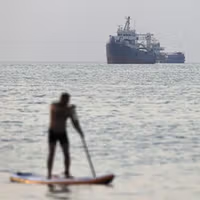
Britain's maritime agency said a drone circled a ship in the Gulf of Oman on Friday, three days after an Iranian-made drone attacked a tanker in the region.
The Maritime Trade Operations (UKMTO), which is part of the Royal Navy, said the incident took place about 50 miles southwest of Muscat. The vessel and crew were reported to be safe. It did not specify what kind of vessel was involved.
The US Central Command said on Wednesday that an Iranian-made drone had attacked the tanker Pacific Zircon on Tuesday.
"This unmanned aerial vehicle attack against a civilian vessel in this critical maritime strait demonstrates, once again, the destabilizing nature of Iranian malign activity in the region," the Central Command statement said.
An Israeli official said Iran was responsible for the strike, while Iran's Nournews, which is affiliated to Tehran's security organization, blamed Israel and said the "Hebrew-Arab axis" aimed to create a "charged atmosphere" ahead the soccer World Cup that starts in Qatar on Sunday.
Pacific Zircon sustained minor damage with no injuries or spillage of the gas oil cargo, its operator, Israeli-controlled Eastern Pacific Shipping, said on Wednesday.
Attacks on tankers in Gulf waters in recent years have come at times of heightened regional tensions.
Reuters Report

While the international community is restricting ties with the Islamic Republic over violence against protesters, Venezuela says it counts on Iran as an ally to bolster its independence.
"We have great friends in the world with a great scientific and technological capacity, the Islamic Republic of Iran, the People’s Republic of China, the Russian Federation, our brothers in India, Belarus," said the Venezuelan president during a speech on state TV Wednesday.
The ninth meeting of the Iran-Venezuela Joint Economic Committee was held in Tehran Tuesday during which Tehran and Caracas agreed for the expansion of ties in several fields.
Both countries are under American sanctions and try to sell their oil by illicit shipments mostly to China.
In June of 2022, Caracas and Tehran signed a 20-year cooperation plan which involves Iranian assistance in repair and maintenance of existing Venezuelan refineries, as well as other technical and engineering expertise.
While Venezuela enjoys what are believed to be the world’s largest petroleum deposits, years of mismanagement, corruption and maintenance issues have dramatically hampered its production and refining capabilities.
As the Iranian public persists with weeks of angry protests against the country's clerical regime, earlier reports from Tehran’s airport suggested some senior officials may have begun sending family members to friendly countries, including Venezuela.
Given Tehran’s relative lack of friends and allies around the world options for Iranian officials to travel to other countries are quite limited.