• العربية
  • فارسی
Brand
  • Iran Insight
  • Politics
  • Economy
  • Analysis
  • Special Report
  • Opinion
  • Podcast
  • Iran Insight
  • Politics
  • Economy
  • Analysis
  • Special Report
  • Opinion
  • Podcast
  • Theme
  • Language
    • العربية
    • فارسی
  • Iran Insight
  • Politics
  • Economy
  • Analysis
  • Special Report
  • Opinion
  • Podcast
All rights reserved for Volant Media UK Limited
volant media logo

Iranian Lawmaker Says Western Guarantees Needed For A Deal

Iran International Newsroom
Aug 8, 2022, 14:19 GMT+1Updated: 17:43 GMT+1
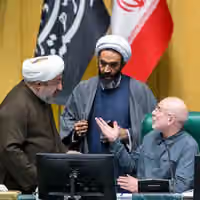
Member of the Iranian parliament's foreign policy committe, Jalil Rahimi Jahanabadi

Iran will not surrender to any kind of threats, pressures or sanctions, a prominent lawmaker said Monday, while nuclear talks were taking place in Vienna.

Jalil Rahimi Jahanabadi, a member of parliament’s foreign policy and national security committee, told the government’s official news website IRNA that it is the West that should act “rationally” in the nuclear negotiations.

“We hope that the West will understand the Islamic Republic’s message,” Rahimi a member of the hardliner majority in parliament said, “because [we] will not dismantle our nuclear installations or reduce our [uranium] enrichment.” He vowed to keep the uranium, which Iran has enriched to 20 and 60-percent, and not accept international monitoring beyond the Nuclear Non-Proliferation Treaty, without the West giving a series of guarantees.

First, the United States and Europe must provide a guarantee not to leave the nuclear deal. They must also guarantee that oil export revenues reach the Iranian government.

Iran has been emphasizing the issue of a guarantee by the US to stay in a new nuclear agreement even before multilateral talks started in April 2021. Tehran’s argument is that former US President Donald Trump unilaterally withdrew from the 2015 deal known as the Joint Comprehensive Plan of Action (JCPOA) and Iran needs assurance that this will not happen again.

However, no US president can provide such a guarantee if an agreement is not a formal treaty, which would need Senate ratification – an almost impossible task with the highly controversial JCPOA.

Iranian officials have also demanded a host of other guarantees, including a pledge by the West that Iran would be able to attract foreign investments if it agrees to limit its nuclear program. The United States has promised to lift its oil export and banking sanctions, but no one can guarantee if Iran would receive foreign investments.

Rahimi told IRNA that the West does not realize that the world has changed and countries like China or Iran will not carry out their orders. “Iran, in terms of military, political and economic power is not a weak state to be subservient to the West, but Westerners look at the world as though it is still the 18th or 19th centuries…”

The Wall Street Journal on Sunday cited the European Union's coordinator of the talks, Enrique Mora, as saying the negotiations to restore the JCPOA are close to completion, but it remained unclear whether Tehran will accept the final deal. The text of a deal could be closed in the coming hours, Mora had said. An unnamed Iranian foreign ministry official denied the report.

“Given the continuation of discussions on some remaining important issues, we’re not yet at a stage to finalize the text. “We believe that Vienna Talks can be concluded soon provided that the other party makes an appropriate decision. But we are not at that stage yet,” IRNA quoted the official as saying.

After sixteen months of negotiations, diplomats gathered in Vienna last week for what some said was a last-ditch effort to reach an agreement. Apparently, Iran insists on receiving guarantees and also demands that an investigation by the International Atomic Energy Agency of its past secret nuclear work be shelved.

Rahimi also said that despite its capabilities in enriching uranium, Tehran is ready for talks to resolve the issue but “the problem Iran has with Western countries is the degree of their understanding of global realities.”

Most Viewed

Iran negotiators ordered to return after internal rift over Islamabad talks
1
EXCLUSIVE

Iran negotiators ordered to return after internal rift over Islamabad talks

2
ANALYSIS

US blockade enters murky phase as tankers spoof signals and buyers hesitate

3
ANALYSIS

Why the $100 billion Hormuz toll revenue is a myth

4

US tightens financial squeeze on Iran, warns banks over oil money flows

5
ANALYSIS

US blockade targets Iran oil boom amid regional disruption

Banner
Banner

Spotlight

  • Hardliners push Hormuz ‘red line’ as US blockade tests Iran’s leverage
    INSIGHT

    Hardliners push Hormuz ‘red line’ as US blockade tests Iran’s leverage

  • Ideology may be fading in Iran, but not in Kashmir's ‘Mini Iran'
    INSIGHT

    Ideology may be fading in Iran, but not in Kashmir's ‘Mini Iran'

  • War damage amounts to $3,000 per Iranian, with blockade set to add to losses
    INSIGHT

    War damage amounts to $3,000 per Iranian, with blockade set to add to losses

  • Why the $100 billion Hormuz toll revenue is a myth
    ANALYSIS

    Why the $100 billion Hormuz toll revenue is a myth

  • US blockade targets Iran oil boom amid regional disruption
    ANALYSIS

    US blockade targets Iran oil boom amid regional disruption

  • Iran's digital economy battered by prolonged blackout
    INSIGHT

    Iran's digital economy battered by prolonged blackout

•
•
•

More Stories

Iran Denies Nuclear Talks Can Be Finalized In Hours

Aug 8, 2022, 12:32 GMT+1

An Iranian foreign ministry official has rejected reports that the text of an agreement to salvage the 2015 nuclear deal could be finalized in the coming hours.

The Iranian government’s official news website IRNA quoted the unnamed official as saying that the talks are still underway on some important issues and that “we are not yet at a stage where we can talk about a finalized deal.”

“Given the continuation of discussions on some remaining important issues, we’re not yet at a stage to finalize the text. Iran has presented its constructive views to the other party so as to move forward and the result is up to their political decision,” the source said. “We believe that Vienna Talks can be concluded soon provided that the other party makes an appropriate decision. But we are not at that stage yet.”

He made the remarks in reaction to a Sunday report by The Wall Street Journal that cited the European Union's coordinator Enrique Mora as saying the negotiations to restore the JCPOA (the Joint Comprehensive Plan of Action) are close to completion but it remained unclear whether Tehran will accept the final deal. The text of a deal could be closed in the coming hours, Mora had said.

However, Iran must still decide whether to set aside its demand that the nuclear deal can only be revived if a multiyear United Nations’ atomic agency safeguard probe into its nuclear program is closed, the report added, noting that “Sev­eral West­ern diplo­mats said Sun­day that Tehran has dou­bled down on this con­di­tion in the past few days of talks and there is no agree­ment on the is­sue.”

Tehran Politician Says Key To A Nuclear Deal Is US Guarantees

Aug 8, 2022, 08:29 GMT+1
•
Iran International Newsroom

A former senior lawmaker in Tehran says a US guarantee about its commitment to the 2015 nuclear agreement with Iran is the master key to unlock a new deal.

Heshmatollah Falahatpisheh told the moderate conservative news website Khabar Online in Tehran on Sunday, August 7, that it is only a US guarantee to lift the sanctions, and a guarantee that there would be no impediment to Iran’s oil exports, other trade and foreign investments .

The former conservative lawmaker who headed the foreign policy and national security committee of the parliament added that it is only with such a guarantee that a revived version of the JCPOA could be signed and put into effect.

According to Khabar Online, an agreement is still not within reach despite all the hopes expressed by Iranian and US officials at different times. Meanwhile, despite conflicting statements by Iranian officials, Iran's former nuclear chief Fereidoun Davani has said, "Iranian negotiators have so far withheld from the nation and the parliament what their preconditions for the revival of the JCPOA are," and that everything in the press about this is sheer speculation.

Falahatpisheh said that "Iran has spent a lot of money on developing its uranium enrichment infrastructure and shutting it down will be a waste. So, Iran deserves a bigger concession if it is to accept to limit its nuclear program at this stage. This bigger concession could be lifting the sanctions and guaranteeing the implementation of the resulting agreement."

Former senior Iranian lawmaker Heshmatollah Falhatpisheh
100%
Former senior Iranian lawmaker Heshmatollah Falhatpisheh

He said that US President Joe Biden has access to five different tools to guarantee an agreement. These tools include an executive order that will allow him to circumvent possible opposition at the Congress. He added that such a guarantee should make sure that any new agreement signed after the revival of the JCPOA would not be subjected to new sanctions.

He went further by saying that US Presidents can do anything if pressured but did not say how Iran can exert that pressure on Biden. Meanwhile, Falahatpisheh did not respond to Khabar Online's question about whether Iran would be ready to modify its preconditions if the US president gives Tehran the guarantees it wants.

Yet the Iranian President, Ebrahim Raisi may have another idea about a guarantee. His deputy chief of staff for political affairs Mohammad Jamshidi wrote in an August 5 tweet: "In all recent telephone conversations between President Raisi and the Presidents of France, Russia and China, it was his firm position that ONLY when the so called Safeguard Issues is resolved and closed, can the final agreement be achieved."

Iranian officials have often also raised the question of receiving foreign investments, while some Iranian commentators have pointed out that Western governments cannot force or convince private companies to invest in a country if they deem the prevailing conditions as risky.

Several Khabar Online readers expressed concern in the comments section about whether it is safe to allow the Iranian government to receive billions of dollars if an agreement is reached. They said that eventually the government would channel the funds to its regional proxy groups.

Others said they were worried that some corrupt officials would embezzle released assets. Several other readers commented that the US government is not trustworthy, and an agreement made with the current government could be torpedoed by the next US administration.

Mixed Messages Coming From Iran Nuclear Talks In Vienna

Aug 7, 2022, 21:00 GMT+1
•
Iran International Newsroom

Diplomats engaged in Iran nuclear talks in Vienna sent conflicting messages on Sunday regarding possible progress to reach an agreement over reviving the 2015 deal.

While Russia’s ambassador Mikahil Ulyanov expressed optimism, the US envoy Rob Malley was quoted as voicing disappointment, and Tehran urging Washington to be flexible. 

Indirect talks between Iran and the United States to save the 2015 pact resumed in Vienna on Thursday after 16 months of negotiations without reaching a deal.

During a Sunday phone call with UN Secretary General António Guterres, Iranian Foreign Minister Hossein Amir-Abdollahian said that Supreme Leader Ali Khamenei's fatwa (religious decree) on prohibition of using nuclear weapons makes it clear to everyone that nuclear arms have no place in Iran's doctrine and are against its policy and beliefs.

Other Iranian officials, however, have said that Khamenei may be requested to change his fatwa and strategy on the prohibition of producing nuclear weapons. "We will ask Supreme Leader Ali Khamenei to change his fatwa and strategy on the prohibition of producing nuclear weapons if the enemies of the Islamic Republic continue their threats," Iranian lawmaker Mohammad-Reza Sabbaghian Bafghi said on August 2.

Amir-Abdollahian also called on the UN nuclear watchdog, the IAEA to technically resolve the remaining issues regarding Iran's nuclear activities before 2003, and "distance itself from non-constructive political issues".

IAEA has discovered unexplained traces of uranium at three sites in Iran used for secret research and development prior to the discovery of the country’s nuclear program. The watchdog says that so far Tehran has not convincingly explained why there was uranium in these sites.

Amir-Abdollahian went on to repeat Iran’s public posture that the success of indirect talks between Tehran and the United States depended on flexibility from the American side. “We are serious about clenching a strong and durable agreement and the negotiations are now going on in Vienna with seriousness. Of course, the outcome of this issue depends on whether the United States wants an agreement to be reached [and] whether the US shows necessary resilience and realism in practice.”

Washington and its European allies say that they have made a reasonable offer and the onus is on Tehran to make a decision.

Also on Sunday, Russia’s chief negotiator Mikhail Ulyanov expressed hope about agreement in the Vienna talks, saying that there has been “progress” on resolving safeguards-related issues but “it has not been fully settled.”

“They are sensitive, especially for Iranians and Americans. I cannot guarantee, but the impression is that we are moving in the right direction, and the number of unresolved issues is minimal. Just three or four and some of them are almost settled… We’re talking about days, not weeks… I will not be surprised if we finish our exercise successfully very soon,” he told reporters outside Vienna’s Palais Coburg. 

“We stand 5 minutes or 5 seconds from the finish line,” Ulyanov said, repeating the exact wording that he had used in February. 

Enrique Mora, the European Union’s top negotiator, also said he is “absolutely” optimistic about the talks’ progress so far. “We are advancing, and I expect we will close the negotiations soon,” he added.

According to Iran International’s correspondent Ahmad Samadi at the venue of the talks in Vienna, US Special Envoy for Iran, Robert Malley, has reportedly told one of the participating diplomats at the talks that he is not hopeful about this round of the negotiations. Malley, however, has not made any comments to reporters during the ongoing round. 

"Unlike what certain Western media reported, none of the previous outstanding issues of Vienna Talks has been removed from Iran delegation's agenda, and the ideas presented by Iranian officials have been raised in the talks," said Nour News, a website affiliated with the secretary of Iran's Supreme National Security Council (SNSC), Ali Shamkhani. 

An adviser to Iran’s nuclear negotiating team said on Saturday, August 6, that some progress was made in Vienna, but issues remain and chances for an agreement is 50-50. Mohammad Marandi told the Arabic Al Mayadeen television, “I don’t know if we will reach an agreement, but the chance is 50 percent.” He stressed that the remaining issues are between Iran and the United States and “there are no differences with Europe or Russia.”

British PM Candidate Says All Options On Table If Iran Nuclear Deal Collapses

Aug 7, 2022, 15:44 GMT+1

UK Foreign Secretary Liz Truss has said that she remains committed to standing up to Iranian hostility and their pursuit of nuclear weapons. 

Truss, who is a candidate to becomes the next UK prime minister at next month’s Conservative Party leadership election, made the remarks in a letter to Conservative Friends of Israel parliamentary group, adding that “I have been clear that progress on the Joint Comprehensive Plan of Action is not moving fast enough and I assure you that if the JCPOA collapses, all options are on the table.”

Truss also Israel’s launch of Operation Breaking Dawn on targets of Iran-backed Islamic Jihad militant outfit in Gaza, with the Foreign Office saying, "The UK stands by Israel and its right to defend itself. We condemn terrorist groups firing at civilians and violence which has resulted in casualties on both sides. We call for a swift end to the violence."

The other Conservative candidate, Rishi Sunak, wrote in his letter to the pro-Israel group that he would seek “a new, strengthened nuclear deal that extends the sunset clauses, lengthens the breakout period and curtails Iran’s ballistic missile program. The credible threat of snapback sanctions, which has so far been missing from the negotiations, is the only way we can force Iran to seriously engage with these proposals.”

He added, “Iran’s quest for regional hegemony and the threat it poses to Israel concerns me deeply. We cannot allow Iran to possess a nuclear weapon and the UK and Israel must enhance our diplomatic, defense and intelligence cooperation to prevent this from happening.”

Iran’s Nuclear Negotiators Attend Religious Mourning Ceremony In Vienna

Aug 7, 2022, 12:34 GMT+1

Members of Iran’s negotiating team who are in the Austrian capital for a last-ditch efforts to revive the 2015 nuclear deal have attended a Shiite religious mourning ceremony in Vienna.

The twitter account of the Islamic Republic’s embassy in Austria published photos of Tehran’s lead negotiator Ali Bagheri-Kani at the mourning ceremonies of the Islamic month of Muharram. The event was held at Vienna’s Islamic center of Imam Ali, a Shiite mosque. 

The highlight of the month-long ceremonies of Muharram are the Days of Tasu'a and Ashura, the anniversary of the slaying of Shiite Imam Hussein and his 72 companions by his rivals to the leadership of Muslims. Ceremonies have been held for centuries in Iran and among Shiites in other countries, marking the event in the 680 AD battle of Karbala, in present-day Iraq, and have gained greater state support since the 1979 Islamic Revolution.

100%

This round of the Vienna talks reportedly focus on a text circulated in late July by Josep Borrell, the European Union foreign policy chief, to bridge gaps between the United States and Iran over how the Joint Comprehensive Plan of Action -- or JCPOA -- can be revived. It is unclear how specific are proposals in Borrell’s text and how far he outlines a process.

European officials have presented a tough face to reporters gathered outside the Palais Coburg hotel in Vienna, insisting that the current talks will not be “reopening” negotiations, and urging Tehran not to make “unrealistic demands.”