A Deal With Iran Will Only Last Until Next President - Rep. Senator
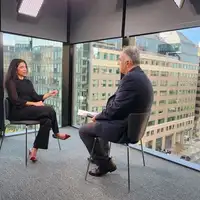
Republican Senator Todd Young
Republican Senator Todd Young has told Iran International that even if the Biden administration manages to restore the nuclear deal with Iran, it will only last until the next president takes office.
“If a deal is cut with this terrorist regime, I want the regime to know that it's highly unlikely that that deal would be honored by a future administration”, he told Iran International’s correspondent Arash Alaei.
He also criticized the current negotiations between Tehran and Washington, saying that “the Iranians refused to back down in their unlawful activities and in their terrorist policies”.
Young also called on Iran’s Supreme Leader Ali Khamenei “to change his activities, particularly his resourcing of terrorists, which has led to the deaths of hundreds of Americans, his continued engagement in unlawful nuclear activities, and his stubborn desire to develop more sophisticated missile technology that can export this regime's terror strategy to even further geographies”.
Iran's foreign minister stressed on Tuesday that Tehran and Washington are still exchanging messages through the European Union despite the halt in Vienna talks.
On Monday, the United States reiterated that it still believes a return to the 2015 Iran nuclear deal (JCPOA) is in its interest, and it continues to pursue the diplomatic path.
Opposition among US lawmakers to a deal restoring JCPOA has gorwn in the past two months.
Iran’s foreign minister told his Irish counterpart Tuesday, that Washington “must correct Trump's illegal behavior with a realistic approach” and take a political step to reach a nuclear agreement.
Talks in Vienna to restore the 2015 nuclear deal, Joint Comprehensive Plan of Action (JCPOA), have been in limbo since mid-March when Iran insisted that its Revolutionary Guard (IRGC) be removed from the US list of terrorist organizations. The US has not agreed to the demand.
Former US president Donald Trump withdrew from, JCPOA, and imposed heavy sanctions on Iran.
Earlier, Amir-Abdollahian had said negotiations on restoring the 2015 Iran deal have not been paused, noting that Tehran and Washington are in indirect correspondence.
He told Yemen’s Almasirah television network on Tuesday, “The Vienna talks have not been paused, but they continue in another process to remove the unilateral sanctions imposed on us and through the exchange of written messages with the Americans through the EU representative”.
Reiterating that “Removing sanctions in all areas and receiving economic guarantees are among the most important items on our negotiating team’s agenda”, he added that Tehran’s objective in the talks is to reach a “strong” and “permanent” agreement.
Enrique Mora, the senior EU official chairing the Vienna process, has told Iranian negotiators he is ready to return to Tehran to open a pathway through the deadlock, diplomats told the Wall Street Journal. Mora failed to convince Tehran to return to the talks during his March 27 visit.
Iran's foreign minister Tuesday stressed that Tehran and Washington are still exchanging messages through the European Union despite the halt in Vienna talks.
Negotiations to revive the 2015 nuclear agreement, JCPOA, have not stopped but continue at another pace through the exchange of written messages with the Americans through the European Union representative with the aim of lifting US sanction on Iran, Hossein Amir-Abdollahian toldBeirut-based Yemeni Almasirah television on Tuesday.
“We urged the American side to be realistic,” Amir-Abdollahian said. “Removing sanctions in all areas and receiving economic guarantees are among the most important items on our negotiating team’s agenda,' the Iranian foreign minister said.
The US State Department Spokesman Ned Price also said Monday that that the EU coordinator of the talks, Enrique Mora, continues to convey messages back and forth between Tehran and Washington. Price, however, declined to comment on whether Tehran has accepted a reported offer by Mora to go to Tehran to break the deadlock in the talks.
"The main issue is the relations between Iran and the US, not the role that Europe can play in the talks … Europe's role is one of a go between. The go between can play a limited role and will not have an effective and decisive role in any negotiations," Nader Entesar, professor of political sciences at South Alabama University told the Iranian Labour News Agency (ILNA) on Tuesday.
In what highlighted the Biden administration’s commitment to revive the JCPOA, Secretary of State Antony Blinken said Mondaythat the United States will not stand in the way of Russia-Iran nuclear cooperation if the JCPOA is restored.
Iran currently has one Russian-built nuclear power plant and a $10 billion contract with Moscow to build two further power plants in Bushehr.
Opponents of reviving the JCPOA argue that one of the problems with the Vienna talks so far is that Russia is set to benefit $10 billion while it is being sanctioned for its invasion of Ukraine.
Another issue is Tehran’s demand for its Revolutionary Guard to be removed from the US list of terrorist organization. The Iranian foreign minister made no mention of the demand, which currently appears to be the most important hurdle to signing off on a deal to but said the Americans have "perfectly understood Iran's red lines".
US State Department spokesman Ned Price reiterated on Monday that Tehran will have to make concessions on some issues if they want to put demands on the table that are outside the confines of the JCPOA. “That’s just the very nature of any negotiation,” he said in a veiled reference to the IRGC designation.
Price told reporters Monday that the Biden administration will continue dialogue with Tehran via its partners, including the European Union, to achieve a mutual return to compliance with the JCPOA for as long as a mutual return to compliance would be in US interests.
"If and when we reached the point where the non-proliferation benefits of a mutual return to compliance with the JCPOA would not overcome the progress that Iran has achieved in its nuclear program in the past three or so years, that’s when we’ll reassess and pursue an alternative course," he said.
US Department of Defense Spokesman John Kirby on Monday told reporters that the Pentagon backs the government's efforts to revive the JCPOA and prevent Iran from building nuclear weapons. "No problem in the Middle East is easier to solve with Iran having a nuclear weapon," he said, adding that even during negotiations, Iran has continued to develop "certain nuclear capabilities", apparently a reference to Iran's enrichment of uranium to 60 percent purity which has brought it closer to 90 percent purity required for building nukes.
The United States has reiterated that it still believes a return to the 2015 Iran nuclear deal is in its interest, and it continues to pursue the diplomatic path.
State Department spokesperson Ned Price told reporters on Monday that “We will continue to forge ahead with efforts, with dialogue via the – via our partners, including the European Union, to seek to achieve a mutual return to compliance with the JCPOA for as long as we determine that a mutual return to compliance would be in our interests.“
Earlier this year, the Biden administration had said that it would consider the end of February as the latest date it was willing to wait for progress in the talks.
In mid-March, negotiation that started in April 2021 came to a standstill as Iran demanded the removal of its Revolutionary Guard (IRGC) from a US list of terrorist organizations. Washington has not agreed to the condition, saying that i tis ready to remove nuclear sanctions, but the terror designation is a separate issue for which Iran has to negotiate over other issues.
Price reiterated that position on Monday. „If Iran wants to seek – wants to put issues on the table that are outside the confines of the JCPOA, Iran will of course have to be in a position to make concessions on those issues. That’s just the very nature of any negotiation.“
Asked if he had any comment about reports that the European Union coordinator in the Vienna talks wants to visit Iran again, Price said the US supports his efforts.
Opposition to retoring the JCPOA has grown in the US, especially rejection of any concession on delisitng the IRGC.
Iran’s president is willing to reach a nuclear deal but “others” oppose it a politician says as others believe Tehran was counting on a Russian victory in Ukraine.
Reformist Ashraf Boroujerdi has said, following a meeting with Raisi along with two dozen politicians last week, that "Raisi himself has come to the conclusion that a nuclear agreement should be reached, but some others who have the upper hand in the government are adamant that Tehran should not sign an agreement with Washington." However, she did not name the elements she believed have the upper hand in making decisions for the government.
Iranian reormist politician Ashraf Boroujerdi
Meanwhile, Iranian academic and reformist political activist Sadegh Zibakalam says Iranian officials were misled to believe that Russia will occupy Ukraine in less than one week and .
The officials believed Russia would plant a puppet government in Kiyv and become the master of the world and Iran would benefit from the situation as Russia's ally, said Zibakalm in a live Instagram video as reported by Didban Iran [Iran Monitor] website.
Zibakalam, who was sure in the interview that Iran and the United States will inevitably come to an agreement, expressed concern over "the regional countries' alliance against Iran and the destructive role played by Russia and China."
He said: "We are upbeat about the rise in oil price, and we know that President Ebrahim Raisi is right about a boost in Iran's oil exports, because with the United States deliberately ignoring its sanctions on Iran's oil industry Iran has been selling oil to some Chinese private companies at prices no one is aware of. However, if the Americans make sure that there will be no agreement with Iran, they will twist the arms of the Chinese in a way that they would forget about purchasing oil from Iran."
Political analyst and a frequent government critic, Sadegh Zbakalam
Zibakalam further added that "a favorable breeze is reaching Iran from the direction of the United States. However, it appears that the Raisi administration has no strategy about how to benefit from the situation." Zibakalam went on to say that "We know today that Deputy Foreign Minister Abbas Araqchi had come to an agreement with the US side before President Ebrahim Raisi took office, but the new administration initially ignored Araqchi's achievement before finally realizing that the negotiations should take place based on the frameworks provided by Araqchi."
Zibakalam then quoted former Culture Minister Ali Jannati as saying that "it was agreed in the talks by Araqchi that the IRGC should be delisted as a terrorist organization and the sanctions against it should be lifted."
The academic said that the United States has now realized it has not managed to stop Iran from high-level uranium enrichment, and Iran's missile development program as well as cut Iran's long hands from the region, at least in the short run. As a result, United States has come to the conclusion that it should adopt a milder policy toward Iran. However, Iran has misunderstood this soft approach. Zibakalam stressed that Iran has wrongly interpreted the change in US policy as a retreat.
In an interview with Didban Iran, former diplomat Fereidoun Majlesi also said that the Revolutionary Guard (IRGC) does not want to be removed from the US list of terrorist organizations because in that case Iran would sign a new nuclear agreement with the United States.
Majlesi argued that the IRGC has an international agenda that may not be implemented if there is an agreement between Iran and the United States. He said that is also the reason why there is a resistance in Iran against abiding by the regulations of the Financial Action Task Force (FATF).
Like Zibakalam, Majlesi also agreed that Russia's invasion of Ukraine has made a nuclear agreement with the United States harder to reach. "Iran's official support for Russia in the hope of benefitting from Russia's measure adversely affected the negotiations to revive the nuclear agreement (JCPOA). But Russians only follow their own interests. There is no reason for them to follow Iran's interests because they do not need us," said Majlesi.
Iranian officials were silent on Monday regarding reports that the European Union wants to send its envoy back to Tehran to jump start the stalled nuclear talks.
Iran on Monday was in a total confusion, as it was not clear if Ramadan ended or not, and if there was a public holiday. The foreign ministry did not hold its weekly press briefing.
Western diplomats told the Wall Street Journal on Sunday that the EU is offering to send its top negotiator Enrique Mora to Tehran again to persuade Tehran to show flexibility.
Mora, the senior EU official chairing the Vienna process, has told Iranian negotiators he is ready to return to Tehran to open a pathway through the deadlock, diplomats told the Wall Street Journal. Mora failed to convince Tehran to return to the talks during his March 27 visit.
Talks in Vienna to restore the 2015 nuclear deal, Joint Comprehensive Plan of Action (JCPOA), have been in limbo since mid-March when Iran insisted that its Revolutionary Guard (IRGC) be removed from the US list of terrorist organizations. The US has not agreed to the demnd.
Reuters reported on Monday that the West has almost given up on the process and is contemplating what to do next.
"They are not yanking the IV out of the patient's arm ... but I sense little expectation that there is a positive way forward," one source, who like others quoted spoke on condition of anonymity because of the issue's sensitiviy, told Reuters.
Western diplomats told the Wall Street Journal that they want to put the onus back on Tehran, making it clear the talks could fail unless Tehran took a step to end the stalemate. Mora, they said, will try to persuade Tehran to leave the issue of IRGC's delisting to a future point and sign off on the deal now. Tehran has so far not responded to the proposition, the report said.
In a phone talk with Iranian Foreign Minister Hossein Amir-Abdollahian's on April 20, the EU foreign policy Chief, Josep Borrell expressed frustration over the pause in the talks and called for fresh contacts between Enrique Mora and Iran’s lead negotiator Ali Bagheri-Kani.
Iran insists that it will not give up on its demand for the removal of the IRGC from the US list of Foreign Terrorist Organizations (FTO), calling it a 'red line' it will not cross at any cost
The Biden administration is adamant that it will only negotiate the delisting of the IRGC if Tehran also agrees to discuss other issues which are important for Washington, presumably Iran's aggressive regional policies and support for militant groups, which are also outside the JCPOA purview.
Despite the deadlock in the talks that appears to have much to do with the IRGC regional activities and pledge to take revenge on American officials for ordering the targeted killing of Ghasem Soleimani, officials in Tehran have shown no signs of softening their rhetoric in the past few weeks
Soleimani, commander of the Qods (Quds) Force, the IRGC's extraterritorial arm, was killed in a drone attack in Baghdad in January 2020 on Trump's orders.
The pause in talks has given ample opportunity for JCPOA critics in both Tehran and Washington. The Republicans have highlighted the prospect that lifting US ‘maximum pressure’ sanctions on Iran in return for Tehran accepting JCPOA limits on its nuclear program would see Tehran repatriate billions of dollars currently frozen by creditors wary of punitive US action.
US Democratic Senator Bob Menendez (NJ) reiterated Sunday that no nuclear deal with Ian was better than a bad deal. “It’s 2022. It's not 2014. Some of the original deal sunsets are even closer… to ending a pathway where Iran could ultimately achieve its goal,” a reference to the belief that Tehran is bent on producing nuclear weapons.