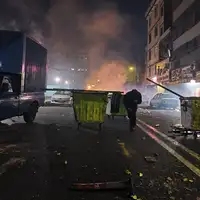
Iranian Lawmaker Says Even Ordinary Medicines Are Scarce Now

A member of parliament says the shortage and high prices of medicines in Iran are not limited to certain drugs anymore, and very common medications are also scarce and expensive.

A member of parliament says the shortage and high prices of medicines in Iran are not limited to certain drugs anymore, and very common medications are also scarce and expensive.
Homayoon Sameh Yeh Najafabadi, who is a member of the parliament's health committee, told ILNA on Wednesday that “today medicine has become very scarce in the country, not special medicines but very ordinary medicines. Therefore, people have to go to several pharmacies for one prescription”.
Criticizing those who claimed to be able to control the prices of medicines, he added that the Health Ministry should have devised a detailed plan for controlling the prices before submitting the budget bill to parliament.
Many officials from the Health Ministry appeared before the parliament and said there would be no problem with the high cost of medicines because the insurance companies would cover the higher in prices, and that there won’t be any pressure on patients once subsidy for imports of essential goods are eliminated, Najafabadi said.
The lawmaker said in addition to medicines, the prices of wheat, flour and bread have also increased, expressing hope that the government has a plan in this regard.
In March, the parliament decided to scrap an annual $9-14 billion subsidy for essential food and medicines, despite warnings of more inflation and hardship.
The subsidy was introduced in April 2018 when former US president Donald Trump signaled his intention to withdraw from the Obama-era nuclear agreement with Iran known as JCPOA, and Iran’s national currency began to nosedive.

General Wei Fenghe, Chinese defense minister, has on his visit to Tehran condemned United States “unilateralism” and called for greater cooperation between “independent” countries.
During a meeting with Iranian counterpart Mohammad-Reza Gharaei Ashtiani, Wei attributed Wednesday much of the world’s insecurity and wars to US “hegemonic” actions, according to the account given by the official news agency IRNA.
China is one of the world powers in year-long talks trying to revive the 2015 Iran nuclear deal, which the US left in 2018. Beijing has been gradually increasing its commercial and even military presence in the Middle East.
“The common security challenges and threats can be combatted through interaction and cooperation among the independent countries that are opposed to unilateralism in the world,” Wei noted. He said that closer ties between Iranian and Chinese armed forces, who conducted their first trilateral naval exercises with Russia in 2019, would help thwart such challenges and in fighting ‘terrorism.’
Ashtiani described US policies as the root cause of growing crises and said multilateralism was needed as a counter. He highlighted Iran’s policy of developing ties with neighboring and Asian countries.
The Chinese defense minister also met with Iranian President Ebrahim Raisi, and with Chief of Staff of the Iranian Armed Forces Major General Mohammad Hossein Bagheri.
"We pursue strategic relations in accordance with mutual political trust regardless of international developments," Raisi said, noting that “successful implementation” of Iran’s 25-year strategic agreement with China, signed March 2021, was a priority.

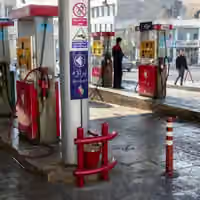
Figures released by the Customs Organization show that last year Iran exported gasoline at an average price of 38 cents per liter, lower than even crude oil.
Speaking to Shargh newspaper, Spokesman of the Customs Organization Ruhollah Latifi said Iran's daily gasoline exports averaged 5.3 million liters in the previous Iranian calendar year. Annual revenues from selling gasoline amounted to $732.6 million, around 38 cents per liter, he said, referring to the Iranian calendar year which ended on March 20.
In 2021, according to OPEC figures, crude oil sold for around $78 per barrel which puts the price of one liter of crude at around 49 cents, higher than the price of gasoline, Shargh's Maryam Shokrani wrote.
Latifi told Shargh that nearly half of all gasoline exports -- at around 39 cents and a total of $244.6 million -- were made in the last month of the year (February 20 to March 20). These figures show that despite the spike in international prices of crude oil and gasoline in March, Iran's gasoline sold at the same rate as before.
Mostafa Nakhaei, spokesman of the parliament's energy committee also told Shargh that the parliament had received reports that in the one-year period from March 21, 2020, gasoline had sometimes been exported at prices as low as 5,000 rials, one-third of its subsidized domestic price – an incredible two US cents per liter or around 10 cents a gallon. ($1=280,000 rials)
Why so cheap?
Bulk gasoline prices in the Persian Gulf region were above 80 cents a liter in this period.
Unlike crude oil, gasoline exports are not sanctioned by the United States, and it is not clear why Iran sold the refined product so much cheaper than international prices.
One explanation can be the desperate need for cash dollars as international banking transfers are out of question amid American banking sanctions. It could also be due to shadowy middlemen and networks handling most of Iran’s fuel exports who take substantial cuts and reduce government revenues. Some of these middlemen are people well connected with top officials, as previous scandals from early 2010s revealed.
As the news emerged on Wednesday some Iranians began commenting on social media that in 2019 the government suppressed protests to a hike in fuel prices by killing hundreds of people while it is ready to export gasoline at two cents a liter.
Nakhaei said that some lawmakers have demanded a probe into the export of gasoline at such low prices and the loss the oil and refinery industries have incurred because of that. "Apparently the government only endeavored to raise the gasoline export figures at any cost," he said.
More oil exports with no visible impact
Officials of the government of President Ebrahim Raisi have repeatedly boasted that they have succeeded in raising oil exports by as much as 40 percent despite sanctions imposed by the US in 2018 when Donald Trump pulled the US out of the 2015 nuclear deal with Iran. They also claim that they are now even fully repatriating the revenues from oil sales.
Many Iranians ask why they can see no change in economic indices despite increased oil exports and repatriation of revenues as the government claims, especially with very high fuel prices since the invasion of Ukraine.
An informed source in oil ministry on Tuesday told the government mouthpiece, Iran newspaper, that the reason for not being able to experience any prompt effect of the money coming into government coffers from oil sales was that it takes 90 days to receive the payments from buyers.
But the government claim about higher oil exports goes back to all of 2021, not just the last three months.

Visiting Tehran, Iraq's parliament speaker has stressed Baghdad’s commitment to helping ease regional tensions through diplomacy.
Mohammed al-Halbousi, who arrived in Tehran at the head of a parliamentary delegation Wednesday, said the country’s Prime Minister Mustafa Al-Kadhimi had attended the latest round of talks between Tehran and Riyadh, which was held in the in Baghdad last week. Al-Halbousi made the remarks in a joint press conference after meeting with his Iranian counterpart Mohammad-Bagher Ghalibaf.
“We see negotiation and understanding as the solution to problems between neighbors,” al-Halbousi said. “Many problems require dialogue and consultation”. Diplomatic relations between Sunni Muslim-ruled Saudi Arabia and predominantly Shiite Iran were broken off in 2016, with the two supporting opposing sides in conflicts in both Syria and Yemen.
During his one-day visit, al-Halbousi was also scheduled to meet with President Ebrahim Raisi, Secretary of the Supreme National Security Council Ali Shamkhani, and Foreign Minister Hossein Amir-Abdollahian.
Halbousi's visit to Iran − his second since 2018 when he assumed office − took place as factional discussions continue over forming a new Iraqi government several months after parliamentary elections. Halbousi’s Sunni alliance is part of a parliamentary bloc in which it is allied with Muqtada Sadr’s Shiite party and the Kurdistan Democratic Party, but the process of forming a government is hindered by the complexities of sectarian arrangements and opposition from the Patriotic Union of Kurdistan and Shia parties close to Tehran.

Iran’s Supreme Leader Ali Khamenei says the United States is losing its power and getting weaker and weaker as a new world order is being shaped.
In a meeting with a group of university students and representatives of student associations in Tehran on Tuesday, Khamenei said the world is on the threshold of a new global order that will replace the “monopolar and bipolar world”.
“Today, the world is on the eve of a new international order that has been in the making following the era of a global bipolar order and the theory of a unipolar world order, during which America has been becoming weaker day by day,” Khamenei said.
He added that “The events of the recent war in Ukraine must be viewed more deeply and in the context of the formation of a new world order which will probably be followed by complex and difficult processes”.
In such a new and complex situation, all countries, including the Islamic Republic, have a duty to be active in both soft and hard power to ensure their interests and security and avoid isolation, Khamenei noted.
During his speech, he didn't refer to the negotiations to restore the 2015 nuclear accord, but some in Tehran speculate that the Russian invasion of Ukraine will eventually force Washington to agree to Tehran's demands and make a deal.

Chinese defense minister General Wei Fenghe is set to visit Iran on Wednesday to meet with senior Iranian officials, including his counterpart Mohammad Reza Gharaei Ashtiani.
In a sign of developing military cooperation, Iran, Russia, and China held naval drills in January in the north Indian Ocean. These were the third such trilateral naval exercises since the first was held in late 2019 and announced as the formation of Marine Security Belt. The 2022 Marine Security Belt exercise covered 17,000 square kilometers and included the navies both of Iran’s Army and its Revolutionary Guards Corps (IRGC).
China’s military role in the region is less than its expanding commercial presence. Chinese trade with Saudi Arabia in 2020 topped $65 billion, and with the United Arab Emirates was around $60 billion.
While Iran-China trade fell back to around $15 billion in 2021 after reaching around $50 billion in 2014, the head of the Tehran-Beijing chamber of commerce, Majid-Reza Hariri, has suggested that the lifting of United States’ sanctions could see it reach $60 billion. Hariri said establishing Iranian representative offices in China was a work in progress.