US Seized Iranian Oil Shipment As Tehran Prepares To Boost Exports
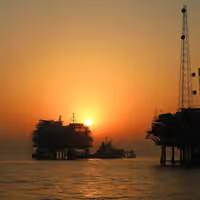
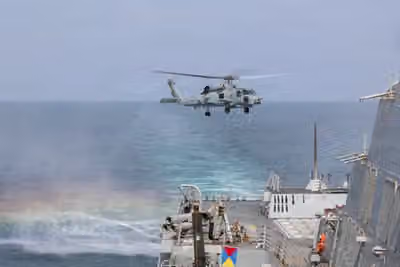
A photo showing tankers in possible ship-to-ship oil transfers.
Associated Press reported Thursday that cargoes of suspected Iranian oil seized a month ago from two tankers were intended to sidestep possible US sanctions involving false documents and repainting the decks.
Under US ‘maximum pressure’ sanctions any third party buying Iranian oil could face punitive action. The US in 2020 sold the contents of four tankers of Iranian oil heading to Venezuela. While much of the proceeds from such seizures is absorbed by ‘administration’ and lawyers’ fees, they have also led to legal action for compensation by relatives of victims of the 2001, ‘9-11’ al-Qaeda attacks on New York and Washington.
Iran’s Supreme Leader Ali Khamenei says retreating against the United States in exchange for sanctions relief would be a “big and naive mistake.”
Addressing members of Iran’s Assembly of Experts on Thursday, Khamenei insisted that to retreat in the face of American pressure or any other power for securing protection against sanctions, will deal a blow to the nation's power.
He added that Islamic Republic’s presence in regional countries and its nuclear program are two factors that contribute to the country’s national power, saying, “Regional presence gives us more strategic depth and national strength. Why should we give it up? Scientific nuclear progress is needed for country’s future”.
Khamenei said it is naïve to reduce Iran’s military programs to get concessions from the West, noting that “security” and military power contributes to Iran’s bargaining power “to fulfill national interests at the regional and global front.” He added, “It is vital for any country to have national power”.
Iran has boosted its uranium enrichment since the United States withdrew from the 2015 nuclear agreement and continued it support for regional militant groups that act as its proxies in various countries. It has also expanded its missile program that West and several regional countries, such as Israel and Saudi Arabia are concerned about.
The Republican Study Committee (RSC) has unveiled new legislation, titled the ‘No Oil From Terrorists Act’, to block purchase of oil products from Iran.
The study group said on Tuesday that the Biden administration needs to focus on boosting domestic energy supplies rather than funding terrorist regimes following the ban on Russian oil over the invasion of Ukraine.
The GOP members of Congress are trying to prevent replacing Russian oil with new imports from Iran amid rising gas prices, saying Biden should lift his executive orders that canceled the Keystone XL pipeline from Canada and froze new oil and gas leases on federal lands.
RSC chairman Jim Banks says Biden crushed the energy industry when “he left Americans dependent on our foreign adversaries for oil. This sent gas prices through the roof and allowed Putin to fund his unprovoked war."
"To add insult to injury, the Biden administration is now considering buying oil from Iran, the world’s largest state sponsor of terror. There is absolutely no reason to import terrorist’s oil when we can drill better, cheaper, and cleaner right here at home", Banks continued.
Republican Senator Marco Rubio said in a Fox news opinion piece on Wednesday that Iran is supplying Russia with illicit oil to finance his war in Ukraine, adding. “This is alarming to say the least, because America and its allies are on the verge of providing a $10 billion windfall to the terrorist regime in Tehran”.
Sen. Rubio did not provide any more details of the alleged scheme.
A senior Iranian lawmaker says the parties involved in the Vienna talks have agreed to remove the Revolutionary Guards from the US list of Foreign Terrorist Organizations (FTO).
A member of the Islamic Republic parliament’s foreign policy committee, Hossein Noushabadi, said on Wednesday that the important issues have been resolved to revive the nuclear deal.
He said the final decision on the fate of the nuclear deal needs to be made by Iran’s Supreme Leader Ali Khamenei.
A former Trump Administration official said last week that information he received from unnamed officials indicated that US negotiators have agreed to lift terror-related sanctions on Iranian individuals and entities.
A hardliner lawmaker had reiterated last week that a good nuclear agreement is one that removes the IRGC from the list of terrorist organizations.
Ebrahim Rezaei has said that the Islamic Republic wants the United States to remove all sanctions imposed on the IRGC, in addition to all other sanctions imposed since 2018.
Noushabadi’s remarks echoed similar ones by the spokesman of the foreign policy committee who last week described removing the IRGC from the US list of terrorist entities as one of the necessary measures to revive the JCPOA nuclear deal.
Abbaszadeh-Meshkini said, "When we say the lifting of all sanctions, it means institutions, companies and individuals; removing the Revolutionary Guard (IRGC) from the list of terrorist organizations is also one of the expectations of the Islamic Republic.”
Iranian gas export revenues surged by more than 250% in the year to March, while earnings from petrochemical exports doubled, Oil Minister Javad Owji said on Wednesday.
He said overall energy export earnings, including crude, rose by 2.5 times but he only gave a breakdown for gas and petrochemicals. Iran does not release figures related to oil exports.
The increase in revenue was partly due to more exports and because Iran managed to collect more of the proceeds from exports despite US sanctions, the minister said.
But energy prices have also increased from the second half of 2021 and Iran’s has been exporting more oil to China because of a reluctance on the part of the Biden Administration to enforce sanctions.
"Through various methods, our government has collected all the revenues from its exports of oil, gas, gas condensate and oil products," Owji said.
Iran’s ability to export natural gas is limited because of high domestic demand and decreasing production. Officials have said that the country needs up to $50 billion in investment to prevent falling output at its gas fields.
Gas export revenues rose to $4.6 billion from $1.27 billion last year, and revenues from petrochemical products exports doubled to $12 billion, the minister said.
US sanctions imposed in 2018 seriously reduced Iran’s crude oil exports and cut its revenues. Banking sanction also made it hard to repatriate the proceeds.
Central Bank of Iran (CBI) says availability of hard currency for businesses has increased by $10 billion in the past 11 months, compared to the previous year.
A spokesman of the bank said on Tuesday that as the Iranian year 1400 is coming to a close, the government was able to make $26.3 billion available to businesses compared with $16 billion dollars in the previous year.
US sanctions since 2018 slashed Iran’s oil and non-oil exports depriving the government of much-needed hard currency for imports. Former president Donald Trump withdrew from the Obama-era nuclear deal and imposed heavy oil export and banking sanctions on Tehran.
Oil exports dropped from more than two million barrels per day to around 200,000 by 2019. However, around the time of US elections in November 2020, Iran’s oil exports began to pick up using illicit ways of shipping mainly to China. Throughout 2021 and early 2022, daily exports were close to one million barrels.
The CBI official did not specifically mention the contribution of oil revenues to the increase in foreign currency circulation, but in the past weeks many officials have boasted of higher oil sales.
The Biden Administration has avoided effective enforcement Trump’s sanctions, with the hope of reaching a nuclear agreement with Iran. The result has been a relative improvement in the finances of the Islamic Republic and perhaps less leverage for Washington.
Another sign of more dollars entering the Tehran currency exchange market is the rise in the value of the rial. The Iranian currency had dropped to 305,000 to the dollar in December, but on Monday it was trading at 255,000, a considerable gain given the other discouraging economic indicators.
One reason for rial’s rising value has been optimism regarding nuclear talks with the United States that would lift oil sanctions, but another factor is simply more dollars flowing back into government-controlled exchange market.
The increase in foreign currency income, however, is not sufficient to address the multiple crisis the government faces. First among them is the need to increase salaries of millions of people employed directly and indirectly by the government. Average salaries are now one-third of the minimum needed to manage bare necessities. Unions say that a worker needs $450 a month just to pay rent and have three meals a day. Most wages are about one third of that.
The second challenging problem is to lower the 40-percent annual inflation, which means the government has to stop printing money for financing its operations. That also needs foreign currency revenues. Therefore, the discounted oil Iran is now selling to China is a lifeline to prevent further deterioration, but it is far from sufficient to end the economic crisis.
The central bank also highlighted the rising prices of oil and expressed hope that more foreign currency will come its way. “We have encountered favorable conditions both in volume of exports and also their monetary value, which have helped in the availability of foreign currency,” the CBI official said.
Iran’s central bank chairman Ali Salehabadi had said in February that Iran was witnessing a financial improvement overall. He alluded that Tehran had found ways to use the international banking system to execute payments “with friendly countries”, without of course divulging any details.