Secretary of State Antony Blinken and his Saudi counterpart in Washington, in October 2021
Government-run media in Iran have been jubilant this week seeing oil prices rising and diplomats saying a nuclear deal that could lift US sanctions more likely now.
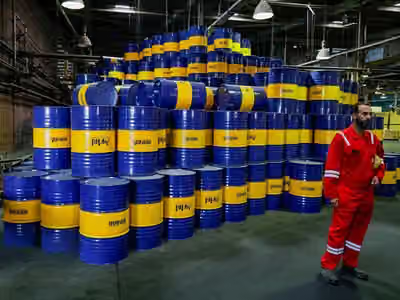
Oil prices experienced a wild swing of $10 a barrel on Thursday, March 3, but styed above $110 on Friday as uncertainty about the Ukraine crisis dominated news. Oil analysts have kept emphasizing that once a nuclear agreement is reached with Iran and oil export sanctions lifted, Tehran can add up to two million barrels a day to world supply.
Iran’s oil minister on Thursday assured markets that within two months of signing a nuclear agreement with world powers, Iran can boost its production and add to its crude exports.
But it remains uncertain as to how much more Iran can supply on top of more than one million barrels it is shipping now despite US sanctions, mostly to China. An additional one million barrels is realistic to expect, but beyond that it is anyone’s guess given the fact that for three years production has stayed down, and Iran has had little available money to invest in the upkeep of its infrastructure.
Saudi Arabia, leading OPEC and potentially becoming even a more influential producer with Russia in the grips of uncertainty, has refused to add production despite direct appeals by President Joe Biden who is facing the prospect of losing US midterm elections with high prices at the pumps.
While output reduction by Saudi-led OPEC in 2020 was a reasonable move given the negative impact of the Covid pandemic on demand, its refusal to produce more and cap prices in the past one year leaves room for speculation that there could be political reasons.
Many industry analysts argue that Saudi Arabia and others simply do not have capacity to quickly restore production, but Riyadh has often done that in the past, as when it quickly restored exportsfollowing a devastating missile and drome attack on its facilities in September 2019. That attack crippled nearly 50 percent of its capacity, which it restored in a matter of weeks.
But in February after a direct appeal by Biden who called King Salman bin Abdulaziz al-Saud to ask for help in capping oil prices, the answer was a polite no. In contrast, Riyadh was fully responsive to similar requests by former president Donald Trump. Saudis were responsive to Trump’s request to lower prices before the 2018 midterm elections and later he thanked them for that.
But Biden’s relations with Saudi leaders have been cordial at best. Early in his term Biden was threatening to reconsider relations and removed Yemen’s Houthi’s from the US terror designation. He also vowed to revive the Obama-era Iran nuclear deal known as JCPOA. Riyadh had opposed the deal during Obama and supported Trump’s decision to pull out in 2018.
After 11 months of US indirect talks with Iran, a deal seems to be at hand, which would not address Saudi concerns about Iran’s regional threats. As a result, Riyadh seems to have decided to find a modus vivendi with Iran, instead of accommodating the Biden administration.
If Saudi Arabia’s reluctance to supply more oil is prompted by political motives rather than technical issues or a purely business decision, then it would be perhaps less problematic for the Biden Administration to resolve its issues with Riyadh rather than count on limited supplies from Iran.
The Intercept quoted a senior Democratic Congressional staffer as saying, “High gas prices will almost certainly be blamed on the party in power, so it really seems like the Saudis are using the oil weapon against Democrats here.”