Iran And US Question Each Other’s Intentions In Nuclear Talks

Iran and the United States both signaled pessimism over nuclear talks in Vienna as Tehran presented proposals for reviving its 2015 deal with world powers.
Iran and the United States both signaled pessimism over nuclear talks in Vienna as Tehran presented proposals for reviving its 2015 deal with world powers.
Antony Blinken, US Secretary of State, told reporters in Stockholm, where he is attending the Organization for Security and Cooperation in Europe (OSCE), that “recent moves, recent rhetoric, don’t give us a lot of cause for…optimism.” Blinken put the onus on Iran to “reverse course and engage meaningfully.”
In what might have been a US reaction to new proposals circulated Thursday by Iran to remaining members of the JCPOA (Joint Comprehensive Plan of Action), Blinken said the US would “in the very near future, the next day or so…be in a position to judge whether Iran actually intends now to engage in good faith.”
In Tehran, Hossein Amir-Abdollahian, Iran’s foreign minister, said that “we are not optimistic about the will and intentions of the US and the three European countries.” Amir-Abdollahian was quoted by the official news agency IRNA saying Iran had been encouraged to return to talks over restoring the JCPOA but had nonetheless faced additional US “sanctions on individuals and entities.”
The foreign minister, quoted after a meeting with Japanese foreign minister Yoshimasa Hayashi, said Iran had gone to Vienna, where talks resumed this week after a five-month pause, with “serious determinations and a clear, logical agenda.”
The talks in the Austrian capital formally involve remaining JCPOA signatories – China, France, Germany, Iran, Russia, and the United Kingdom – with a US delegation led by special envoy Rob Malley taking part indirectly.
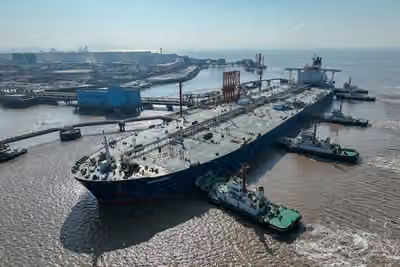
Iran has stressed the importance of lifting ‘maximum pressure’ sanctions, targeting its oil exports and financial sector, imposed by the US after 2018 when former president Donald Trump left the JCPOA, whereas the US has highlighted Iranian nuclear advances since 2019 beyond limits set by the deal.
‘That will not happen’
"What Iran can't do is sustain the status quo of building their nuclear program while dragging their feet on talks,” Blinken said. “That will not happen.”
Iran’s latest breach of the JCPOA, reported by the International Atomic Energy Agency (IAEA) Wednesday, is to begin enriching uranium at its fortified Fordow plant using relatively advanced centrifuges.
Iran’s lead negotiator Ali Bagheri Kani, who earlier Thursday announced Iran had circulated its new proposals, later met IAEA chief Rafael Mariano Grossi, who subsequently tweeted that they had discussed both “current exchanges in the context of the JCPOA negotiations” and “our own bilateral activities.”
The IAEA would have enhanced monitoring powers under a revived JCPOA, and is meanwhile trying to arrange better access after Iran in February limited agency inspections largely to those required under the Nuclear Non-Proliferation treaty.
Grossi told France24 television Wednesday that be believed talks in Vienna were “trying to build on what was going on before” and that he said an agreement was needed “soon.” The talks were suspended in June, with some diplomats suggesting there was 70-80 percent agreement, and there has been speculation as to how far a new Iranian negotiating team, after the election of President Ebrahim Raisi (Raeesi), would shift Iran’s position.