Speaker Mohammad Ghalibaf delivering his speech in Mashhad. October 25, 2021
In a rare admission the speaker of Iran’s parliament said Monday, “We could not accomplish anything” with 80 percent of the economy dominated by the government.
In a speech in Mashhad, Mohammad Bagher Ghalibaf, a former top IRGC officer and Tehran mayor, said, “We eliminated people from various areas of public life, or we stratified them”, insisting that without the involvement of large segments of society the Islamic Republic cannot succeed.
Ghalibaf’s remarks come as hardliners loyal to Supreme Leader Ali Khamenei have dominated all three branches of government since February 2020 and have sidelined the loyalist opposition of ‘Reformists’. Ghalibaf himself is accused by former officials and journalists of a role in major corruption schemes in Tehran municipality when he was mayor (2005-2017) and also in suppressing student protests more than two decades ago.
Those who disagreed with the tenants of the Islamic Republic have long been purged by death or exile.
Iran’s economy became dominated by the state after the 1979 revolution when major industries were nationalized in the wake of an Islamic-leftist zeal, and businessman were either jailed, killed or had to flee for their lives.
Speaker Ghalibaf delivering remarks in Mashhad. October 25, 2021
Ghalibaf spoke of alienated youth and asked, “Aren’t these our children…shouldn’t we talk with them?” He also spoke of hardship gripping ordinary workers, saying that they earn less than $200 a month working two jobs and asked, “Shouldn’t we talk about this?”
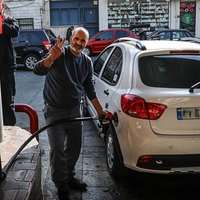
Anemic economic growth and high inflation that were prevalent since the revolution have become much more acute in the past three years because of United States sanctions. Iran’s currency has dropped almost ninefold since late 2017 and annual inflation is close to 50 percent.
As the situation deteriorates, former and current government officials seem to be competing in advocating for better living conditions for the average Iranian. They also untiringly accuse each other of being responsible for creating the current impasse. Hardliners accuse former President Hassan Rouhani for signing the 2015 nuclear deal, the JCPOA, while reformists argue that without normalization of ties with the rest of the world Iran cannot hope to improve its lot.
Ghalibaf, however, seemed to be taking the rhetoric to a higher level on Monday by saying that without attention to ordinary people even religious beliefs will be eroded. Referring to Shiite sanctities, the speaker of parliament said, “Until when people should show steadfastness for Imam Hussein’s blood?” The grandson of Prophet Muhammed, Hussein, who was killed in 680 AD by other Muslim forces is the saint Shiites uphold as the true heir of the Prophet.
Ghalibaf said, “We were not able to work correctly. We spent more than $20 billion in the past three years to subsidize seven essential imports,” but prices rose for the people. “So, we don’t have a good record in running the country.” He added that open discussion is important because “people are important, and they are the ones to save the religion.”
The speaker who is himself a loyal follower of Khamenei also repeated some of the clerical regime’s favorite themes, such as a “media war” that “enemies” have launched to weaken the Islamic Republic. Another favorite theme he mentioned is a theory advanced by Khamenei that the US created the Islamic State group to weaken Islam.
But Ghalibaf underlined, “When we are in power, we have a responsibility toward everyone, all groups with different views, all religions and ethnic groups, because people live under the umbrella of the Islamic regime, which is in power in the name of religion.”