Police Say Corruption In Iran Jumped by 333 Percent Since March

A police official in Iran announced Sunday that corruption cases increased 333 percent in monetary value in the first six months of the current Iranian year.

A police official in Iran announced Sunday that corruption cases increased 333 percent in monetary value in the first six months of the current Iranian year.
Mohammad Reza Moghimi, the head of economic security police, also stated that the number of corruption cases the police is aware of increased by 61 percent, and the number of the accused in these cases went up by 94 percent compared with last year (March 21, 2020-March 20, 2021).
Although Moghimi implicitly blamed former president Hassan Rouhani, in fact current hardliner president Ebrahim Raisi (Raeesi) was in charge of Iran’s all-powerful judiciary in the period.
Iranian authorities do not disclose details of corruption and embezzlement cases, usually mentioning the accused just be their initials. Large cases are handled either by the Intelligence Ministry or by the Intelligence Organization of the Revolutionary Guard.
Almost all people involved in large corruption cases are either official government employees or appointed to managerial position at state-run economic entities.
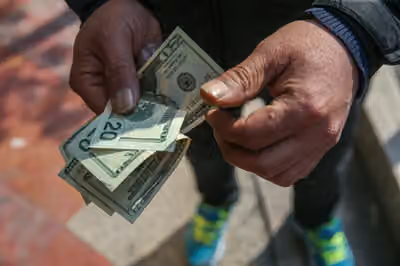

Iran's central bank says $9.5 billion in foreign currency has been appropriated for importing medicines and essential goods for the current Iranian year.
Shiva Raveshi, the head of currency operation at the central bank said Friday that $8 billion was appropriated for regular essential imports per Iran’s current budgetary projection and $1.5 billion for Covid needs.
She added that in the past Iranian year (March 21, 2020-March 20, 2021) a similar amount was spent on these imports but this year the hard currency has already been appropriated. She added that the government is using incentives to encourage exporters to bring back their hard currency earnings to the country.
Under tough US sanctions Iran has lost most of its oil export income and has resorted to belt-tightening and spending its hard currency reserves, which are estimated to have declined to around $30 billion from more than $100 billion before its sanctions kicked in in 2018.
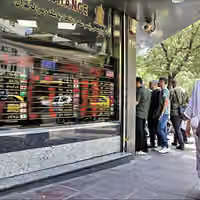
Iran’s battered currency rial has declined to its lowest point in the past 12 months, trading at more than 280,000 rials to the US dollar on Saturday. This constitutes a 20 percent decline since May.

In the Economic Freedom of the World report by Canada’s Fraser Institute Iran has ranked among the ten worst countries, scoring 160 among 165 in the world.
The group of experts who compiled and supervised the report say that measures such as size of government, legal system and property rights, sound money, freedom to trade internationally and regulations were considered in deciding the rankings. The data used was from 2019, but the report was published last month. The report is issued every five years, with the previous one published in 2015.
“The index published in Economic Freedom of the World measures the degree to which the policies and institutions of countries are supportive of economic freedom. The cornerstones of economic freedom are personal choice, voluntary exchange, freedom to enter markets and compete, and security of the person and privately owned property,” Fraser Institute said.
Iran ranked at the very bottom of the scale in freedom to own foreign currency bank accounts, and most notably in freedom of foreigners to invest and even travel to Iran. This has been detrimental to Iran’s economy especially in its oil and gas sectors, where infusion of new capital and technologies are sorely needed. Iranian officials have said that more than $50 billion is needed immediately to upgrade decaying infrastructure.
While the Iranian government has been blaming international sanctions in early 2010s and US sanctions since 2018 for its economic problems, the report sheds light on the need to reform legal, banking and other regulations by the government to boost investments and productivity.
Data in the report show that Iran has a closed economic system with a big government sector and huge subsidies that limit the government’s ability to invest. What is not well reflected in the data is the size of state ownership, since Iran presents most of its large industries and companies as privately held, while they are in fact hybrid entities controlled by the government and owned by powerful insiders and state banks or “charities”.
The data in the report also show a high degree of “military interference in rule of law and politics,” over the years. In fact, the Islamic Revolutionary Guard Corps (IRGC) is one the largest business conglomerates in the country, stifling competition and any chance of foreign investments.
In the section about ‘Freedom to trade internationally’, Iran received low scores in tariff rates and the gap between official and black market currency exchange rates.
The regulatory landscape also received low marks, with credit market regulation, including interest rate controls, and labor laws hitting low scores.
An overall observation shows little change in economic freedom since the last report was issued in 2015. The bottom ten countries in the study were: Central African Republic, Democratic Republic of Congo, Syria, Republic of Congo, Iran, Zimbabwe, Algeria, Libya, Sudan, and Venezuela.

Iran has permitted licensed cryptocurrency mining machines to resume operations after a three-month lull ordered by former President Hassan Rouhani.
Around seven percent of world cryptocurrency mining by powerful computers that use a lot of electricity is estimated to be taking place in Iran. The world’s cheapest electricity rates in the country encourage to lucrative business, in some cases with the involvement of some Chinese entities.
Iran experienced renewed electricity shortages in June when temperatures rose and air-conditioning units were turned on. The controversial practice of cryptocurrency mining was banned for three months, although tens of thousands of illegal, underground computers continued to work.
Electricity shortages are again expected in the winter, as Iran is chronically short of power generation due mainly to lack of investments in the sector. A severe drought in 2021 has further reduced power generation as most dams are more than half empty.
Although some officials have said that crypto mining only uses 300 megawatts of power, others have warned that usage is much higher and it can threaten to power grid.
Local media have been reporting that even in some government offices illegal crypto machines have been operating. The director of Tehran’s stock exchange Wednesday announced his resignation after cryptocurrency mining machines were uncovered at the offices of the organization.

After a letter from Iran's Supreme Leader Ali Khamenei, President Ebrahim Raisi has insisted Iran will not take imports from South Korea’s LG and Samsung.
This follows speculation for some months that a reported agreement over using Iranian money frozen in Korean banks to buy humanitarian goods might be extended to cover Korean-made home appliances, which dropped out of the Iranian market when the United States introduced stringent banking sanctions in 2018.
The letter, signed by Khamenei office chief Mohammad Mohammadi Golpaygani September 6, cited a call from Iranian manufacturers that Korean home appliances be kept out.
Khamenei's ban could also be a means to pressure South Korea to address the issue of Iran's frozen funds. On Thursday, two days after the ban was made public, Iran's foreign minister Hossein Amir-Abdollahian held a phone talk with his Korean counterpart Chung Eui-yong and urged him to redouble efforts to address the issue.
Raisi conveyed the leader’s office instruction to the relevant ministers − for the economy, and for industries, mines and trade − September 8. Official news agencies Tuesday published the two communications.
The value of Iran's home appliances market has been estimated at between 4.5 to 6 billion dollars. Aside from problems with US sanctions, Iran has for several years not issued import permits for home-appliances if comparable items are made at home.
Khamenei's letter referred only to "two South Korean companies" but meant LG and Samsung, who ceased trade with Iran after the US introduced in 2018 financial sanctions threatening third parties in 2018, despite Iran’s warning it would be difficult for them to return once US sanctions ended. The Korean firms had previously established an important market, including the assembly in Iran by Iranian companies of a variety of goods including air conditioners, and TV and audio sets.
In February media reported the US Treasury was in talks with South Korea to allow the transfer of some of Iran's funds frozen by Korean banks to Switzerland for humanitarian purchases. In July the South Korean Finance Ministry said an agreement had been reached.
Some Iranian media claimed the agreement also allowed frozen funds to be used to buy products from LG and Samsung to send to Iran. This was denied by an official of Iran's Home Appliances Industries Association, Abbas Hashemi, on September 6 in an interview with the Iranian Students News Agency (ISNA), when he insisted Tehran rather than Washington should decide how to use the frozen money.
"The matter is not too complicated,” Mohammad-Reza Bagheri, a hardliner activist tweeted Thursday. “South Korea wanted to pay its debt with home appliances, conquer our markets and paralyze our industries…the Supreme Leader has opposed it."
Others on social media took a different view, posting in support of importing Korean products by claiming they were better than others on the market, or that not importing South Korean products benefits Chinese companies. Goldiran and Sam Service, the two Iranian companies that assembled LG and Samsung products for over two decades, now work with Chinese producers.
"Khamenei's ban on South Korean home appliances is more backing Chinese than Iranian domestic production because currently [Iranian companies] only assemble Chinese parts in Iran. Nothing is being produced," one of the many tweets against the ban said.

After a letter from Iran's Supreme Leader Ali Khamenei, President Ebrahim Raisi has insisted Iran will not take imports from South Korea’s LG and Samsung.
This follows speculation for some months that a reported agreement over using Iranian money frozen in Korean banks to buy humanitarian goods might be extended to cover Korean-made home appliances, which dropped out of the Iranian market when the United States introduced stringent banking sanctions in 2018.
The letter, signed by Khamenei office chief Mohammad Mohammadi Golpaygani September 6, cited a call from Iranian manufacturers that Korean home appliances be kept out.
Khamenei's ban could also be a means to pressure South Korea to address the issue of Iran's frozen funds. On Thursday, two days after the ban was made public, Iran's foreign minister Hossein Amir-Abdollahian held a phone talk with his Korean counterpart Chung Eui-yong and urged him to redouble efforts to address the issue.
Raisi conveyed the leader’s office instruction to the relevant ministers − for the economy, and for industries, mines and trade − September 8. Official news agencies Tuesday published the two communications.
The value of Iran's home appliances market has been estimated at between 4.5 to 6 billion dollars. Aside from problems with US sanctions, Iran has for several years not issued import permits for home-appliances if comparable items are made at home.
Khamenei's letter referred only to "two South Korean companies" but meant LG and Samsung, who ceased trade with Iran after the US introduced in 2018 financial sanctions threatening third parties in 2018, despite Iran’s warning it would be difficult for them to return once US sanctions ended. The Korean firms had previously established an important market, including the assembly in Iran by Iranian companies of a variety of goods including air conditioners, and TV and audio sets.
In February media reported the US Treasury was in talks with South Korea to allow the transfer of some of Iran's funds frozen by Korean banks to Switzerland for humanitarian purchases. In July the South Korean Finance Ministry said an agreement had been reached.
Some Iranian media claimed the agreement also allowed frozen funds to be used to buy products from LG and Samsung to send to Iran. This was denied by an official of Iran's Home Appliances Industries Association, Abbas Hashemi, on September 6 in an interview with the Iranian Students News Agency (ISNA), when he insisted Tehran rather than Washington should decide how to use the frozen money.
"The matter is not too complicated,” Mohammad-Reza Bagheri, a hardliner activist tweeted Thursday. “South Korea wanted to pay its debt with home appliances, conquer our markets and paralyze our industries…the Supreme Leader has opposed it."
Others on social media took a different view, posting in support of importing Korean products by claiming they were better than others on the market, or that not importing South Korean products benefits Chinese companies. Goldiran and Sam Service, the two Iranian companies that assembled LG and Samsung products for over two decades, now work with Chinese producers.
"Khamenei's ban on South Korean home appliances is more backing Chinese than Iranian domestic production because currently [Iranian companies] only assemble Chinese parts in Iran. Nothing is being produced," one of the many tweets against the ban said.