• العربية
  • فارسی
BrandBrand
  • Iran Insight
  • Politics
  • Economy
  • Analysis
  • Special Report
  • Opinion
  • Podcast
  • Live TV
  • Iran Insight
  • Politics
  • Economy
  • Analysis
  • Special Report
  • Opinion
  • Podcast
  • Live TV
  • Theme
  • Language
    • العربية
    • فارسی
  • Iran Insight
  • Politics
  • Economy
  • Analysis
  • Special Report
  • Opinion
  • Podcast
  • Live TV
All rights reserved for Volant Media UK Limited
volant media logo

IAEA says Iran still blocking access to damaged nuclear sites

Oct 27, 2026, 14:48 GMT+0

Iran has yet to grant international inspectors access to its damaged nuclear facilities, while longstanding questions about its nuclear program remain unresolved, the UN nuclear watchdog said.

At Tuesday's UN Security Council meeting on Iran's nuclear program, International Atomic Energy Agency Director General Rafael Grossi said the agency would continue working with Tehran to clarify issues that have remained unanswered for three years.

Grossi also said any path toward resolving Iran's nuclear dispute must include IAEA inspections.

France's representative to the Security Council said Iran had failed to meet its obligations under the Nuclear Non-Proliferation Treaty.

Britain's representative said the IAEA Board of Governors had referred Iran's nuclear file to the Security Council for the first time in two decades.

Bahrain's representative said Tehran had failed to meet its obligations to the agency for more than seven years, while Russia opposed the Security Council's consideration of Iran's nuclear program.

Most Viewed

Bessent says Iran economy will contract by more than 25%
1
EXCLUSIVE

Bessent says Iran economy will contract by more than 25%

2

Qatar pushes for Iran deal, new US strikes remain possible

3

Oil price surge fuels Iran hardliners’ case against US deal

4

Mecca defense pact members hold talks with Iran

5
INSIGHT

'Iraq-first' message from Iran ally sparks calls for retaliation

Spotlight

  • Iran’s neighbors push diplomacy, prepare for its failure
    ANALYSIS

    Iran’s neighbors push diplomacy, prepare for its failure

  • Three members of Iranian family die within months after protest killing

    Three members of Iranian family die within months after protest killing

  • Iran talks with Mecca pact states may be ‘last chance’ before military action
    ANALYSIS

    Iran talks with Mecca pact states may be ‘last chance’ before military action

  • 'Iraq-first' message from Iran ally sparks calls for retaliation
    INSIGHT

    'Iraq-first' message from Iran ally sparks calls for retaliation

  • Oil price surge fuels Iran hardliners’ case against US deal

    Oil price surge fuels Iran hardliners’ case against US deal

Banner
Banner
Banner
Banner
Banner
•
•
•

More Stories

Israel election sees record turnout as Iran takes center stage

Oct 27, 2026, 13:55 GMT+0
100%
An advert for an Israeli television channel that will broadcast Israel's election coverage features Israeli Prime Minister Benjamin Netanyahu and former Israeli military chief Gadi Eisenkot, leader of the Yashar party, ahead of Israel's national election, on a bridge in Tel Aviv, Israel, October 21, 2026.

Israelis are voting Tuesday in an election in which Iran has emerged as a central issue, with turnout running at its highest level in decades.

The vote could bring an end to Benjamin Netanyahu’s long tenure as prime minister, with his Likud facing an opposition led by former military chief Gadi Eisenkot.

Voter turnout has reached 55.7 percent as of 4pm, Israeli media report, citing the Central Elections Committee.

Turnout at the same time in the 2022 election stood at 47.5 percent.

“We have surpassed all the records kept by the Central Elections Committee,” acting director general Dean Livne said. “There hasn’t been such a nationwide voter turnout since 1973.”

Long lines prompted election officials to say polling stations would remain open beyond their scheduled 10 p.m. closing time if voters were still waiting.

“We promise, everyone will vote,” Livne said. “If there is a line at 10 p.m., the polling stations will continue to operate until everyone who arrived by 10 p.m. has voted.”

Exit polls, normally released as voting ends, could consequently be delayed.

Iran has featured prominently in the closing days of the campaign.

Israeli media reported that Netanyahu clashed with military chief Eyal Zamir over proposed action related to Iran that Zamir feared could trigger renewed conflict. Netanyahu denied the reports, while Defense Minister Israel Katz called reports of a rift baseless.

Eisenkot backed Zamir, accusing Netanyahu of putting his political survival ahead of national security and warning that he would not allow the military to become a tool in Netanyahu’s “campaign of survival.”

Another opposition leader, Avigdor Liberman, went further, saying any attempt to drag Israel into military action to prevent the election would amount to treason.

Eisenkot, like Netanyahu, says Iran must be prevented from acquiring nuclear weapons and has backed military strikes against its nuclear program.

But he has rejected Netanyahu’s pursuit of regime change in Tehran as an achievable military objective and argued for combining economic pressure and diplomacy with military action when necessary.

Earlier this month, Eisenkot said another attack would be justified if Iran were making a dash for a nuclear weapon, but said he was unaware of any development requiring an immediate strike.

The result is being followed closely in Iran, where Israel’s next government will inherit decisions over whether and under what circumstances to resume military action against Tehran.

Iran could lose 1.4 million jobs this year, official warns

Oct 27, 2026, 12:04 GMT+0
100%
Two men sit beside a fountain in an Iranian park.

Iran could lose up to 1.4 million jobs this year if its economy contracts by seven to eight percent, a senior Labor Ministry official said on Tuesday, estimating that around 2.5 million people are already unemployed.

Malek Hosseini, deputy minister for entrepreneurship and employment development, said Iran's economy contracted by 10 percent excluding oil and 4.6 percent including oil in the spring, citing official figures in an interview with labor-focused ILNA news agency.

According to two decades of Labor Ministry research, every one-percentage-point decline in economic growth corresponds to an average loss of 170,000 jobs, Hosseini said.

“If negative growth of seven to eight percent is recorded by the end of the year, around 1.2 million to 1.4 million people will have completely left the labor market” over the course of the year, he said.

The warning follows remarks by Ali Babaei Karnami, head of parliament's Social Affairs Committee, who said on October 23 that more than 1.7 million Iranian workers had lost their jobs since the start of the 12-day war.

Economist Ahmad Alavi told Iran International on October 18 that poverty, unemployment and declining purchasing power had existed before the war but had since worsened, attributing the country's economic difficulties to the Islamic Republic's policies.

More than one million leave insurance rolls

Around 1.15 million people were removed from Iran's compulsory social insurance rolls between March and August, although further analysis is needed to distinguish retirements, disabilities and new registrations, Hosseini said.

Another 300,000 people joined the unemployment benefits system by the end of August.

Iran's formal labor market recorded a net loss of approximately 500,000 workers during the Iranian year ending March 2026, according to Hosseini.

The official estimated that informal employment accounts for 54 percent of Iran's workforce, compared with 46 percent in formal employment.

“Our labor market suffers from chronic and structural problems,” Hosseini said, adding that the balance had shifted further toward informal and underemployed work since the war.

Government proposes jobs without insurance coverage

The Labor Ministry is developing a public employment program for unemployed people and informal workers affected by the economic crisis, offering short-term construction and service-sector work.

“There is absolutely no social security insurance under the public employment program,” Hosseini said.

Participants will also fall outside the protections of Iran's labor law, although existing employers and workers in registered businesses will remain subject to those regulations.

Hosseini said the ministry was working with the Central Bank to identify informal workers through banking transactions, distinguishing wage income from investment returns.

The official also warned that if raw materials are not adequately supplied, Iran's garment production and distribution chain could suffer losses equivalent to about 60 percent of its pre-war workforce, potentially affecting up to 750,000 jobs.

Workers, retirees and employees across Iran have repeatedly staged protests in recent months over low wages, unpaid salaries, rising living costs, dismissals and job insecurity.

Bessent's tax boycott and fuel advice sparks debate among Iranians

Oct 27, 2026, 11:28 GMT+0
•
Saba Heidarkhani
100%
Shoppers walk through a crowded bazaar in Iran, as the country faces mounting economic pressure and concerns over rising living costs.

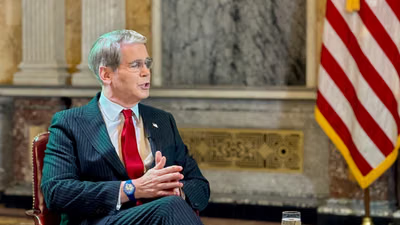
US Treasury Secretary Scott Bessent's advice to stop paying taxes and stockpile fuel drew mixed reactions on Iran International's Instagram page, with commenters debating its practicality and the role of public resistance against the Islamic Republic.

The responses followed Bessent's interview with Iran International, in which he urged Iranians to prepare for severe fuel shortages and forecast a contraction of more than 25 percent in the country's economy in the year ending March 2027.

“My advice to the Iranian people would be: don't pay your taxes because you're not going to get anything back from the government,” Bessent told Iran International's Kambiz Tavana on Monday.

  • Bessent says Iran economy will contract by more than 25%

    Bessent says Iran economy will contract by more than 25%

Bessent also urged households to stock up on heating fuel and fill their gasoline tanks, warning that Washington's Operation Economic Outcast would intensify over the next eight weeks.

The interview prompted a discussion among Iranians commenting on Iran International's Instagram post, with responses ranging from support for economic noncooperation to questions about how individuals could implement the recommendations.

Tax boycott prompts questions over implementation

Several commenters pointed out that income taxes are deducted automatically from salaries, leaving employees with little control over whether they pay them.

“We don't voluntarily pay taxes; they take them from us. Other deductions are made too, and whatever salary remains is paid late,” one commenter wrote.

Others noted that taxes are also included in the prices of goods and services, making them difficult to avoid through individual action.

“To avoid paying taxes, we'd have to stop eating because they're built into essentials. We'd starve if we didn't pay. And what fuel are we supposed to store, and how?” another wrote.

Some business owners and other respondents raised concerns about the consequences of withholding taxes, including potential restrictions on bank accounts and payment terminals.

“If you fail to pay taxes, your card terminal and bank accounts can be blocked. A shopkeeper's livelihood depends on them. We know this route; if it worked, we'd have tried it. Why not listen to people about practical solutions?”

  • US crackdown leaves much of Iran’s shadow banking untouched

    US crackdown leaves much of Iran’s shadow banking untouched

Others questioned how much a boycott of individual tax payments would affect the Islamic Republic's finances.

Fuel recommendations draw questions

Bessent's recommendation to stockpile gasoline and heating fuel also generated discussion about household infrastructure, storage capacity and costs.

Several commenters noted that many Iranian homes use piped natural gas for heating and hot water, rather than fuel that can easily be stored.

“Where am I supposed to store fuel? I live in a 74-square-metre apartment with no balcony or storage. There's barely room for me. Even if I had fuel, how would I use it in my gas heating system?”

Another asked how households could prepare for shortages of piped gas or gasoline.

“How exactly should we stockpile fuel? How can we store the piped gas supplied to our homes, or gasoline for our cars?”

Financial considerations were another recurring theme, with some respondents describing difficulties setting aside money for additional supplies.

“A week after my salary arrives, only a small portion remains in my account, and I have to live on that until the end of the month. How am I supposed to stockpile fuel?” one wrote.

Others responded with humor, including suggestions about filling balloons with gas or storing kerosene in apartments.

Some urge collective action against the Islamic Republic

Not all responses focused on the practical challenges. Some supported Bessent's broader message, arguing that Iranians should take an active role in increasing economic pressure on the Islamic Republic.

“People of Iran, we should act too; we cannot expect the US to do everything. Let's start by not paying water, electricity and gas bills, and shopkeepers should withhold taxes.”

The suggestion also prompted questions about possible consequences, including the disconnection of essential services for nonpayment.

Others raised concerns about the wider impact of Washington's pressure campaign, including the possibility of military action and its consequences for civilians.

  • What Operation Economic Outcast means for Iran, and for everyone trading with

    What Operation Economic Outcast means for Iran, and for everyone trading with

“Are Iranians supposed to do everything – take to the streets, risk their families and lives – only for the US to bomb Iran, divide its territory and take its oil? Ordinary Iranians would be worse off,” one commenter wrote.

Bessent said the US campaign was intended to pressure Iran's leadership rather than its population, forecasting further economic deterioration and serious fuel shortages this winter.

Kuwait sentences three to death over Iran-linked plot to kill interior minister

Oct 27, 2026, 08:38 GMT+0
100%

A Kuwaiti court sentenced three men to death after convicting them of collaborating with Iran and Hezbollah and plotting to assassinate senior officials, including First Deputy Prime Minister and Interior Minister Sheikh Fahad Al-Yousef Al-Sabah.

Kuwait Times reported that the State Security Criminal Court’s anti-terrorism division handed down the sentences on Monday over charges including espionage, planning attacks against Kuwait, membership in an outlawed organization and actions deemed harmful to national interests.

The death sentences are not final and are subject to review by Kuwait’s Court of Appeals.

Explosives alleged in assassination plan

Prosecutors accused some of the defendants of preparing to use explosives in the assassination plot, while one was accused of attempting to smuggle explosives into Kuwait for use in the planned attacks.

The court said the defendants sought to undermine state security, create instability and weaken public confidence in the authorities’ ability to maintain order, according to Kuwait Times.

AFP, citing two judicial sources, identified one of those sentenced to death as Hussein Abdallah al-Maatouq, a religious figure and secretary-general of the National Islamic Alliance. The sources said another of the three had previously been convicted on terrorism charges in 2016, later pardoned by Kuwait’s emir and arrested again in April.

Similar cases in Kuwait

The ruling follows another Iran- and Hezbollah-linked espionage case in Kuwait earlier this year.

In July, Kuwait’s State Security Court of Appeal sentenced a Kuwaiti citizen to life imprisonment after overturning an earlier 10-year term. Local reporting said he had been convicted of cooperating with Iran’s Revolutionary Guards and Hezbollah and had traveled to Qom, where prosecutors said he received weapons and drone training.

The allegations in that case included meetings with security figures linked to Iran and Hezbollah and preparations for activity deemed harmful to Kuwait’s national security.

Bahrain has also prosecuted alleged IRGC networks

Bahrain has brought several similar cases this year involving alleged cooperation with Iran’s Revolutionary Guards.

In May, a Bahraini court sentenced nine defendants to life imprisonment and two others to three years after convicting them of collaborating with the IRGC in what authorities described as hostile and terrorist activities against the kingdom.

Bahrain’s Interior Ministry had earlier said it arrested dozens of people it linked to the IRGC as authorities investigated alleged networks operating during the wider regional conflict.

The cases have unfolded amid heightened tensions between Iran and states across the Persian Gulf, with governments in the region increasing scrutiny of alleged Iranian-linked security and espionage networks.

Iran talks with Mecca pact states may be ‘last chance’ before military action

Oct 27, 2026, 05:06 GMT+0
•
Negar Mojtahedi
100%
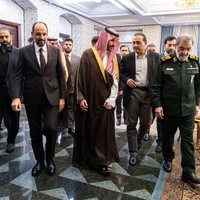
Saudi Arabia’s Defence Minister Prince Khalid bin Salman, Pakistan’s Chief of Defence Forces Field Marshal Asim Munir, and Turkish intelligence chief Ibrahim Kalin during a meeting with Iranian officials in Tehran, Iran, October 26, 2026. (ISNA)

Talks involving Saudi Arabia and its defense partners in Tehran may offer a final diplomatic opportunity before a collective military response, a regional affairs analyst said Monday, amid attacks on Saudi territory and threats of renewed US-Iran fighting.

Mohamed Fahmy, a journalist and regional affairs analyst, described the visit as an exercise in "coercive diplomacy," arguing that the alliance was combining negotiations with preparations for a possible military response.

"This may be the last chance before a collective imminent military action," he told Iran International.

Saudi Defense Minister Khalid bin Salman, Pakistani army chief Asim Munir and Turkish intelligence chief Ibrahim Kalin met Iranian President Masoud Pezeshkian and Supreme National Security Council Secretary Mohsen Rezaei, with Rezaei hosting the four-way talks.

Riyadh said the visit by representatives of the Mecca Joint Defense Agreement was part of efforts to reduce tensions and promote dialogue.

The attacks on Saudi Arabia have presented the first major test of the agreement, signed by Saudi Arabia, Turkey and Pakistan in August, which pledges collective action when a member comes under attack.

Iranian state television reported that the four countries agreed to continue discussions on regional peace and security. No agreement to halt the Houthi attacks was announced.

The talks also unfolded against renewed threats of military action between Washington and Tehran. President Donald Trump has kept open the possibility of renewed strikes, while Iranian officials have warned of retaliation.

"The main objective is pressure," Fahmy said.

He said Saudi Arabia and its partners were attempting to exhaust diplomatic options while demonstrating that continued Houthi attacks could bring a collective response.

Professor Saad bin Tefla al-Ajmi, a former Kuwaiti information minister, told Iran International that the seniority of the delegation demonstrated the lengths to which Iran's neighbors were prepared to go to prevent another war.

He described the visit as an extraordinary diplomatic effort to prevent renewed hostilities, but said it could be interpreted in sharply different ways within Tehran, either as evidence of Iranian strength or as an opportunity to pursue a diplomatic settlement.

Iranian hardliners, he said, could portray the arrival of senior Saudi, Turkish and Pakistani officials as evidence that the Islamic Republic had gained the upper hand, forcing its neighbors to seek accommodation on Iranian territory.

A more pragmatic interpretation would see the visit as an opportunity for Tehran to demonstrate a willingness to cooperate with neighboring countries and pursue a diplomatic settlement, while portraying Washington and Israel as responsible if negotiations failed.

"It depends on whose mind you are reading in Tehran now," al-Ajmi said.

Attacks test the Mecca pact

Al-Ajmi also pointed to a hardening Saudi position toward the Houthis, arguing that Riyadh had exhausted its attempts to accommodate the group.

"I think that they have made their mind that the Houthi will have to go and they can't take it anymore," he told Iran International.

Al-Ajmi said Saudi Arabia was seeking international diplomatic and political support while demonstrating that it had been the target of aggression by the Houthis and their Iranian backers.

The urgency of the talks follows a series of deadly attacks on Saudi civilian and strategic infrastructure.

The Houthis claimed fresh attacks Monday on Saudi oil infrastructure and Riyadh airport, although Saudi authorities did not immediately confirm those claims.

The Saudi-led coalition also reported destroying Houthi missile infrastructure in Yemen, while Egypt's parliament authorized military support to help defend Saudi Arabia, potentially drawing another regional power more directly into the confrontation.

Egypt's decision, Fahmy argued, adds another dimension to the confrontation, with potential consequences for the country's already vulnerable economy.

The diplomatic effort may also involve financial concessions.

Israel Hayom reported Monday, citing unnamed Persian Gulf diplomatic sources, that Saudi Arabia was discussing a possible $1 billion payment to the Houthis through Iran as part of a ceasefire arrangement.

The Israeli newspaper said a Saudi official did not confirm any transfer but acknowledged that earlier understandings with the Houthis included financial assistance for public-sector salaries and reconstruction in exchange for an end to attacks.

Iran International could not independently verify the reported $1 billion proposal.

The possibility of a negotiated settlement comes as the Mecca pact's ability to fulfill its military commitments faces growing scrutiny.

Historian and political analyst Dr. Shahram Kholdi told Iran International that the alliance had failed to deliver the protection promised to its members.

"The Mecca Pact has effectively been a paper tiger," Kholdi said.

He argued that despite military cooperation among the three countries, Saudi Arabia remained vulnerable to Houthi missile and drone attacks.

Obstacles to a lasting settlement

Kholdi believes the delegation's principal objective is to persuade Tehran to restrain the Houthis, potentially in exchange for efforts to convince Washington to reconsider some of the conditions preventing renewed US-Iran negotiations.

He said Turkey and Pakistan were reluctant to confront the Houthis directly because of the risk of Iranian retaliation, leaving Saudi Arabia pursuing diplomacy while continuing to face attacks.

Even securing Tehran's cooperation, however, may not produce a lasting settlement.

Kholdi argued that the Houthis could demand political guarantees amounting to the effective partition of Yemen before agreeing to stop their attacks.

Such an arrangement could leave Saudi Arabia facing an entrenched hostile entity along its southern border, an outcome Riyadh has so far resisted.

Other regional diplomatic efforts have focused on the US-Iran standoff. Qatari officials visited Tehran on Sunday, while Pakistan has continued to serve as an intermediary between the United States and the Islamic Republic.

Disagreements remain over the US naval blockade of Iranian ports, access through the Strait of Hormuz and the terms of a broader settlement addressing Iran's nuclear program.

Kholdi expects the diplomatic effort could produce a temporary reduction in hostilities, but doubts it will deliver a lasting ceasefire. He warned that even a brief lull could unravel through miscalculation.

The Mecca pact was established to provide collective security. Continued attacks on Saudi Arabia are now testing that commitment while its members pursue talks with Iran.

With no announced agreement to halt the Houthi attacks and the US-Iran standoff unresolved, the risk of a military confrontation extending well beyond Yemen remains.