China sent Iran 1,300 air shipments of weapons parts - WSJ

Around 1,300 air shipments containing drone and missile parts were sent from China to Iran in the first six months of this year, The Wall Street Journal reported, citing customs data.
One shipment arrived on the day the United States and Iran reached a ceasefire in April, following the outbreak of war in February, the newspaper said.
Another shipment two days later carried drone parts worth more than $6 million, according to the report.
The Journal said a surge in cargo flights from China had been crucial to sustaining Iran’s weapons programs under US sanctions.
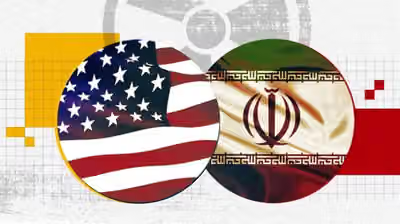







Iran and the United States ended Wednesday divided over how to end their war despite renewed UN talks, as Tehran rejected US pressure and Washington maintained its blockade of Iranian ports while oil shipments continued through Hormuz.
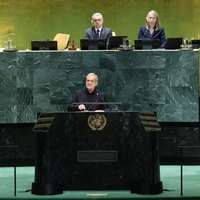
The first indirect talks between the two countries in months took place Tuesday on the sidelines of the UN General Assembly, between speeches in which US President Donald Trump threatened further military action and Iranian President Masoud Pezeshkian rejected the use of force to secure a deal.
Pezeshkian told the assembly Wednesday that Iran would not surrender to American pressure but remained willing to negotiate. He accused Trump of displaying a “bullying mentality” and argued that diplomacy could not succeed under military threats.
His address left the central dispute unresolved. A senior Iranian official told Reuters that Tehran was reviewing Washington’s response to its proposal for ending hostilities but that the sides remained far apart. The proposal prioritizes lifting the US blockade of Iranian ports and reopening Hormuz.
Trump had described Tuesday’s discussions as productive. Iranian officials confirmed that Foreign Minister Abbas Araqchi communicated with US envoys Steve Witkoff and Jared Kushner through Qatari mediation but disputed suggestions that Tehran had abandoned its conditions for reopening the strait.
Hormuz remains at the center of the dispute
The disagreement over the waterway links the diplomatic exchanges to the continuing confrontation at sea.
Pezeshkian argued in his UN speech that Iran could not be denied access to Hormuz while other countries benefited from shipping through it. Tehran has linked reopening the strait to an easing of US military pressure and the lifting of the blockade. Washington has rejected Iran’s efforts to exert greater control over navigation and collect fees from passing vessels.
While those terms remained unsettled, US Treasury Secretary Scott Bessent said American forces were helping move between 10 million and 17 million barrels of oil a day through Hormuz despite attacks on tankers.
He compared that volume with about 20 million barrels a day before the war and said roughly 3 million barrels were moving through alternative routes.
“The tankers, they may get hit. Many of them just sail on,” Bessent told Fox News.
US Central Command separately said it had redirected 115 commercial vessels as of September 23 while enforcing the blockade of Iranian ports. The figures describe two distinct parts of Washington’s maritime campaign: maintaining oil flows through the strait and restricting trade with Iran.
Continued shipments have not restored safe passage for commercial crews. A vessel was struck in Hormuz on Wednesday, killing one crew member and forcing the evacuation of more than 20 others, according to Oman’s navy. The origin of the projectile was not immediately established.
The danger also prompted India’s Forward Seamen’s Union to seek naval escorts for merchant ships after Indian sailor Suraj Yadav, 26, was killed aboard the MV Cape Dao off Oman.
European Council President António Costa raised the shipping dispute with Pezeshkian, urging Iran to halt strikes on neighboring countries, restore freedom of navigation through Hormuz and resume cooperation with the International Atomic Energy Agency.
Economic pressure continues alongside diplomacy
Washington also pressed ahead with restrictions beyond the maritime blockade.
Bessent said US sanctions had shut down more than 80% to 90% of Iran’s international flights and questioned how Tehran’s delegation to the UN would return home. The measures expose foreign companies servicing Iranian airlines to potential secondary sanctions.
The restrictions disrupted routes to neighboring countries, although some international flights continued after the US deadline. The Guardian reported that Iranian officials were seeking to preserve air links as the new measures took effect.
The diplomatic opening did not produce an announced shift in the military positions of Iran or Israel. Iran’s Armed Forces Chief of Staff Ali Abdollahi vowed retaliation for the killing of the country’s former supreme leader and children in Minab. Israel’s UN ambassador Danny Danon said Israel had not finished its mission against Iran and called for further sanctions.
By the close of Wednesday, the talks had restored a channel between Washington and Tehran but left the terms of a settlement unresolved. The US blockade remained in place, oil continued to move through a dangerous waterway, and neither side had announced an agreement on how unrestricted navigation through Hormuz would resume.
Iran’s economy contracted sharply in the spring as war hit its oil and gas sectors, with new data pointing to an energy crunch that could force Tehran to balance gas exports against rising domestic demand as winter approaches.
Iran’s Statistical Center reported that gross domestic product contracted 10.1% year on year in the spring, with almost every major sector shrinking except agriculture.
The value added of the oil and gas extraction sector, measured at constant 2021 prices, fell 26.4%. Its share of Iran’s economy also declined from 26% in the spring of last year to 21% in the same period this year.
International Energy Agency data show that Iran produced an average of about 2.6 million barrels of crude oil per day between April and June, roughly corresponding to the spring quarter. That was more than 20% below the same period last year.
Average daily oil production fell further to around 2.3 million barrels in the summer. With the United States imposing a naval blockade on Iran from mid-July, the contraction in GDP is expected to be significantly sharper in the summer than in the spring.
Gas distribution
Statistical Center data show that the value added of the gas distribution sector, measured at constant 2021 prices, fell by more than 21% in the spring from a year earlier.
Israel targeted gas-processing facilities at South Pars, the field that accounts for around 70% of Iran’s gas production, on March 18. Since then, Iranian officials have given varying estimates of the decline in gas production, ranging from 100 million to 230 million cubic meters per day.
The International Energy Agency’s initial estimates, published in May, suggested that Iran’s daily gas production may have fallen by around 100 million cubic meters.
The Statistical Center did not specify the exact daily volume of gas distributed during the spring. However, an earlier report showed that Iran produced and injected around 726 million cubic meters per day of processed gas into the distribution network in the spring of last year.
Given the 21% decline in the sector’s value added at constant prices, this suggests that gas supplied to the domestic network fell by roughly 152 million cubic meters per day this spring, to around 573 million cubic meters.
The decline is particularly significant ahead of winter. Iran faces a severe natural gas deficit during the cold months, with the daily shortfall reaching as much as 250 million cubic meters during periods of peak demand.
The government has consequently been forced to restrict supplies to industries, power plants and the petrochemical sector to meet rising residential demand.
The gas export puzzle
Despite the decline in gas supplied to the domestic network, Iran increased exports to one of its two gas customers.
Data from Turkey’s energy market regulator (EMRA) show that Iranian gas exports to Turkey increased 27% between April and June to 30 million cubic meters per day. Iran also exports gas to Iraq, although comparable data for the same period have not been published.
The increase in exports to Turkey may have two main explanations.
First, domestic gas demand is lower during the warmer months than in autumn and winter. Second, Iran’s industrial and petrochemical sectors may have experienced a significant decline in gas consumption because of the war.
According to earlier Statistical Center data, Iran’s petrochemical sector and industries consumed about 82 million and 397 million cubic meters of gas per day, respectively, in the spring of last year.
Combined, that represented roughly 75% of domestic gas sales, excluding exports, transmission and distribution losses, and gas used to operate the network itself. The combined figure was equivalent to about 66% of the total processed gas injected into the network that spring.
Israel targeted parts of Iran’s petrochemical complexes in Asaluyeh and Mahshahr during the spring. Together, those facilities account for around 70% of Iran’s petrochemical production. Israel also targeted the Mobarakeh and Khuzestan steel complexes, which together account for about half of Iran’s steel production.
It is therefore likely that gas consumption by these industries fell sharply during and after the attacks, freeing up some gas for exports.
But the situation could change rapidly as temperatures fall.
Household gas consumption rises to roughly twice its spring and summer levels in autumn and more than three times the warm-season level in winter. Households accounted for 49% of Iran’s total gas consumption last winter, according to the Statistical Center.
It remains unclear whether Iran will be able to maintain gas exports to Turkey and Iraq once domestic demand surges in the coming months.
Iran warned Wednesday that any renewed US attack would draw a stronger military response, even as officials from the two countries pursued a new diplomatic opening in New York that has triggered a backlash among hardliners in Tehran.
The warnings followed President Donald Trump's threat at the United Nations to “annihilate” Iran, while Tehran has said further negotiations depend on Washington accepting seven conditions it has put forward for ending the conflict.
Mohsen Rezaei, secretary of Iran's Supreme National Security Council, sharply criticized Trump in remarks broadcast on state television, saying Iran would not return to what he described as the previous model of diplomacy.
He said the United States would first have to meet Iran's seven conditions before Tehran would agree to reopen the Strait of Hormuz and begin negotiations.
Rezaei said it had been agreed at a meeting with President Masoud Pezeshkian that Foreign Minister Abbas Araghchi would communicate the conditions to intermediaries during his visit to New York.
That account has become significant amid a growing dispute in Tehran over Araghchi's contact with US special envoy Steve Witkoff on Tuesday and whether the foreign minister had authorization to meet him directly.
US officials have described the latest contact between the two sides as face-to-face, while Iranian accounts have emphasized the role of mediators and said the purpose was to convey Tehran's conditions to Washington.
‘Childish and vile’
Iran's state broadcaster reported Tuesday evening that Araghchi had met Witkoff at the insistence of the American side and that the purpose of the meeting was to communicate Iran's conditions for reopening the Strait of Hormuz.
Foreign Ministry spokesman Esmail Baghaei said contact with the US side took place through Qatari mediators and was intended to communicate conditions including an end to the war on all fronts, a halt to US military operations, an end to the naval blockade and economic war, and the release of Iranian assets.
The contact prompted strong criticism of Araghchi from hardline and IRGC-affiliated media.
Tasnim News Agency, which is affiliated with the IRGC, described Araghchi's explanation as “childish and vile” and demanded an apology, questioning why he needed to meet Witkoff if Iran's conditions had already been communicated through intermediaries.
Ebrahim Rezaei, spokesman for parliament's National Security and Foreign Policy Committee, also questioned the meeting and asked Araghchi to explain what authorization he had received.
But parliament member Mojtaba Zarei defended Araghchi, saying his own review indicated that the foreign minister had been authorized to meet Witkoff.
“There was and is no negotiation,” Zarei wrote, saying Iran's seven conditions, including the lifting of the blockade of Yemen, had been communicated directly to Trump's representative.
Pezeshkian’s revised speech
The dispute unfolded as Pezeshkian and Trump publicly exchanged warnings while leaving open the possibility of diplomacy.
Pezeshkian said during his address to the General Assembly on Wednesday that he had changed his prepared remarks after hearing Trump's speech.
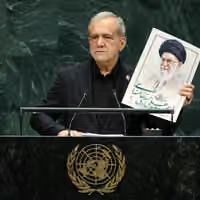
Holding up photographs of children killed in the attack on a primary school in Minab alongside an image of late Supreme Leader Ali Khamenei, Pezeshkian accused the United States and Israel of imposing the war on Iran and said the Islamic Republic had “powerfully” defended itself.
But he also said Iran remained open to negotiations in pursuit of peace and would not accept what he called “the language of coercion.”
Trump, meanwhile, issued a fresh warning against Iran while also expressing optimism that the dispute between Washington and Tehran could be resolved.
Speaking Wednesday at a meeting with Gulf Cooperation Council leaders in New York, Trump said the United States would “immediately” attack Iran if it carried out activities at the Kolang underground facilities.
Later Wednesday, after meeting British Prime Minister Andy Burnham, Trump said negotiations were continuing and that he believed the two sides would ultimately reach an agreement.
Iran's General Staff of the Armed Forces and the Khatam al-Anbiya Central Headquarters accused Trump of using the UN podium to justify military action and said Iran was prepared to deliver “stronger, crushing and unpredictable blows” in response to any renewed attack.
The simultaneous threats and diplomatic contacts have left the two sides pursuing negotiations while publicly warning that renewed military action remains possible.
Iranian children returned to classrooms Wednesday for an unusually somber start to the school year, the first since young people were killed in a government crackdown on January protests and in the war with the United States.
The normally jovial ceremonies marking the first day of the Iranian school year were shadowed by the memory of children who might otherwise have returned to class this week.
Children were among those killed by Iranian security forces during the January protests, while 120 children died when a primary school in the southern city of Minab was struck on the first day of the war on Feb. 28.
More than 16.5 million students returned to over 124,000 schools across Iran for the new academic year, according to state media. Classes had been suspended after the United States and Israel launched strikes on Iran.
A United Nations fact-finding mission said last week there were reasonable grounds to believe US forces were responsible for the Minab attack and that the strike was indiscriminate and violated international law.
The mission also found that Iranian authorities committed crimes against humanity in their crackdown on the nationwide protests, including unlawful killings, torture and arbitrary detention.
War enters the classroom
But accounts sent to Iran International from several cities suggest the war and the government's response to it were following students back into school in other ways as well.
A parent in Mazandaran province said the principal of her son's school had warned students that failing to bring an Islamic Republic flag on the first day of school could negatively affect their end-of-year grades.
In Garmdareh, west of Tehran, another person said several flag-bearing vans and a vehicle equipped with loudspeakers entered Barati school on the first day, playing religious mourning music at high volume.
Military personnel were also present in the school grounds, the person said.
‘Cultural battle’
Iran's Education Ministry announced during the summer that material related to the conflict and the country’s military and nuclear capabilities would be incorporated into educational content.
The country's Organization for Educational Research and Planning has printed and distributed 12 million copies of educational materials titled “We Defend Our Iran” for older primary and secondary school students.
Officials with the student Basij have spoken of training tens of thousands of student “commanders” under a program called Yavaran-e Velayat for what they describe as a “cultural battle.”
As children filed back into classrooms across Iran, Pezeshkian was in New York addressing the UN General Assembly, where diplomacy aimed at ending the war was also gathering pace.
He held up photographs of children killed in the Minab strike as he accused the United States and Israel of attacking Iranian civilians.
For the children returning to school at home, however, the events of the past nine months were already part of the new school year.
Any effort to end the Iran war faces a fundamental obstacle even after the resumption of US-Iran diplomacy in New York: apparent divisions within Tehran over who has the authority to negotiate and how far those negotiations can go.
Iranian President Masoud Pezeshkian devoted both the opening and closing sections of his address to the United Nations General Assembly on Wednesday to rejecting President Donald Trump's accusations against Tehran.
He also made clear that while Iran welcomed negotiations, it would not yield to coercion or what he described as Trump's “bullying.”
The tension between those two messages reflects the difficult political terrain surrounding the latest diplomatic opening. Pezeshkian and Foreign Minister Abbas Araghchi have signaled a willingness to pursue talks, but criticism from hardliners has raised questions about how much room they have to negotiate.
Those divisions surfaced after Araghchi's contact with US envoy Steve Witkoff in New York on Tuesday.
The IRGC-affiliated Tasnim News Agency reported Wednesday that the contact had taken place without authorization from Iran's policymaking bodies, including the Supreme National Security Council.
Citing Mohsen Rezaei, secretary of the council, Tasnim said the approved plan had been limited to conveying Iran's seven conditions through mediators. It described Araghchi's reported interaction with Witkoff as a “major error” and called on the foreign minister to explain his actions.
The criticism points to a potentially important fault line in Tehran: not necessarily over whether diplomacy should continue, but over how direct that diplomacy is permitted to become.
Accounts of Tuesday's discussions have themselves differed. US officials have described a three-hour diplomatic exchange positively, while Iranian accounts have emphasized the role of mediators and said Tehran's conditions were conveyed to Washington.
An Iranian diplomat told Reuters before Pezeshkian's speech that discussions on ending hostilities could continue in New York and described the General Assembly as “a golden opportunity for America to return to diplomacy.”
US Secretary of State Marco Rubio said any agreement would require sustained work over time and that Trump retained military options.
Rubio also pointed to divisions within Tehran, saying potential agreements had repeatedly faltered after being referred back to the country's revolutionary establishment. He blamed the IRGC for the collapse of an earlier US-Iran understanding after it attacked ships in the Strait of Hormuz.
Hardliners test the limits
Despite Tasnim's criticism of Araghchi, some hardline messaging immediately before and during the New York talks appeared to leave room for diplomacy.
Before opposition to the talks became more vocal, even the hardline Kayhan newspaper sounded unusually supportive of Pezeshkian on Wednesday morning.
IRGC spokesman Hossein Mohebbi also delivered a dual message following reports of the talks.
“We don't reject diplomacy, but we impose our own conditions. Our defensive power will be proven in the field,” he was quoted as saying.
The formulation suggested that the IRGC was not rejecting negotiations outright, even while insisting that diplomacy take place on Tehran's terms and alongside continued military pressure.
The dispute over Araghchi's contact with Witkoff suggests the argument may therefore be less about whether Iran should negotiate than about the format, limits and authorization of those negotiations.
Pezeshkian's own language at the United Nations appeared designed to preserve that room while demonstrating that negotiations would not amount to capitulation.
Responding to Trump's rhetoric, he warned the United States, Israel and regional actors that Iran would respond forcefully to threats, while insisting that Tehran still believed in diplomacy.
Major General Ali Abdollahi, chief of staff of Iran's Armed Forces, similarly argued that “rhetoric doesn't change the power calculus” and described Trump's remarks as “a sign of desperation” on the US side.
The sequencing problem
The mediation channel has so far allowed the two sides to exchange complex proposals without requiring the politically riskier spectacle of a meeting between Trump and Pezeshkian.
But even if Tehran's internal disagreements can be contained, substantial differences remain over what each side must do first.
Washington is reportedly insisting on the clearance of maritime choke points and assurances related to Iran's nuclear program before easing its naval blockade.
Tehran, by contrast, is demanding an immediate end to US interdictions and the release of $24 billion in frozen foreign assets as conditions for further progress, according to a source close to the Iranian diplomatic team.
Iran has also linked progress in negotiations to reopening the Strait of Hormuz.
The diplomatic opening in New York therefore leaves two related questions unresolved: whether Washington and Tehran can agree on the sequence of steps needed to end the conflict, and whether Iran's diplomats have sufficient authority at home to deliver whatever they negotiate.
The reaction from the IRGC and other hardline institutions in the coming days may provide an early indication of the answer.