Calls for a tougher response have grown louder as fighting expands beyond the Strait of Hormuz and US pressure on Iranian oil exports intensifies.
In parliament, ultraconservative lawmaker Mohammad Taghi Naghdali has called for a stronger response to prevent further weakening of Lebanese Hezbollah, while Hassan Ghashghavi, spokesman for parliament’s National Security and Foreign Policy Committee, has argued for measures aimed at strengthening Iran’s deterrence.
Other hardline figures have gone further, renewing calls for Iran to withdraw from the Nuclear Non-Proliferation Treaty, end remaining international monitoring and adopt a more confrontational nuclear posture.
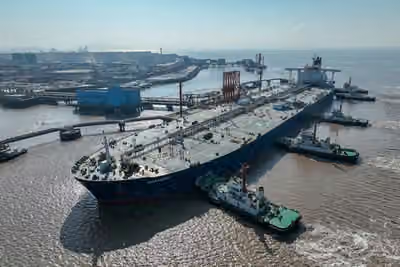
The Revolutionary Guards said Thursday its navy had targeted two US vessels, eight oil tankers and 10 other ships in the Persian Gulf and Strait of Hormuz in response to US attacks on five Iranian tankers.
The escalation is taking place against severe economic pressure at home. Food inflation reached 127.5 percent year-on-year in the month to late August, while the rial has fallen to record lows against the dollar.
For advocates of escalation, the calculation is that greater military pressure can produce strategic leverage before the economic and military costs become harder to sustain.
The International Atomic Energy Agency’s Board of Governors this week reported Iran to the UN Security Council over breaches of its nuclear non-proliferation obligations, the first such referral in 20 years.
Tehran rejected the decision, accusing Western governments of using disruption caused by US and Israeli attacks on its nuclear facilities as a pretext for further pressure.
Calls to leave the NPT or further restrict international monitoring could give Tehran another means of raising the stakes. They could also deepen its isolation and increase the risk of further military action at a time when diplomatic options are already limited.
But what are Iran’s alternatives?
Yet judging the hardliners’ strategy solely against Iran’s vulnerabilities misses the other side of the calculation.
President Donald Trump said this week that negotiations with Iran “could happen,” but added that talks were “not something we’re looking at” for now. US forces, meanwhile, have continued attacks on Iranian oil tankers and enforcement of Washington’s maritime blockade.
Trump also said he wants any eventual agreement to go beyond the nuclear issue, potentially making a negotiated settlement more difficult to reach.
Senior advisers have privately warned Trump that Iran could continue resisting US pressure and that the conflict could last through the remainder of his presidency, according to a Wall Street Journal report.
Iran’s latest attack on the US base in Jordan required American forces to fire roughly 30 Patriot interceptors, according to a US official, adding to concerns about the rate at which the war is consuming sophisticated air-defense missiles.
Precise stockpile figures are classified, but independent estimates and recent reporting have pointed to significant pressure on US inventories of Patriot and other high-end interceptors, which can take years to replenish.
The disparity in overall military and economic power remains considerable, while Iran is already contending with high inflation, disruption to its oil trade and the costs of sustained military operations.
But the calculation in Tehran appears to be that Iran can impose sufficient costs on the United States and its regional partners before its own vulnerabilities become overwhelming.
It is a strategy with considerable risks. But with no clear diplomatic off-ramp, the harder question is whether Tehran’s hardliners are ignoring the options available to Iran—or responding to how few remain.