US official confirms IRGC strike damaged US aircraft in Jordan - Reuters

Iranian strikes damaged multiple US military aircraft this week at Muwaffaq Salti Air Base in Jordan, Reuters reported Thursday, citing a US official.
The official told Reuters that one A-10 Thunderbolt II, known as the Warthog, was hit and left missing a wing, while roughly eight F-15s sustained light damage and were returned to service.
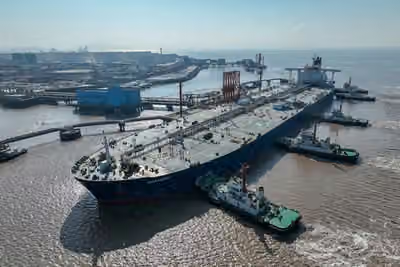
The Iranian attack came on Tuesday after US forces said they destroyed five Iranian crude oil tankers in response to the Revolutionary Guards targeting a US Navy warship with ballistic missiles twice over the previous two days.
The US official said American forces fired roughly 30 Patriot interceptors to counter the Iranian missiles.
Reuters reported that 42 US military aircraft had already been lost or damaged in the conflict as of May, citing the Congressional Research Service. Since the war began in February, 18 US service members have been killed and more than 800 injured, according to the report.
The report also cited a CSIS estimate that about 65% of US Patriot interceptors were expended between February and July, leaving fewer than 850 from 2,330 before the war.



The United States on Thursday sanctioned networks it said were helping Iran finance and support allied armed groups across Iraq, Lebanon, the United Arab Emirates and Turkey.
The Treasury Department said the measures targeted individuals and businesses supporting Iraq’s Kata’ib Hezbollah and Lebanese Hezbollah, including militia members, arms dealers, procurement companies, money exchangers and alleged sanctions-evasion networks.
“Whether they finance terror, launder money, or help Iran evade sanctions, we will find them, cut them off from the U.S. financial system, and dismantle the networks keeping the regime aflotat,” Treasury Secretary Scott Bessent said.
Among those sanctioned were four alleged Kata’ib Hezbollah commanders and members.
The Treasury also targeted figures connected to Iraq’s Popular Mobilization Forces, saying Iran-aligned factions had used their positions within the state-backed umbrella organization to obtain military equipment and channel resources to networks linked to Iran’s Revolutionary Guards.
One of those targeted was a UAE-based Iraqi arms dealer whose company, according to the Treasury, supplied goods and services to the Popular Mobilization Forces, including maintenance for Russian-made helicopters.
Another Iraqi procurement company was accused of helping acquire foreign defense equipment and components through dealings involving Russia, Iran and China, and of participating in attempted purchases of US defense articles through sanctions-evasion networks.
The sanctions also targeted Dubai-based Shams and Bahr Trading Company and two Iraqi businessmen associated with it. The Treasury said the exchange had been used to transfer millions of dollars from Iraq to Iran through the UAE.
In Lebanon, Washington focused on what it described as a cash-smuggling network used to move proceeds from Iranian oil sales to Hezbollah.
The Treasury said the Revolutionary Guards’ Quds Force used front companies and regional exchange houses to transfer the money, alleging that two Lebanese businessmen moved hundreds of millions of dollars from the Quds Force to Hezbollah between May and September 2025.
It also targeted gold and currency exchange businesses that it said formed part of the network, including operations involving the purchase of gold in Dubai and its movement into Lebanon by couriers.
The measures are part of Operation Economic Outcast, announced by Bessent on August 24 as Washington sought to sever Iran’s remaining sources of revenue, increase the cost of sanctions evasion and expand secondary sanctions exposure for companies continuing to do business with Tehran.
Alongside the new designations, the Treasury tightened its Iran licensing policy, saying applications for specific licenses covering otherwise prohibited Iran-related transactions would now generally face a presumption of denial, except in limited circumstances.
OFAC also announced a separate $1.43 million settlement with an individual accused of violating Iran sanctions by providing consulting and advisory services to an Iranian software company, receiving Iranian-origin dividends through US bank accounts and acquiring property in Iran.
Hardliners in Tehran are pressing for further military and nuclear escalation despite mounting economic pressure and a widening confrontation with the United States. Is it a reckless gamble, or a realistic response to Iran’s dwindling options?
Calls for a tougher response have grown louder as fighting expands beyond the Strait of Hormuz and US pressure on Iranian oil exports intensifies.
In parliament, ultraconservative lawmaker Mohammad Taghi Naghdali has called for a stronger response to prevent further weakening of Lebanese Hezbollah, while Hassan Ghashghavi, spokesman for parliament’s National Security and Foreign Policy Committee, has argued for measures aimed at strengthening Iran’s deterrence.
Other hardline figures have gone further, renewing calls for Iran to withdraw from the Nuclear Non-Proliferation Treaty, end remaining international monitoring and adopt a more confrontational nuclear posture.
The Revolutionary Guards said Thursday its navy had targeted two US vessels, eight oil tankers and 10 other ships in the Persian Gulf and Strait of Hormuz in response to US attacks on five Iranian tankers.
The escalation is taking place against severe economic pressure at home. Food inflation reached 127.5 percent year-on-year in the month to late August, while the rial has fallen to record lows against the dollar.
For advocates of escalation, the calculation is that greater military pressure can produce strategic leverage before the economic and military costs become harder to sustain.
The International Atomic Energy Agency’s Board of Governors this week reported Iran to the UN Security Council over breaches of its nuclear non-proliferation obligations, the first such referral in 20 years.
Tehran rejected the decision, accusing Western governments of using disruption caused by US and Israeli attacks on its nuclear facilities as a pretext for further pressure.
Calls to leave the NPT or further restrict international monitoring could give Tehran another means of raising the stakes. They could also deepen its isolation and increase the risk of further military action at a time when diplomatic options are already limited.
But what are Iran’s alternatives?
Yet judging the hardliners’ strategy solely against Iran’s vulnerabilities misses the other side of the calculation.
President Donald Trump said this week that negotiations with Iran “could happen,” but added that talks were “not something we’re looking at” for now. US forces, meanwhile, have continued attacks on Iranian oil tankers and enforcement of Washington’s maritime blockade.
Trump also said he wants any eventual agreement to go beyond the nuclear issue, potentially making a negotiated settlement more difficult to reach.
Senior advisers have privately warned Trump that Iran could continue resisting US pressure and that the conflict could last through the remainder of his presidency, according to a Wall Street Journal report.
Iran’s latest attack on the US base in Jordan required American forces to fire roughly 30 Patriot interceptors, according to a US official, adding to concerns about the rate at which the war is consuming sophisticated air-defense missiles.
Precise stockpile figures are classified, but independent estimates and recent reporting have pointed to significant pressure on US inventories of Patriot and other high-end interceptors, which can take years to replenish.
The disparity in overall military and economic power remains considerable, while Iran is already contending with high inflation, disruption to its oil trade and the costs of sustained military operations.
But the calculation in Tehran appears to be that Iran can impose sufficient costs on the United States and its regional partners before its own vulnerabilities become overwhelming.
It is a strategy with considerable risks. But with no clear diplomatic off-ramp, the harder question is whether Tehran’s hardliners are ignoring the options available to Iran—or responding to how few remain.
Iranian missiles damaged several American military aircraft at a base in Jordan this week, a US official told Reuters, underscoring the continuing ability of Iranian strikes to penetrate US defenses after more than six months of war.
The attack on Muwaffaq Salti Air Base on Tuesday damaged an A-10 Thunderbolt II, commonly known as the Warthog, as well as about eight F-15 fighter jets, according to the official, who spoke on condition of anonymity.
The F-15s sustained light damage and were returned to service.
The exchange began after US forces destroyed five Iranian crude oil tankers.
Washington said the strikes were carried out after Iran’s Islamic Revolutionary Guard Corps twice targeted a US Navy warship with ballistic missiles over the previous two days.
Iran then launched ballistic missiles at the American base in Jordan, forcing US forces to fire roughly 30 Patriot interceptors, the official said.
That expenditure comes amid growing concern in Washington over the rate at which the war is consuming some of the US military’s most sophisticated missiles.
Precise stockpile figures are classified, but independent estimates and recent reporting suggest inventories of Patriot, THAAD and other high-end munitions have fallen sharply during the Iran war.
The Center for Strategic and International Studies estimated in July that the United States had expended about 65 percent of its prewar Patriot interceptor inventory, leaving between 759 and 827 missiles from an estimated 2,330 before the conflict.
The concern is less that the United States is about to run out of missiles for the Iran war than that rebuilding inventories could take years, potentially reducing Washington’s ability to respond to another major conflict.
CSIS has estimated that replenishing several key weapons, including Patriot, THAAD and Tomahawk missiles, will be a multiyear undertaking.
The aircraft damaged in Jordan add to mounting US equipment losses since the war began in February.
According to a May report from the Congressional Research Service, 42 US military aircraft had already been lost or damaged in the conflict. The losses included more than two dozen drones, fighter aircraft hit by Iranian strikes and aircraft lost in accidents.
Eighteen US service members have been killed and more than 800 injured since the war began.
Soaring food prices in Iran are increasingly reflected in reports of theft, with groceries appearing in cases ranging from first-time shoplifting to warehouse raids and armed robbery.
A butcher in Karaj told Iran International that some customers now ask for their meat to be placed in black bags so it does not attract attention.
He described an elderly woman who had just bought meat when a man on a motorbike snatched the bag from her hand, causing her to fall and suffer injuries.
Police and judicial authorities do not publish detailed statistics on food theft, making it impossible to establish its scale or whether such crimes have increased. But basic groceries feature repeatedly in recent media reports of theft.
Some cases appear to involve people with no previous history of crime.
Meat, rice, cream
State news agency IRNA reported the case of a woman caught hiding two tubs of cream under her chador. When stopped by a security guard, she said her children were hungry. Her husband, described as a day labourer, reportedly knew nothing about the theft.
In a review of similar cases, IRNA said some of those accused, including housewives, had no criminal record and were facing theft charges for the first time. Cheese, yoghurt, cream and cooking oil were among the goods being stolen, it said.
The newspaper Jahan-e Sanat has separately reported thefts of cheese, butter and meat from shops.
The reports come as the cost of basic food has risen far faster than overall prices.
According to the Statistical Center of Iran, year-on-year inflation for food and drink reached 127.5 percent in the month to late August, meaning average prices in the category had more than doubled in a year.
Some staples rose considerably faster. Solid vegetable oil increased by more than 383 percent, eggs by nearly 294 percent, chicken by around 177 percent and red meat by 148 percent.
Iranian media reported last month that a kilogram of beef fillet cost around 42.7 million rials, about $19. At that price, one kilogram was equivalent to roughly seven and a half days of earnings at the minimum daily wage of 5.54 million rials, or about $2.50.
Armed robberies
But food is also appearing in crimes that have little apparent connection to immediate hunger, suggesting that sharply higher prices have made groceries more attractive to thieves.
In eastern Tehran, members of a gang who police said confessed to more than 10 house burglaries were stealing rice alongside gold, dollars and coins.
Police have also reported larger thefts, including around 1.5 tons of rice and other groceries from a storeroom in Tehran and approximately 15 tons of rice from a private warehouse in Rey.
Local media reported two armed robberies of shops in Iranshahr, in Sistan and Baluchistan province. In one, attackers took six sacks of rice, around 12 bottles of cooking oil, tinned food and pulses. In another, robbers fired shots before taking rice and cooking oil.
The cases cannot establish that food theft is increasing, nor do they point to a single motive. Shoplifting by someone struggling to feed a family is plainly different from a gang stealing rice alongside gold or raiding a warehouse.
What connects them is the changing value of food after years of inflation, particularly the steep price rises of recent months. Basic groceries have become increasingly difficult for many Iranians to afford — and valuable enough to steal.
A dispute over Iran’s proposed measures to combat foreign infiltration escalated Thursday, with a senior lawmaker accusing President Masoud Pezeshkian’s government of acting illegally after the cabinet opposed a parliamentary committee report on the controversial legislation.
The cabinet has opposed a report by parliament’s National Security and Foreign Policy Committee concerning the proposal, state news agency IRNA reported, citing Iran’s national database of laws and regulations.
The published notice did not specify which parts of the committee report the government opposed. The decision was taken at an August 23 cabinet meeting and formally communicated on September 8 by First Vice President Mohammad-Reza Aref.
Alireza Salimi, a member of parliament’s presidium, hit back Thursday, saying the government had exceeded its authority and was approaching the legislation politically rather than on its merits.
“This is a parliamentary proposal, not a government bill, and therefore the government’s action in opposing it is illegal,” Salimi told parliament’s ICANA news agency.
Controversial measure
The confrontation is the latest stage in a dispute over legislation that would significantly broaden the state’s powers to police contacts with foreign governments, media, universities and international organizations in the name of combating espionage and infiltration.
Parliament approved the proposal’s general principles in August by 183 votes to four, but lawmakers have yet to complete consideration of its individual provisions.
A publicly circulated draft would impose new restrictions on sharing information and contacts with foreign institutions and give the Intelligence Ministry and the Revolutionary Guards’ Intelligence Organization roles in identifying prohibited foreign links.
Critics have warned that its broad language could expose journalists, academics, researchers and others engaged in academic, cultural or civil-society cooperation abroad to prosecution.
Pezeshkian’s administration had already raised objections before the cabinet’s formal decision.
Brain drain risk
Vice President for Legal Affairs Majid Ansari said in August that the proposal conflicted with constitutional protections for individual freedoms and could sharply restrict academic contacts with institutions overseas.
He also argued that Iran already had laws and security agencies to combat foreign intelligence activity.
“If every type of contact and communication faces restrictions and is criminalized by law, naturally they will prefer to migrate and carry out their scientific and research activities in a free environment,” Ansari warned.
Salimi said any defects should instead be addressed as parliament considers the proposal.
“If there are flaws in parliament’s proposal, they should be corrected through expert review,” he said.
He also questioned why government representatives had not raised their objections earlier with the National Security and Foreign Policy Committee.
The dispute leaves the government and parliament at odds not only over the scope of the proposed restrictions, but over the administration’s authority to challenge a security initiative originating in parliament.