US to press G20 members to comply with Iran sanctions - AFP
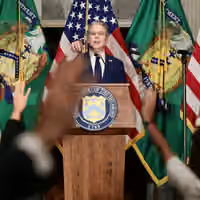
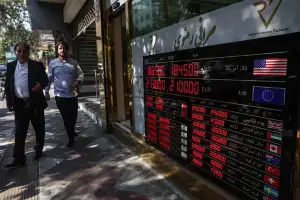
US Treasury Secretary Scott Bessent will press G20 finance ministers next week to comply with Washington’s sanctions on Iran as the Trump administration steps up efforts to isolate Tehran economically, AFP reported Thursday, citing a US Treasury official.
Finance ministers and central bank governors from major G20 economies are due to meet in Asheville, North Carolina, on Monday and Tuesday.
The United States launched “Operation Economic Outcast” on Monday, sanctioning nearly 60 Iran-linked individuals, entities and vessels and expanding the threat of secondary sanctions against those continuing to do business with Tehran.
China, the main buyer of Iranian oil, is expected to be a key challenge for Washington as it seeks broader international compliance with its sanctions campaign.
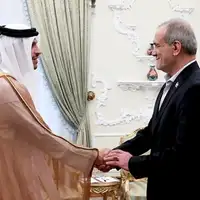
Qatar’s Prime Minister and Foreign Minister Mohammed bin Abdulrahman Al Thani shakes hands with Iran's President Masoud Pezeshkian in Tehran. August 27, 2026
Three regional mediators have visited Tehran in three days in an intensifying diplomatic push to revive Iran-US talks, even as the two sides remain deeply divided over the Strait of Hormuz and Washington’s economic pressure campaign.
Qatar’s Prime Minister Mohammed bin Abdulrahman Al Thani arrived on Thursday, following Omani Foreign Minister Badr Albusaidi on Tuesday and Pakistan Army Chief Field Marshal Asim Munir on Monday, as regional powers seek to create a path toward de-escalation and renewed negotiations.
Al Thani’s visit, his first to Iran since the war began in late February, came after days of diplomacy focused partly on finding an arrangement over Hormuz that could provide an opening for broader talks.
He met President Masoud Pezeshkian, Foreign Minister Abbas Araghchi, Parliament Speaker and senior negotiator Mohammad-Bagher Ghalibaf and security chief Mohsen Rezaei.
The messages he received reflected the competing currents shaping Tehran’s response to the diplomatic push.
Pezeshkian praised efforts by Qatar, Pakistan, Oman and other countries to promote peace and security in the region. He also pointed to factions in the United States, Israel and Iran that he said were trying to prevent agreements from taking shape, urging US officials to ignore voices opposed to a return to stability.
Ghalibaf told Al Thani that an economic blockade of Iran would be ineffective and said Washington should implement commitments made under the Islamabad memorandum.
Rezaei struck a more confrontational tone, warning that Iran would target US military and economic interests if Washington sought to “commit mischief” against Iran. He reiterated that the Strait of Hormuz would remain closed unless the United States met Tehran’s conditions.
Qatar’s Foreign Ministry said Al Thani discussed regional developments, efforts to reduce tensions and creating conditions for the resumption of dialogue between Tehran and Washington.
Mediators push for talks
The flurry of diplomatic activity has fueled speculation in Iranian media that Tehran and Washington could return to negotiations, although there is little indication that a breakthrough is imminent.
Iran Nuances, an English-language outlet apparently linked to Iran’s Foreign Ministry, argued that the succession of visits reflected concern among regional states that intensified economic pressure could produce wider instability rather than force Iran to capitulate.
The Iranian news agency ILNA was more cautious. In a commentary headlined “Can Qatar Unlock the Negotiations?”, it said the gap between Tehran and Washington remained too wide for Qatar’s mediation to be certain of success.
“If Iran considers lifting economic pressure and ending the blockade a precondition for any opening, while the United States continues to insist on increasing pressure, even activating Qatar’s mediation channels will not necessarily lead to the resumption of negotiations,” it said.
ILNA suggested that Doha could instead begin by mediating over de-escalation and freedom of navigation in the Strait of Hormuz, potentially creating an opening for wider negotiations.
Economic daily Donya-ye Eqtesad described the succession of regional visits as a form of “multi-layered diplomacy” aimed at developing a phased roadmap involving Iran, the United States and regional mediators, with maritime arrangements providing an initial route toward de-escalation.
But optimism in parts of the Iranian media contrasts sharply with Washington’s public posture.
US President Donald Trump told Al Jazeera on Wednesday that he was “not in a hurry” to resume negotiations with Iran and had set no timetable for ending the war. He said economic pressure and military action were proving effective.
White House spokeswoman Karoline Leavitt said Thursday that there were currently no negotiations between the United States and Iran and that all options remained on the table.
Fate of missing Iranian pilots
Al Thani’s visit also brought renewed attention in Tehran to the fate of Iranian pilots who went missing in March after their Sukhoi fighter jets were shot down over Qatar.
Iranian officials say three pilots survived after ejecting from their aircraft, were captured by Qatari forces and have been held there since.
Qatar strongly rejects that account. Doha says its search-and-rescue teams found the remains of one pilot and handed them to Iran, but that it has no information about the fate of the others.
Iran has requested that an Iranian Air Force expert team and the International Committee of the Red Cross become involved in determining their fate.
Iranian army spokesman Mohammad Akraminia said Wednesday that if Qatar genuinely did not know what had happened to the pilots, it should make greater efforts to establish their whereabouts.
Fada-Hossein Maleki, a member of parliament’s National Security Commission, said Thursday that the lack of clarity over the pilots remained a source of tension with Doha and warned that any evidence they had been mistreated would affect bilateral relations.
Hardliners also seized on the issue during Al Thani’s visit, accusing Iranian officials of failing to press Qatar publicly over the pilots’ fate.
Simin Fahandej, representative of the Baha'i International Community's United Nations Office in Geneva
Iran’s rising wave of raids, arrests and property seizures against Bahá’ís amounts to “state-sponsored theft,” the Bahá’í International Community’s representative to the United Nations in Geneva said, citing hundreds of incidents since the January crackdown.
Simin Fahandej told Iran International that pressure on the community had intensified following nationwide protests in January, fitting what she described as a longstanding pattern in which Bahá’ís are targeted during periods of crisis.
“Every single time that there has been a crisis in Iran, the Baha'i community is the first to be scapegoated,” Fahandej said, adding that confiscation of Bahá’í property had been a feature of persecution since the 1979 revolution.
Fahandej said hundreds of cases of persecution had been recorded since January across more than six provinces, while prosecutions of Bahá’ís had doubled from the previous year.
“These arrests and imprisonment of Baha'is isn't an incident,” she said. “It's a nationwide state-led campaign of persecution.”
Cash, gold, instruments
Thirteen United Nations experts earlier this month also warned of an increase in persecution of Bahá’ís in Iran, including allegations of torture and enforced disappearance, and said 57 members of the community were detained or imprisoned.
The warnings come amid a series of raids on Bahá’í families in the central city of Isfahan in which security forces seized cash, gold, household belongings, vehicles, musical instruments and equipment used by families to make a living.
More than 20 security agents simultaneously raided three homes on Monday belonging to Amin Tabyanifard, his mother Bahariyeh Askarinasab and his son Nima Tabyanifard, a source familiar with the matter told Iran International.
The source said plainclothes agents searched the properties from around 8 a.m. until about 1 p.m.
A combination image shows the homes of Amin Tabianifard, Baharieh Asgarinasab and Nima Tabianifard in Isfahan, Iran, after security forces raided the properties on August 24, 2026.
Askarinasab lives in a separate unit in the same building as Amin Tabyanifard, while Nima Tabyanifard lives in another neighborhood of Isfahan.
Agents searched the family’s musical-instrument workshop and seized its tools, equipment and specialized machinery, along with several valuable handmade instruments.
They also seized cash, gold, electronics, household belongings and numerous musical instruments. Authorities later sealed the family’s music and musical-instrument store.
The source said agents in one of the raids used violence, beat people present and made threats.
Nima Tabyanifard was ordered to report to the Isfahan Intelligence Department, while other members of the family received summonses to appear before a court located at Isfahan’s Dastgerd Prison.
Fahandej said some recent arrests and confiscations in other cases had been carried out without warrants.
“These arrests and confiscations, I have to make clear, have taken place entirely illegally,” she said. “They did not have warrants for confiscation nor arrest.”
She said security personnel had in some cases climbed over walls to enter Bahá’í homes.
“If this is not theft and stealing people's property, I don't know what is,” Fahandej said.
She described one case in which a parent was arrested in front of a two-year-old child, and another in which authorities deployed 14 guards, five vehicles and a representative of the prosecutor general to arrest one woman.
‘You didn’t learn your lesson’
In a separate Isfahan case, filmmaker and journalist Sepehr Atefi said security forces raided his parents’ home for the second time in several months.
Atefi wrote on X that eight male agents and one female agent spent more than six hours searching the property and his father’s workplace, including the soil in flowerpots and a bag of rice.
He said agents packed household possessions, including a television, vacuum cleaner and toolbox, along with gold, valuables, communications devices and children’s toys, into his parents’ own suitcases and bags before taking them away in a pickup truck. The family’s car was also seized, Atefi said.
Atefi told Iran International that the repeated raids were taking a psychological and practical toll on his parents.
“This incident and its recurrence can mentally exhaust them,” he said. “Confiscating their IDs and mobile phones can trap them in administrative bureaucracy for days and disrupt their daily lives.”
When his mother objected to the confiscations, agents told her: “These are illicit possessions,” and: “You didn’t learn your lesson the first time,” according to Atefi.
He interpreted the remark as meaning that the family had failed to change its religion and said they were being targeted because they were Bahá’ís.
Fahandej said such language made what she described as the discriminatory nature of the raids explicit.
“There is no other basis for any of these confiscations, arrests, raids ... other than the fact that they're Baha'i,” she said.
She said court documents in some prosecutions had also explicitly cited membership in the Bahá’í community.
“With the misuse of their state authority, they essentially steal Baha'is' properties with complete impunity,” Fahandej said.
Livelihoods targeted
Fahandej said the economic impact of the seizures was particularly severe because Bahá’ís already face restrictions on higher education and public employment.
“Baha'is in Iran are banned from universities,” she said. “Then they're also banned from public employment, so they can't be doctors or lawyers, teachers, and any form of public employment.”
That leaves many members of the community dependent on small businesses and home-based work, she said, making the confiscation of tools, equipment and businesses particularly damaging.
“The basic and modest livelihoods that they would be able to build through these small businesses, sometimes home businesses, are also confiscated.”
Fahandej said authorities had increasingly used Article 49 of Iran’s Constitution, which allows the state to confiscate wealth deemed to have been acquired through illicit means, to seize Bahá’í property under what she described as vague pretexts.
She also pointed to large bail demands as another form of economic pressure.
“Some of the bail amounts that we see actually becomes the equivalent of working for a hundred years in Iran,” she said, calling it “quite a devastating form of persecution.”
Property confiscation has a long history in the Islamic Republic’s treatment of Bahá’ís. Fahandej said community and individual properties were seized in the early years after the 1979 revolution, while Bahá’í institutions were banned from 1983.
Crackdown widens
Recent cases have extended beyond property seizures.
Fahandej pointed to Peyvand Naimi and Venus Hosseini-Nejad, two Bahá’ís arrested in Kerman in southeastern Iran in January whose coerced confessions were later broadcast on state television. The Bahá’í International Community said Naimi was tortured and subjected to mock hangings in detention.
“We saw the forced live confessions of two Baha'is on television, essentially to justify persecution against them and the entire community,” Fahandej said.
A Revolutionary Court in the northern city of Sari has also sentenced 12 Bahá’ís to prison terms and restrictions on their social rights. Six other Bahá’ís were recently arrested in Sari and Karaj, while a Bahá’í student at Islamic Azad University in Birjand was expelled and barred from continuing his studies because of his faith.
Unofficial estimates put Iran’s Bahá’í population at more than 300,000. The Bahá’í faith is not recognized under the Islamic Republic’s constitution, which recognizes Islam as well as Christianity, Judaism and Zoroastrianism.
Human Rights Activists in Iran said Bahá’ís accounted for about 62 percent of reported violations of religious minority rights in 2025.
Fahandej said the latest escalation was taking place as Iranians were already struggling with severe economic pressures.
“It's heartbreaking that amid an already difficult economic crisis in Iran, that the state-sponsored attack against the Baha'is is now sweeping the community, as they, together with all other Iranians, are already suffering,” she said.
A court in Iran has sentenced Leila Abolhassani, a 43-year-old mother of two teenage daughters detained during the January protests in the central city of Shahin Shahr, to death on charges of “waging war against God,” a source familiar with her case told Iran International.
The source said Abolhassani was only filming a supermarket fire when she was arrested on the evening of January 8. Branch 5 of Isfahan’s Revolutionary Court nevertheless sentenced her to death on charges of participating in setting fire to the store.
Abolhassani, who worked as a nail technician, was transferred following her arrest to Dowlatabad Prison in Isfahan, where she has been held for more than seven months.
Her case was referred to Iran’s Supreme Court following an appeal against the sentence and remains under review, the source said.
She faces execution if the Supreme Court upholds the ruling.
Abolhassani’s case follows reports of death sentences against two other men detained during January’s nationwide protests.
Earlier in the week, US-based rights group HRANA reported that Amir Mohammad Mojallal Choubari, 22, and Hossein Nazari, 25, were sentenced to death in separate cases.
Last Sunday, Iran executed Majid Adineh, another January protest detainee, after the Supreme Court upheld his death sentence.
Adineh was arrested on January 9 in Mohammadshahr, near Karaj. A Revolutionary Court sentenced him to death and ordered the confiscation of all his property over accusations of taking “operational action” for Israel, the United States and hostile groups.
Earlier this month, UN Human Rights Chief Volker Türk said on that Iran was using capital punishment to “instill fear among the population and suppress dissent,” urging authorities to halt executions and move toward abolishing the death penalty.
He called the persistent lack of fair-trial and due-process guarantees “deeply troubling,” citing reports of confessions obtained under torture and cases in which executions followed within weeks of arrest.
The US-based Abdorrahman Boroumand Center said Wednesday it had documented 950 executions in Iran since the beginning of 2026, including at least 20 women and 30 protesters. It recorded 45 executions in August so far.
The rights group said Iran’s use of the death penalty took place within a judicial system marked by unfair proceedings, a lack of transparency and political interference, with fair-trial protections systematically violated.
Workers at a Digikala fulfillment center in Iran process and prepare orders for delivery.
Two years ago the editor of Iran's most hardline newspaper said management of the country's biggest online retailer would "fortunately" pass to those who serve the state. It is now chaired by a former spokesman for the supreme leader's business empire.
Hojjat Niki-Maleki identifies himself on LinkedIn as chairman of Digikala Group, having joined the board as a representative of Harakat Aval, the investment arm of the mobile operator MCI. An official company filing lists him as a board member without specifying the chairmanship.
The change dates to June 10 but became public only when the formal notice was published this week, according to the Iranian technology outlet Digiato.
Niki-Maleki previously headed communications for the Execution of Imam Khomeini's Order, commonly known as Setad, a conglomerate built largely on property confiscated after the 1979 revolution, controlled by the office of the supreme leader and under US sanctions. He also spent more than four years on MCI's board.
Hojjat Niki-Maleki
His earlier work was in hardline media. He ran Afsaran, an online platform that promoted anti-Western messaging and the authorities' concept of a cultural "soft war."
His social media history also shows an affinity with the military establishment: in January 2020 he posted a photograph of himself seated beside Qasem Soleimani, then commander of the Revolutionary Guards' Quds Force, on an aircraft.
"I told him I was the son of a martyr, and his respect for me doubled," he wrote, describing Soleimani embracing him at an airport. "The sweet taste of my conversation with Haj Qasem is still with me."
Hojjat’s father, Hossein Niki-Maleki, was a member of the security team aboard Iran Air Flight 655, which was shot down by the United States in 1988.
A social media post by Hojjat Niki-Maleki shows him seated next to Qassem Soleimani on a plane.
Boycott calls
The appointment prompted calls on Persian-language social media to stop shopping at Digikala, with critics pointing to his Setad connection, his politics and his role promoting Iran's domestic Covid-19 vaccine.
"Do not buy from Digikala. This is something you can do," one user wrote on X, arguing that purchases would ultimately help finance Revolutionary Guards missiles and drones.
Another framed the appointment as part of a wider expansion of state-linked influence over the company.
Workers handle packages at a Digikala warehouse in Iran.
Much of the criticism returned to the vaccine. Niki-Maleki worked for Setad when its pharmaceutical arm developed CovIran Barekat, the domestically produced Covid-19 vaccine that authorities promoted during the pandemic, and he repeatedly used his own accounts to publicize its production and effectiveness.
That program became politically charged after the late Supreme Leader Ali Khamenei barred imports of American and British vaccines in January 2021. Critics argued that relying on domestic production delayed access to sufficient doses while Iran struggled to vaccinate its population, and some hold the officials who promoted it responsible for deaths that followed, a charge they have never accepted.
"He used to come here every day two years ago and hashtag that there would soon be good news and we would make a coronavirus vaccine," one user wrote.
About 150,000 people died from the pandemic across Iran, one of the heaviest official tolls in the region. Turkey, with a population of similar size, recorded roughly 100,000. Saudi Arabia reported fewer than 10,000 and the United Arab Emirates around 2,400. What each of those countries did have was early access to Western vaccines, the ones Iran's Supreme Leader had ruled out.
Hojjat Niki-Maleki receives a COVID-19 vaccine during a clinical trial in Iran.
A pattern, not an appointment
The reaction reflects something larger than one board seat: a sequence of events that has moved Iran's most prominent private technology company steadily closer to the state.
Digikala was founded in 2006 by the brothers Hamid and Saeid Mohammadi and grew into the country's dominant online marketplace, the most recognizable business to emerge from Iran's private technology sector.
The pressure began in the summer of 2023, when police sealed its offices after photographs circulated of female employees without compulsory hijab.
In February 2024, the judiciary filed charges over products it said insulted Islamic sanctities, after users circulated images of mugs sold on the site bearing the name Fatemeh Zahra, the daughter of the Prophet Mohammad. The company's chief executive, Masoud Tabatabai, was arrested on the order of the security prosecutor's office and released hours later pending further appearances. Pro-government vigilantes painted threatening messages on the company's building.
That same month, Hossein Shariatmadari, editor of Kayhan and Khamenei's representative at the newspaper, said management of digital companies such as Digikala and the ride-hailing platform Snapp would "fortunately" be transferred to those "who serve the state."
Negotiations over a stake in Digikala also began in that period. They concluded this spring, when Harakat Aval, MCI's venture capital arm, bought 40 percent of Digikala Group in cash, taking over the holding of the venture firm Sarava Pars along with parts of other shareholdings.
The agreed valuation was 300 trillion rials, about $146 million at current market rates, in what the company called the largest investment in the history of Iran's digital economy.
Digikala said the founders would retain 22 percent and two of five board seats, along with executive management, business strategy and the selection of senior managers, and that no single shareholder would control the company.
MCI's own ownership is the point critics return to. Iran's largest mobile operator is a subsidiary of the Telecommunication Company of Iran, privatized in 2009 in a sale to a consortium widely reported to be linked to the Revolutionary Guards.
Niki-Maleki's appointment points to a wider shift in Iran's digital economy: the steady expansion of state-linked institutions into businesses built as private enterprises – which is also why a prediction made in a hardline newspaper in 2024 reads today less like a threat than a schedule.
Bank Melli Iran's branch in Hamburg remains open despite EU sanctions that Germany says apply to the Iranian state-owned bank's German operation, as Washington steps up pressure for its foreign branches to be closed.
The German Foreign Ministry, responding to questions from Iran International, said Bank Melli and its Hamburg branch were already covered by wide-ranging EU restrictions.
“Bank Melli Iran is already subject to far-reaching sanctions at EU level, and this of course also applies to Bank Melli's branch in Germany,” the ministry said.
The ministry did not say whether Germany was considering closing the Hamburg branch or whether Washington had formally asked Berlin to do so.
US pressure
The questions follow US Treasury Secretary Scott Bessent's launch earlier this week of “Operation Economic Outcast,” a campaign aimed at cutting Iran's financial and commercial links abroad.
Bessent specifically targeted Bank Melli, saying “every Bank Melli branch must be shuttered.”
The German Foreign Ministry said Berlin had taken note of Bessent's announcement and remained in talks with Washington and other partners.
“The federal government has taken note of US Treasury Secretary Bessent's announcement and is in constant contact with the US as well as other partners in the EU and in the region regarding further measures against Iran,” it told Iran International.
Berlin gave no indication in its response that a decision had been made on the future of the Hamburg branch.
EU sanctions
The European Union reimposed nuclear-related sanctions against Iran in September last year after France, Germany and Britain triggered the snapback mechanism the previous month.
The measures restored asset freezes on listed Iranian entities and broader restrictions on trade and financial activity.
Bank Melli is explicitly listed under the EU measures along with all its branches and subsidiaries.
EU documents describe Bank Melli as Iran's largest bank, owned and controlled by the Iranian government, and say it provides services to the Ministry of Defense and Armed Forces Logistics.
Under the sanctions, funds and economic resources belonging to or controlled by listed entities must be frozen, and funds or economic resources generally cannot be made available to them directly or indirectly.
EU rules also restrict transfers involving Iranian banks and their branches, while providing exemptions and procedures under which competent authorities can authorize certain transactions.
German oversight
The German Foreign Ministry said the Bundesbank was responsible for implementing EU and UN financial sanctions under Germany's foreign trade framework and referred questions about banking supervision to BaFin.
The Bundesbank says its Financial Sanctions Service Center is Germany's authority for implementing restrictions on capital and payments.
BaFin declined to comment to Iran International on possible measures involving Bank Melli, citing legal confidentiality requirements concerning individual financial institutions.
The regulator told Iran International that Bank Melli remained in its official database and said any final measure that could legally be made public would be published on its website.
BaFin has previously acted against the Hamburg branch.
The regulator said in October 2021 that it had imposed a credit ban on the branch on September 7 of that year after finding that it had breached the four-eyes principle required under German banking rules.
Iran International has also asked the Bundesbank how the restored EU sanctions are being implemented in relation to Bank Melli's Hamburg branch. The central bank had not responded by the time of publication.
For now, Germany has confirmed that EU sanctions apply to the branch but has not said it plans to close it, even as Washington presses foreign governments to shut Bank Melli operations abroad.