• العربية
  • فارسی
Brand
  • Iran Insight
  • Politics
  • Economy
  • Analysis
  • Special Report
  • Opinion
  • Podcast
  • Live TV
  • Iran Insight
  • Politics
  • Economy
  • Analysis
  • Special Report
  • Opinion
  • Podcast
  • Live TV
  • Theme
  • Language
    • العربية
    • فارسی
  • Iran Insight
  • Politics
  • Economy
  • Analysis
  • Special Report
  • Opinion
  • Podcast
  • Live TV
All rights reserved for Volant Media UK Limited
volant media logo

Trump says he is in no hurry for talks as Iran admits the strain

Aug 27, 2026, 08:25 GMT+1
Commercial vessels are seen near a port along the Strait of Hormuz amid heightened tensions over shipping through the waterway.

Iranian officials acknowledged mounting economic strain on Wednesday, and in the same breath restated their conditions for reopening the Strait of Hormuz, as Donald Trump said he was in no hurry to resume talks.

The US president told Al Jazeera he had set no deadline for ending a conflict now in its seventh month.

"I have no time schedule, none," he said, calling economic warfare and military strikes against Iran "both effective."

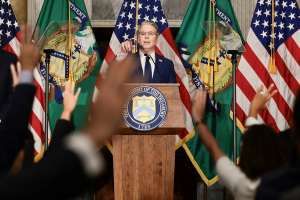
His remarks followed Monday's launch of Operation Economic Outcast, a Treasury campaign that named nearly 60 Iran-linked individuals, entities and vessels and widened the threat of secondary sanctions against anyone still doing business with Tehran.

Iran points to economic toll

Iranian officials are now describing the pressure in language they avoided for months.

President Masoud Pezeshkian said Iran was facing "the worst conditions of an economic war." Executive Vice President Mohammad Jafar Ghaempanah said domestic gasoline production was insufficient and the US naval blockade was preventing imports.

“Continuing on this path is impossible,” Ghaempanah said.

Tehran is fighting the campaign diplomatically as well. Foreign Minister Abbas Araghchi called on the United Nations to condemn Operation Economic Outcast as "economic terrorism," saying its purpose was to sever Iran's lawful economic ties through secondary sanctions and exclusion from the US financial system.

The confrontation has also pulled in Beijing. China said on Tuesday that its economic cooperation with Iran was conducted within international law and should not be disrupted, rejecting what it called illegal unilateral sanctions.

Parliament Speaker Mohammad-Bagher Ghalibaf welcomed that position, saying Iran-China ties "need no one's permission."

Hormuz remains the leverage

While conceding the economic damage, it also showed no sign of softening its position on the Strait of Hormuz.

Revolutionary Guards spokesperson Hossein Mohebi said Iran and Oman had reached understandings on their respective shares of the strait's waters and revenues after about a month of talks.

That went further than the joint Iranian-Omani statement issued on Tuesday, which announced an interim framework for a temporary shipping corridor and joint mine-clearing but said nothing about revenues. A senior Iranian source told Reuters on Wednesday that no final agreement had been reached.

The effect on shipping was visible the same day. An Indian tanker attempting the southern route through the strait turned back after an Iranian warning, according to the Revolutionary Guards-affiliated Fars news agency, which said the route had carried no traffic in the previous 24 hours.

Mohebi set the price plainly. "If the United States stops obstructing and returns to the memorandum, we can reopen the Strait of Hormuz within the framework of the understanding reached," he said. Otherwise, he said, it stays closed.

Diplomacy continues in parallel

Regional governments are still working to keep a route open.

Qatar's prime minister and foreign minister, Sheikh Mohammed bin Abdulrahman Al Thani, travels to Tehran on Thursday for talks on reducing tensions and creating conditions for dialogue.

Qatar said the discussions would cover freedom of navigation in the strait and efforts to restore the conditions that prevailed before February 28, when the 40-day war began.

Washington continues to describe a negotiated outcome as preferable even while expanding the economic campaign.

US Energy Secretary Chris Wright said on Wednesday that the administration's "strong desire" was to end Iran's nuclear program through negotiations and inspections administered by the International Atomic Energy Agency.

"Our number one objective is they will not possess nuclear weapons," Wright said. "If we can do it through negotiation and inspections, that is absolutely the desired way."

He added that Washington was prepared to destroy Iran's nuclear facilities and industrial capacity by military means if necessary.

Most Viewed

What Operation Economic Outcast means for Iran, and for everyone trading with
1
INSIGHT

What Operation Economic Outcast means for Iran, and for everyone trading with

2
EXCLUSIVE

Iran fuel reserves may run dry within weeks, sources say

3
ANALYSIS

Will Mojtaba Khamenei's absence help the Islamic Republic survive?

4
INSIGHT

Tehran debates waiting out Trump’s economic war

5

Iran plotted to assassinate Netanyahu’s son in Florida – Newsmax

Banner
Banner

Spotlight

  • Regional diplomacy tests path back to Iran-US talks
    INSIGHT

    Regional diplomacy tests path back to Iran-US talks

  • Tehran debates waiting out Trump’s economic war
    INSIGHT

    Tehran debates waiting out Trump’s economic war

  • Will Mojtaba Khamenei's absence help the Islamic Republic survive?
    ANALYSIS

    Will Mojtaba Khamenei's absence help the Islamic Republic survive?

  • What Operation Economic Outcast means for Iran, and for everyone trading with
    INSIGHT

    What Operation Economic Outcast means for Iran, and for everyone trading with

  • Iran keeps finding gas. Getting it out is the problem
    ANALYSIS

    Iran keeps finding gas. Getting it out is the problem

  • Tehran mosques used to surveil, shoot at January protesters
    EXCLUSIVE

    Tehran mosques used to surveil, shoot at January protesters

Banner
  • What Operation Economic Outcast means for Iran, and for everyone trading with

    What Operation Economic Outcast means for Iran, and for everyone trading with

•
•
•

More Stories

Regional diplomacy tests path back to Iran-US talks

Aug 26, 2026, 21:39 GMT+1
•
Maryam Sinaiee
100%
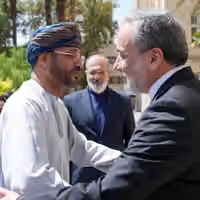
Omani Foreign Minister Badr al Busaidi visited Tehran on August 25, 2026 for talks with his counterpart Abbas Araghchi.

Regional diplomacy around Iran appears to be gathering pace, with Pakistan, Oman and potentially Qatar seeking to turn an emerging agreement over the Strait of Hormuz into a path back to negotiations between Tehran and Washington.

In Tehran, the diplomatic push is already exposing divisions over what comes next.

Pragmatists see the visits as a possible route back to the Islamabad memorandum and negotiations with Washington, while hardliners portray them as an American attempt to escape the pressure Iran has created around Hormuz.

Farda News, a website close to Parliament Speaker Mohammad-Bagher Ghalibaf, said visits by Omani Foreign Minister Badr al-Busaidi and Pakistan’s army chief Field Marshal Asim Munir shared the objective of finding a political solution to the confrontation.

But it stressed that an agreement with Oman would not itself mean reopening Hormuz.

“Tehran insists that a technical agreement with Oman does not mean returning the strait to its pre-war conditions, and that remains tied to the implementation of US commitments under the Islamabad memorandum,” it wrote.

‘American pawn’

Economic daily Donya-ye Eqtesad similarly said the phased agreement could provide a route toward reviving the Islamabad memorandum, easing pressure around the strait and eventually returning Iran and the United States to negotiations.

But hardline Kayhan called the visits a “new phase of the White House deception operation,” arguing that Washington needed Iran back at the negotiating table to escape the energy crisis and deadlock over Hormuz.

It described Munir as an “American pawn” being used to help Washington escape what it called the quagmire of the war and declared the Islamabad memorandum dead.

The competing interpretations follow an unusually concentrated burst of regional diplomacy. Al-Busaidi visited Tehran on Tuesday, a day after Munir, while Qatar’s prime minister is expected in the Iranian capital on Thursday, according to Iranian media.

Diplomatic push

Tehran and Muscat announced after al-Busaidi’s visit that they were working on a phased framework including a temporary maritime corridor through Hormuz and a joint mine-clearance project.

Technical negotiations are continuing over a permanent corridor and the future management of the strait, with the two sides stressing the importance of discussions involving other Persian Gulf states.

After leaving Tehran, al-Busaidi discussed the proposed Hormuz framework with Qatar’s Prime Minister and Foreign Minister Mohammed bin Abdulrahman Al Thani.

Qatar, another mediator between Tehran and Washington, said Tuesday that it continued to support efforts to resolve the crisis.

Former diplomat Jalal Sadatian told Fararu that Oman’s renewed activity should be understood in light of its established mediation role. He said Munir also appeared to have carried a message from Washington aimed at reducing tensions and reopening a channel for talks.

International affairs analyst Jafar Ghanadbashi went further, writing in Arman Melli that the Pakistani and Omani visits were “a very clear sign of America’s view of the current situation and its need for negotiations at this time.”

‘No rush for talks’

But Iranian officials have made clear that progress with Oman does not mean Tehran is ready to reopen the strait.

Deputy Foreign Minister Kazem Gharibabadi said Tuesday that Iran still considered itself to be at war and that the agreement with Oman did not amount to an immediate reopening of Hormuz.

He said reopening depended on an end to the war on all fronts, the lifting of the blockade against Iran and a resolution of the situation in Yemen.

Gharibabadi also challenged US claims about mine clearance in the strait, asking why vessels had not resumed passage if the mines had been removed. He warned that US mine-clearance vessels entering the area would be targeted.

Hossein Mohebi, a spokesman for the Islamic Revolutionary Guard Corps, said Wednesday that negotiations with Oman over the past month had produced mutually acceptable results concerning the two countries’ respective waters and revenues from the strait.

But he accused Washington of obstructing a final agreement and reiterated that reopening Hormuz depended on the United States returning to the Islamabad memorandum.

“If the United States does not accept our conditions, the Strait of Hormuz will not open under any circumstances,” Mohebi said.

President Donald Trump said Wednesday he was “not in a hurry” to resume negotiations with Iran and had “no time schedule” for ending the war. He said both economic warfare and military strikes against Iran were effective.

The competing signals leave regional mediators with a difficult sequencing problem: whether an agreement over Hormuz can create enough room to restart diplomacy before either Tehran or Washington decides it has more to gain by waiting.

Iran plotted to assassinate Netanyahu’s son in Florida – Newsmax

Aug 26, 2026, 11:24 GMT+1
100%
یائیر نتانیاهو

Iran allegedly plotted to assassinate Israeli Prime Minister Benjamin Netanyahu’s eldest son, Yair, while he was living in South Florida, Newsmax reported on Wednesday, citing a US law enforcement source familiar with the matter.

Iran allegedly plotted to assassinate Israeli Prime Minister Benjamin Netanyahu’s eldest son, Yair, while he was living in South Florida, Newsmax reported on Wednesday, citing a US law enforcement source familiar with the matter.

Israeli intelligence learned of the alleged plot in December and alerted US authorities, according to the source. Iranian operatives were believed to be in the Miami area and to have conducted surveillance of Yair Netanyahu’s home and movements.

The 35-year-old, who lived in Hallandale Beach and was accompanied by an Israeli security detail, was reportedly instructed to leave immediately. He departed without collecting his belongings and returned to Israel, where he now lives.

Israel’s Channel 12 reported that some news organizations had known about the alleged plot for months but were prevented from publishing details by Israeli military censorship.

Benjamin Netanyahu first disclosed the alleged assassination attempt during an interview with Israel’s Channel 14 on Monday but did not identify which of his two sons had been targeted.

“There is something here that is unbelievable. Iran targeted one of my sons. Iran tried to murder him, tried to murder one of my sons,” Netanyahu said while defending government-funded security for his family.

In July, Israel extended Shin Bet protection for Netanyahu’s wife, Sara, and his sons, Yair and Avner. The two sons are expected to retain protection for five years after Netanyahu leaves office, Newsmax reported.

The alleged plot emerged amid longstanding US accusations that Iran has pursued assassination operations abroad in retaliation for the US killing of Quds Force commander Qassem Soleimani in January 2020.

US prosecutors charged an alleged Iranian asset, Farhad Shakeri, in 2024 over what they described as an IRGC-directed plan to assassinate Donald Trump.

In 2022, the Justice Department charged IRGC member Shahram Poursafi with offering $300,000 to arrange the killing of former US national security adviser John Bolton.

Iranian state television also recently broadcast a video threatening Trump’s son Barron and claiming that his movements and security arrangements had been monitored.

The US Secret Service said it was aware of the broadcast and investigated threats against those under its protection.

Who speaks for Iran? Rezaei’s threats fuels divide over war and diplomacy

Aug 25, 2026, 02:50 GMT+1
•
Maryam Sinaiee
100%
Former IRGC commanders Mohammad Bagher Ghalibaf (left) and Mohsen Rezaei, currently Parliament Speaker and security chief. Undated file photo

Mohsen Rezaei’s threats to halt Iranian oil exports, target countries cooperating with the United States and comments suggesting a possible nuclear shift have triggered a debate in Tehran over his authority to outline such policies as tensions escalate.

Rezaei, secretary of Iran’s Supreme National Security Council (SNSC) and the Supreme Leader’s representative on the body, said Sunday that Tehran would consider any country participating in or supporting the US economic campaign against Iran to have committed an act of war.

“If the economic war continues, not a single drop of oil will be exported, neither through the Strait of Hormuz nor from anywhere in the Persian Gulf,” he wrote on X.

But the sweeping statements have raised a more fundamental question: Is Rezaei articulating Iran’s security policy, the Supreme Leader’s position or his own?

The question has become particularly significant because Rezaei’s increasingly confrontational rhetoric comes as President Masoud Pezeshkian and Parliament Speaker Mohammad-Bagher Ghalibaf have struck a markedly different tone.

Pezeshkian said Friday it would be better to end the war while Iran remains in a position of “power and dignity,” while Ghalibaf warned that “no matter how much military power we have, we won't survive if people are hungry.”

‘Secretary or president’?

Hardliners have seized on the contrast.

The hardline Hamshahri newspaper praised Rezaei on Monday for offering an alternative to what it called the language of “weakness and surrender” from other officials.

His approach, it said, was “neither a denial of economic pressure nor merely an attempt to neutralize sanctions, but to make the siege costly for its designers and supporters.”

“From this perspective, with Rezaei’s remarks, Iran’s economic doctrine has become militarized,” Hamshahri said.

Reformists, however, have questioned whether the SNSC secretary has the authority to articulate such policies without a formal council decision.

They argue that the secretary administers and communicates the council’s decisions rather than independently determining them, while Pezeshkian serves as president of the SNSC.

Former reformist lawmaker Mahmoud Sadeghi addressed Rezaei directly on X: “The seat you are sitting on is the secretaryship of the Supreme National Security Council, not the presidency.”

The nuclear question

The disagreement is particularly consequential because Rezaei has gone beyond the immediate economic confrontation to raise the possibility of reconsidering Iran’s longstanding rejection of nuclear weapons.

In an interview broadcast on state television, he argued that US attacks had demonstrated that neither membership in the Non-Proliferation Treaty nor cooperation with international nuclear inspectors could protect a country from military attack.

“When America is waging such a war, people naturally ask: Why shouldn’t we pursue nuclear weapons ourselves?” Rezaei said.

He went further, arguing that a nuclear weapon could be “cheaper and more effective than having hundreds of F-35s and spending enormous amounts of money on other military capabilities.”

Rezaei stopped short of saying Iran had decided to pursue a bomb. But some hardliners interpreted his remarks as an invitation to reconsider Iran’s nuclear doctrine.

“I hope this accurate and correct analysis by General Rezaei will be a prelude to Iran’s withdrawal from the NPT and a change in Iran’s nuclear doctrine,” hardline journalist Nezameddin Mousavi wrote.

Hamshahri similarly said Rezaei had raised the question of an atomic bomb without explicitly presenting it as Iran’s official position.

‘Solution out of reach’

Abdollah Ramezanzadeh, spokesman for former reformist President Mohammad Khatami, countered that the responsibilities of the SNSC chairman, secretary, members and Supreme Leader’s representatives are separately defined.

The secretary’s job, he argued, is to prepare meetings and communicate decisions under the chairman’s supervision.

Hardliners reject that interpretation, pointing to Rezaei’s second position as the Supreme Leader’s representative on the council.

Rezaei served as the Leader’s military adviser during the war before being appointed his representative on the SNSC, alongside his appointment as secretary by Pezeshkian.

His supporters argue that the dual role gives his statements greater political weight than those of an ordinary council secretary. Some have gone further, portraying criticism of Rezaei as an attack on the Supreme Leader himself.

Conservative journalist Ehsan Salehi, meanwhile, portrayed Rezaei’s statements as part of a deliberate escalation strategy in which each new stage of US pressure produces a tougher Iranian response.

“Each new stage of pressure and tension makes Iran’s behavior more complicated and tougher and puts a solution further out of reach,” Salehi wrote.

The dispute comes as Iran confronts increasingly severe economic pressure and an unresolved military standoff with the United States—and is no longer simply over tactics.

With Rezaei threatening oil exports across the Persian Gulf and openly questioning the logic of remaining non-nuclear, it has become an argument over who has the authority to signal how far Iran is prepared to go.

Iran state TV airs threat against Trump’s son Barron

Aug 24, 2026, 03:30 GMT+1
100%
A screen grab from an Iranian state television segment depicting a hooded figure monitoring images of Barron Trump as part of a report on purported efforts to reach the US president’s son

Iranian state television has broadcast a segment describing efforts to reach President Donald Trump’s son Barron and referring to a $10 million reward, an unusually explicit threat against a member of the US president’s immediate family.

The roughly three-minute report focuses on Barron Trump and portrays attempts to identify ways of reaching him, using stylized graphics depicting surveillance, online activity and people in his surroundings.

The segment displays locations and online platforms purportedly associated with the effort and depicts attempts to map social connections around the president’s son and penetrate layers of Secret Service protection.

Iran International could not independently verify the operational claims made in the broadcast, which relies heavily on dramatized graphics and provides no evidence that any attempt to reach Barron Trump has succeeded.

But the decision to air such material on Iranian state television is significant in itself. Threats against Trump and other current and former US officials have featured for years in Iranian political rhetoric, state-linked media and rallies, alongside alleged assassination plots that US authorities have attributed to Tehran.

Similar videos have been broadcast before targeting Trump and his wife, Melania.

US prosecutors have previously accused members or associates of Iran’s Revolutionary Guards of plotting to kill former senior American officials, including former national security adviser John Bolton, in retaliation for the 2020 US killing of Quds Force commander Qasem Soleimani.

Trump himself has also been the subject of alleged Iranian assassination plots. US prosecutors said in 2024 that Tehran had tasked an operative with developing a plan to kill him, while Iranian threats have contributed to heightened security around the president.

Such rhetoric has intensified dramatically since the war began on February 28, when US-Israeli strikes killed Supreme Leader Ali Khamenei and other senior Iranian military and political figures.

Calls for revenge have since become a prominent feature of hardline messaging. Hundreds of thousands attending Khamenei’s funeral chanted against the United States and Israel, while some hardliners openly called for Trump’s assassination.

The latest broadcast marks a potentially significant escalation in that rhetoric by shifting the focus from Trump and US officials directly involved in policy toward Iran to the president’s family.

Toward the end of the segment, the narrator asserts “many would be willing” to take the $10 million reward connected to efforts targeting Barron Trump.

Will Iran bend or escalate as US launches economic war?

Aug 24, 2026, 01:16 GMT+1
•
Negar Mojtahedi
100%
A participant holds a sign reading “Kill Trump” at a state-backed event in central Tehran, as a giant billboard depicting an avenging warrior looms over the crowd, August 21, 2026

Iran’s leadership may see an end to the war as necessary under mounting US economic pressure, but that does not mean Tehran will heed Washington’s demands, experts say, warning that the pressure could instead drive it toward further escalation.

President Masoud Pezeshkian said Friday that it would be better to end the war now, while Iran remains in what he called a position of “power and dignity.” Parliament Speaker Mohammad Baqer Ghalibaf was more blunt about the stakes of a deteriorating economy.

“No matter how much military power we have, we won't survive if people are hungry and we don't have financial turnover, economic growth and national production,” Ghalibaf said, according to Iran’s official news agency IRNA.

Raz Zimmt, director of the Iran and Shiite Axis Research Program at Israel’s Institute for National Security Studies, believes the statements reflect growing recognition in Tehran that the current situation is unsustainable.

But he says there is a potentially dangerous gap between recognizing that reality and deciding to compromise.

“If they have to make a choice between taking the risk for a new round of war with the United States or making concessions which they consider to be full capitulation to the United States... I think it’s very clear that they are not going to give up,” Zimmt told Iran International’s Eye for Iran podcast.

The dilemma comes as Washington prepares to intensify the pressure. US Treasury Secretary Scott Bessent has promised the “toughest sanctions in history,” alongside a naval blockade already squeezing Iranian trade.

Iran entered the war with high inflation and a weakened currency. By July, annual inflation had reached 66 percent and food prices were 128 percent higher than a year earlier, according to official data.

‘Reasons to resist’

Zimmt says Iran’s ability to use Hormuz as leverage could also erode as the United States makes military gains in opening a corridor through the strait. But he sees no evidence yet of a consensus in Tehran for a change of course.

Iran’s calculation, he argues, is shaped by what happens after any agreement as much as by what happens now. Its leaders do not appear convinced that concessions would guarantee a permanent end to the war.

Instead, they may fear reopening Hormuz and surrendering leverage in exchange for a ceasefire that Washington could abandon after the US midterm elections in November.

Washington’s own messaging may be reinforcing that distrust.

Bessent said Thursday that the combination of the blockade and new sanctions could “collapse this regime,” even as he argued that successful economic pressure could reduce the likelihood of another large-scale military campaign.

From Tehran’s perspective, Zimmt argues, such statements can strengthen those who ask why Iran should make concessions to an administration that is simultaneously talking about its collapse.

The war itself may have given Tehran another reason to resist concessions.

“The conclusion in Iran is that the United States and Israel don’t have the capability to force Iran into major concessions,” Zimmt said.

‘Escalation before negotiations’

Hormuz provides Tehran with another source of leverage. After decades of threatening to close the strategic waterway, Iran has demonstrated its ability to severely disrupt it. Only seven commodity vessels passed through on Thursday, compared with more than 130 a day before the war, according to Kpler data.

Zimmt believes Iran’s leadership may therefore calculate that it can inflict enough economic pain on its Persian Gulf neighbors and the global economy to improve its position before negotiating.

He points to Iran’s behavior after Trump withdrew from the nuclear deal during his first presidency. Tehran initially responded to maximum pressure with what it called “strategic patience” but escalated as the economic damage mounted, including through attacks on Persian Gulf shipping and the downing of a US drone.

He sees the possibility of the same logic asserting itself again.

“If the Iranians reach the conclusion that they can’t resist or they can’t handle the growing economic pressure,” Zimmt said, “their decision would actually be to escalate things even further before returning to negotiations.”

The pressure may be working. The unanswered question is what Tehran chooses to do because of it.

You can watch Eye for Iran on YouTube or listen on any podcast platform.