The remark marked a subtle but significant shift. Iranian officials have long acknowledged espionage and intelligence breaches, particularly after the precision with which senior commanders, nuclear scientists and political leaders have been located and targeted exposed profound vulnerabilities within Iran's security establishment.
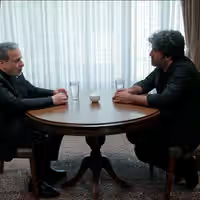
Speaking in the first part of a nearly 90-minute podcast interview, Araghchi suggested foreign intelligence activity inside Iran may be something more ambitious than gathering intelligence: shaping the decisions of the state itself.
He made the remarks when asked by establishment podcaster Javad Mogoei about the opening hours of the war, when coordinated strikes killed Iran's supreme leader along with several senior military, security and political figures.
"I believe this security breach is not limited merely to infiltration and obtaining information," Araghchi said.
"Sometimes it also exists in influencing the decision-making process itself. And even more importantly, it extends to shaping our psychological environment and public perception."
Araghchi did not identify any foreign intelligence service or explain how such influence might operate, although Israel appeared to be the implied actor in the discussion.
To Alex Vatanka, a senior fellow at the Middle East Institute, that distinction was the most revealing part of the interview.
"The job of these assets isn't just to leak the location of leaders in a certain place to be killed," Vatanka told Iran International. "It is to influence decision-making. It's to influence the policy process."
Vatanka believes Araghchi's remarks were directed as much at Iran's internal political debate as at foreign intelligence operations.
"He's hinting that elements inside the regime are openly arguing for policies that the enemy—the United States and Israel—prefer," he said. "Is he talking about the pro-war hawks? Is this part of scoring points against one another? Could well be."
"These things are obviously not accidental," he added. "This is very much messaging at a moment of war."
Mogoei nevertheless raised another possibility, invoking Masoud Kashmiri, the alleged infiltrator who rose through the ranks of the Islamic Republic before the 1981 bombing that killed President Mohammad Ali Rajai and Prime Minister Mohammad-Javad Bahonar.
"Perhaps we have another Kashmiri," he suggested.
Araghchi did not endorse the comparison, saying Iran's adversaries had become familiar with the supreme leader's routine and that the Intelligence Ministry meeting may simply have coincided by chance.
Whether Araghchi was describing a sophisticated foreign influence operation or speaking more broadly about the effect of outside pressure on Iran's internal politics is where analysts begin to diverge.
Omid Memarian, an Iran analyst at DAWN, said one possible manifestation of the kind of influence Araghchi described would be officials advocating policies that prolong the war despite the damage continued conflict causes to the Islamic Republic's own interests.
"Some of the decisions they are making are exactly the things that Israelis might wish for," Memarian told Iran International.
"When it comes to Iran's national security and national interests, they don't make sense,” he added. "We see the smoke. We don't see the fire."
Behnam Ben Taleblu, senior director of the Iran Program at the Foundation for Defense of Democracies, said Araghchi's comments should also be viewed through the lens of Iran's internal political rivalries.
"That doesn't mean these guys are doves by any measure," Taleblu told Iran International. "But it does mean that they have different views about how best to preserve, protect and defend the Islamic Republic."
Taleblu said public acknowledgments of security failures are often aimed less at the Iranian public than at rival political factions or security institutions, with officials defending their own approach while criticizing competing strategies.
He said Araghchi's comments also highlighted a less discussed aspect of intelligence operations: their ability to shape leaders' perceptions rather than merely gather information.
"Influence is to shape their decision-making, perhaps by lulling the Supreme Leader's office into a false sense of security and back into the routines that existed before," he said.